

Manhattan NY Personal Injury Lawyer
An injury in Manhattan can create several problems at once. You may be trying to arrange medical care, explain an absence from work, locate the right insurance company, and answer calls from people whose interests are not the same as yours.
The early decisions matter. Evidence can disappear, insurance forms have short deadlines, and a claim involving the City, a transit authority, or another public entity may require action within 90 days. Billy Cooper Law helps injured people determine who was responsible, what evidence needs to be preserved, and what should happen next.

Types of Injury Cases We Handle in Manhattan NY
- Personal Injury
- E-Bike Accidents
- Car Accidents
- Slip and Fall
Communities We Serve
- New York County
- Manhattan
- Upper East Side
- Upper West Side
- Washington Heights
- East Harlem
- Harlem
- Inwood
- Midtown
- Chelsea
- Greenwich Village
- Lower East Side
- Financial District
What You Should Expect From Your Lawyer
A personal injury case is not just a collection of medical records. Your lawyer needs to understand how the accident happened, how your life changed, and what future problems the injury may create.
Billy Cooper Law traces its history to a practice founded in 1960. The firm reports more than 75 years of combined experience, and William H. Cooper has served as lead trial counsel in serious injury cases for decades. His professional recognition includes selection to Super Lawyers from 2024 through 2026. (billycooperlaw.com)
That experience is relevant when an insurer disputes fault, minimizes an injury, or refuses to account for future care. The firm reports a $2.4 million recovery in a New York County wrongful death case involving a commercial vehicle collision—an example of the complex, high-stakes cases its attorneys handle. (billycooperlaw.com)
Attorney Anieska J. Garcia is fluent in English and Spanish, allowing clients to discuss their injuries and concerns directly rather than relying on a relative to interpret. The firm offers free consultations and handles personal injury cases on a contingency basis, with no upfront legal fee and no legal fee unless compensation is recovered. (billycooperlaw.com)
Why Manhattan Injury Cases Require a Local Investigation
Manhattan accidents often involve more potential defendants—and more potential evidence—than may be apparent at first.
A pedestrian struck at an intersection may have claims involving a driver, vehicle owner, employer, delivery company, or contractor. A fall outside an apartment building may require an investigation into the building owner, managing agent, commercial tenant, sidewalk permits, prior complaints, and recent construction. An injury in a subway station may involve the New York City Transit Authority, a maintenance contractor, or another entity responsible for the condition.
The volume of nearby evidence can help, but only if it is preserved. Manhattan buildings may have lobby, elevator, loading-dock, and exterior cameras. Stores, delivery vehicles, buses, taxis, and neighboring properties may have recorded the accident from different angles. Those recordings are not necessarily kept for long.
The first task is therefore not simply to file an insurance claim. It is to identify every party that controlled the location or activity and send preservation demands before useful records are erased or discarded.
A Snapshot of Serious Accidents in Manhattan
The numbers show why an investigation must look beyond cars alone. According to the New York City Department of Transportation’s 2024 Bicycle Crash Data Report:
- 7,954 people were injured and 44 were killed in Manhattan traffic crashes during 2024.
- Pedestrians accounted for 1,934 injuries and 27 fatalities in Manhattan during 2024.
- Traditional bicyclists suffered 1,501 injuries in Manhattan during 2024.
- Motorized two-wheel users—including people on e-bikes, mopeds, motorcycles, and stand-up scooters—suffered 843 injuries and 15 fatalities in Manhattan during 2024.
Construction creates a separate set of risks. The New York City Department of Buildings recorded 238 construction-related incidents, 201 injuries, and three fatalities in Manhattan during 2024. (nyc.gov)
These statistics do not determine who was at fault in a particular case. They do show the range of collisions, falls, workplace incidents, and transportation injuries that occur within a relatively small and heavily traveled borough.
Where Serious Injuries Happen in Manhattan
Intersections, Crosswalks, and Loading Areas
Pedestrians and cyclists frequently share limited street space with buses, taxis, rideshare vehicles, delivery trucks, private cars, and motorized two-wheelers. Turning vehicles, blocked sightlines, open vehicle doors, curbside loading, and vehicles entering bike lanes can all contribute to a collision.
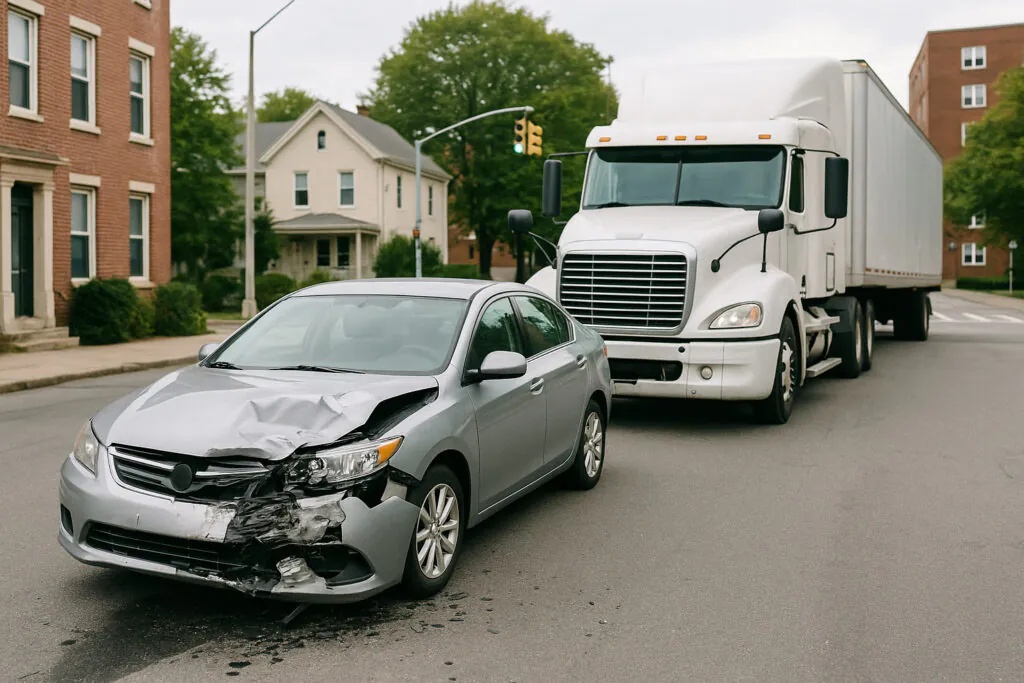
Commercial vehicle cases deserve particular attention. The driver may not be the only responsible party. An employer, vehicle owner, delivery contractor, maintenance provider, or company that imposed an unsafe schedule may also need to be investigated.
Subway Stations and Buses
A transit injury can arise from a wet or broken stairway, defective platform condition, sudden bus movement, closing doors, inadequate maintenance, poor lighting, or an employee’s conduct.
The exact transit entity matters. The Metropolitan Transportation Authority is not interchangeable with the New York City Transit Authority, MaBSTOA, or a private contractor. Naming the wrong entity or waiting too long to investigate can create avoidable problems.
Sidewalks, Apartment Buildings, and Commercial Properties
Manhattan fall cases often turn on control of the property. New York City law generally places responsibility for maintaining many sidewalks on the adjoining property owner, although the law contains exceptions and claims involving City responsibility can raise additional notice requirements. NYC DOT warns that property owners may be liable for injuries caused by a failure to keep an adjoining sidewalk reasonably safe. (nyc.gov)
Inside a building, evidence may include inspection logs, porter schedules, cleaning records, elevator service reports, tenant complaints, repair invoices, surveillance footage, and contracts between the owner and managing agent.
Construction and Renovation Sites
Manhattan construction is not limited to new towers. Serious injuries also happen during façade work, demolition, interior renovation, roof repairs, elevator work, and scaffold installation.
New York Labor Law may provide important protections when a worker is injured in a fall, struck by a falling object, or harmed by a violation of an applicable safety rule. Depending on the work and the parties involved, a claim may exist against an owner, general contractor, or another company even when workers’ compensation covers part of the worker’s immediate losses.
Personal Injury Cases Billy Cooper Law Handles
The firm represents people injured in cases involving:
- Catastrophic injuries, including spinal cord damage, traumatic brain injuries, burns, and amputations
- Car accidents
- Pedestrian accidents
- Bicycle accidents
- E-bike accidents
- Uber and Lyft accidents
- Truck and commercial vehicle accidents
- Subway accidents
- Construction accidents
- Premises liability, including unsafe sidewalks, stores, apartment buildings, and commercial properties
- Medical malpractice
- Defective products
- Dog bites
- Work accidents
- Wrongful death
Different cases require different evidence. A vehicle collision may depend on electronic data and camera footage. A fall may depend on maintenance records and proof that a dangerous condition existed long enough to be discovered. A construction case may turn on contracts, site roles, safety devices, and the work being performed.
What to Do After an Accident
Your health comes first. Seek medical attention if you are in pain, disoriented, bleeding, unable to bear weight, experiencing numbness, or showing any other concerning symptom. Do not assume an injury is minor simply because adrenaline allowed you to leave the scene.
When possible:
- Report the accident. Call 911 after a serious collision and report falls or building accidents to the property owner, manager, employer, or transit employee.
- Photograph the area. Take wide and close-up photos before vehicles, debris, water, snow, equipment, or warning signs are moved.
- Record the exact location. A building address, intersection, subway entrance, platform direction, bus number, store name, or construction-site entrance can determine which records exist.
- Collect names and contact information. Witnesses often become difficult to locate within days.
- Preserve damaged property. Keep your shoes, bicycle, helmet, clothing, vehicle, or defective product in its post-accident condition.
- Follow medical instructions. Gaps in care can harm your recovery and give an insurer room to argue that the injury resolved.
- Be careful with insurance calls. You may have a duty to notify your own insurer promptly, but you do not have to speculate about fault or the long-term effects of an injury during an unexpected call from another party’s carrier.
If a City agency, public hospital, bus, subway, or government-owned property may be involved, speak with a lawyer promptly. The ordinary lawsuit deadline may not be the first deadline that applies.
Evidence Worth Preserving
The most useful evidence depends on how and where the accident occurred. A Manhattan investigation may include:
- Building, storefront, lobby, elevator, or street-facing surveillance footage
- Taxi, bus, delivery-vehicle, or rideshare camera recordings
- Vehicle event data and onboard telematics
- Rideshare trip records and delivery-platform logs
- NYPD collision reports, 911 recordings, and officer records
- MTA or transit incident reports and video
- NYC DOT signal, street-work, permit, and maintenance records
- Department of Buildings permits, violations, complaints, and inspection records
- 311 complaints concerning a sidewalk, roadway, light, tree, or dangerous condition
- Cleaning, inspection, repair, and porter logs
- Contracts identifying which company maintained or controlled the location
- Witness statements
- EMS records, emergency-room imaging, operative notes, and rehabilitation records
- Wage statements, tax records, and employer documentation
- Photographs showing how your daily life changed after the injury
A lawyer can send preservation notices, identify the legal owner of a property or vehicle, and request public records. That work should begin before everyone has settled on a convenient explanation of what happened.
New York Deadlines and Insurance Rules
The General Personal Injury Deadline
Many New York negligence actions must be commenced within three years under CPLR § 214. That is not a universal deadline. Medical malpractice, wrongful death, claims against public entities, and other specialized cases may have shorter time limits. (nysenate.gov)
Waiting also creates a practical problem even when the lawsuit deadline is years away. Video can be overwritten, vehicles repaired, witnesses lost, and accident locations changed.
No-Fault Insurance Deadlines
New York no-fault coverage generally provides up to $50,000 in basic economic-loss benefits for covered medical expenses, lost earnings, and certain other necessary expenses, regardless of who caused the crash.
The New York Department of Financial Services advises injured people to provide written notice of a no-fault claim within 30 days of the accident unless there is clear and reasonable justification for a delay. Medical bills generally must be submitted within 45 days of treatment, and lost-earnings claims generally must be submitted within 90 days after the loss is incurred. (dfs.ny.gov)
These deadlines are separate from the time allowed to bring a lawsuit.
The Serious-Injury Requirement in Vehicle Cases
In many claims between people covered by New York’s no-fault system, pain-and-suffering damages are available only when the injury satisfies the statutory definition of a “serious injury.”
The law recognizes categories including fractures, significant disfigurement, permanent loss of use, permanent consequential limitations, and significant limitations of a body function or system. A 2026 amendment removed the former category involving a nonpermanent injury that prevented substantially all usual activities for at least 90 of the first 180 days. The change took effect for actions and proceedings commenced on or after May 26 2026. (nysenate.gov)
Medical documentation, objective testing, specialist evaluations, and a consistent treatment history can become central to this issue.
What Happens If You Were Partly at Fault?
New York changed its comparative-fault rule for certain motor vehicle injury actions in 2026.
For an action subject to Article 51 of the Insurance Law and commenced on or after May 26 2026, an injured claimant is barred from recovery if the claimant’s fault is greater than the fault of the defendant—or the combined fault of the defendants—from whom recovery is sought. A claimant found exactly 50% at fault may still recover, but the award is reduced by that percentage. (nysenate.gov)
Other personal injury claims generally continue to use pure comparative fault. In those cases, partial responsibility ordinarily reduces compensation rather than eliminating the claim.
This distinction makes the type of accident, parties involved, and filing date especially important.
BILLY COOPER LAW
Who May Be Responsible?
The person who caused the immediate harm may be only one part of the case.
Potentially responsible parties can include:
- A negligent driver
- The owner of the vehicle
- A driver’s employer
- A trucking, delivery, or rideshare company
- A property owner or managing agent
- A commercial tenant responsible for maintenance
- A general contractor, subcontractor, or construction-site owner
- A product manufacturer or distributor
- A medical provider or healthcare institution
- The City of New York or a City agency
- The New York City Transit Authority or another public authority
- A private maintenance, security, cleaning, or repair contractor
Responsibility is often divided by contracts that an injured person has never seen. Obtaining those agreements can reveal that the company visible at the scene was not the company legally responsible for maintenance, supervision, or safety.
Compensation After a Serious Injury
A claim should account for what the injury has already cost you and what it is reasonably expected to cost in the future.
Depending on the case, recoverable losses may include:
- Hospital, surgical, diagnostic, and rehabilitation expenses
- Future medical treatment and therapy
- Lost wages
- Reduced ability to earn a living
- Home healthcare and personal assistance
- Mobility devices and home modifications
- Pain and suffering
- Emotional distress
- Scarring or disfigurement
- Loss of mobility, independence, or enjoyment of life
- Losses suffered by a spouse
- Funeral expenses and financial losses resulting from a wrongful death
A quick settlement may not account for surgery that has not yet occurred, permanent work restrictions, future treatment, or the long-term effect of a brain, spinal, orthopedic, or nerve injury. A careful damages analysis often requires input from treating physicians, specialists, vocational professionals, economists, or life-care planners.
Claims Involving the City or Transit System
A claim involving the City of New York generally requires a notice of claim within 90 days. A lawsuit ordinarily must then be commenced within one year and 90 days, subject to the requirements governing the particular claim. Filing a police report, submitting a 311 complaint, or telling an agency employee what happened is not necessarily the same as filing a legally sufficient notice of claim. (nysenate.gov)
Transit claims have their own requirements. The MTA’s current personal injury claim form states that claims involving the New York City Transit Authority, MaBSTOA, and SIRTOA should be submitted within 90 days. Public Authorities Law § 1212 also imposes notice and lawsuit requirements for claims against the New York City Transit Authority. (nysenate.gov)
This is why identifying the correct public entity is not a technicality. An accident involving a subway staircase, bus, City vehicle, sidewalk, public hospital, bridge approach, or construction project can involve different defendants with different rules.
Local Courts, Hospitals, and Agencies
Many substantial civil cases arising in Manhattan are litigated in the New York County Supreme Court, Civil Term, at 60 Centre Street in New York NY 10007. The correct court and venue depend on the parties, the amount at issue, and other facts—not simply where the accident occurred. (nycourts.gov)
People with serious injuries may be taken to one of several Manhattan hospitals. NYC Health + Hospitals/Bellevue is a Level I adult trauma center, while NYC Health + Hospitals/Harlem is currently designated as a Level II adult trauma center. The hospital where you were treated does not determine the value of a case, but its records may contain important early documentation of symptoms, diagnoses, imaging, and trauma care. (nychealthandhospitals.org)
Other agencies may hold evidence:
- NYPD may have collision reports, 911 records, and officer documentation.
- NYC DOT may hold street-design, traffic-signal, permit, or maintenance records.
- NYC Department of Buildings maintains permit, inspection, complaint, violation, and construction-incident information.
- NYC Comptroller’s Office receives notices of claim against the City.
- New York City Transit Authority and MTA entities may hold incident reports, maintenance information, operator records, and video.
A lawyer’s job is to determine which records matter and request them before they become unavailable.
How Billy Cooper Law Investigates a Manhattan Case
The investigation begins with your account of what happened. The legal team then works outward from the scene, identifying the people, companies, insurance policies, and government entities that may be involved.
That may include:
- Inspecting and photographing the location
- Obtaining collision and incident reports
- Sending demands to preserve video and electronic data
- Interviewing witnesses
- Identifying property, vehicle, and business owners
- Reviewing contracts that divide maintenance or safety responsibilities
- Examining Department of Buildings, NYC DOT, transit, or City records
- Reviewing medical records with the nature and future course of the injury in mind
- Documenting lost income and the effect on your work
- Consulting qualified experts when liability or future damages require specialized analysis
The goal is not simply to show that an accident occurred. It is to explain why it occurred, who had the ability and legal duty to prevent it, and what the injury has taken from you.
Frequently Asked Questions
Should I talk to the other party’s insurance company?
You may need to cooperate with your own insurer and meet prompt notice requirements. You generally should not guess about speed, distance, fault, prior health conditions, or whether you have recovered during an unexpected call from another party’s carrier. Ask who is calling, obtain the claim number, and consider getting legal advice before giving a recorded statement.
What if the police report says I caused the accident?
A police report can be important, but it does not always decide fault. The officer may not have witnessed the collision, and additional video, witness testimony, vehicle data, or physical evidence may provide a different account.
Can I still recover if I was partly responsible?
Possibly. The answer now depends in part on whether the claim is subject to New York’s 2026 motor vehicle comparative-fault rule. In covered vehicle cases, fault greater than 50% can bar recovery. In many other injury cases, partial fault generally reduces the award without automatically eliminating the claim.
What if I was injured while visiting Manhattan?
You do not have to live in Manhattan to bring a claim arising from an accident there. Visitors, commuters, students, and workers may all have claims. Much of the investigation and case communication can also be handled remotely when returning to New York is difficult.
How much does a personal injury lawyer cost?
Billy Cooper Law handles personal injury cases on a contingency basis. There are no upfront legal fees, and the firm does not collect a legal fee unless compensation is recovered.
What if a subway, bus, or City-owned property was involved?
Do not assume the ordinary three-year deadline is the only deadline. A notice of claim may be required within 90 days, and the correct public authority must be identified.
How long will my case take?
Some claims resolve in months. Others take longer because the injuries need time to stabilize, fault is disputed, multiple defendants are involved, or a lawsuit and trial preparation are necessary. The timing should not be driven by an insurer’s desire to close the claim before the full medical picture is known.
Can I speak with the firm in Spanish?
Yes. Attorney Anieska J. Garcia is fluent in English and Spanish.
Related Resources
- personal injury claims
- Motor vehicle accident claims
- Construction accident claims
- Premises liability claims
- Catastrophic injury claims
- Billy Cooper Law case results
- Meet the Billy Cooper Law team
Tell Us What Happened
You do not need to know who owns the sidewalk, which transit authority operated the bus, or whether an insurance company has correctly evaluated your injuries before asking for help.
Billy Cooper Law can investigate the accident, explain the deadlines that may apply, and help you understand your options. The firm’s New York City location at 4746 Broadway in New York NY 10040 is available by appointment.
Call (718) 866-3311 or (914) 730-5789 for a free consultation, or contact Billy Cooper Law online. There are no upfront legal fees, and no legal fee is owed unless compensation is recovered.
Sources
Billy Cooper Law
- Billy Cooper Law official website
- Billy Cooper Law personal injury practice
- Meet the Billy Cooper Law team
- William H. Cooper attorney profile
- Anieska J. Garcia attorney profile
- Billy Cooper Law case results
- Billy Cooper Law contact information
- Catastrophic injury practice
- Motor vehicle accident practice
- Car accident practice
- Bicycle accident practice
- Pedestrian accident practice
- E-bike accident practice
- Uber and Lyft accident practice
- Commercial vehicle and truck accident practice
- Subway accident practice
- Construction accident practice
- Premises liability practice
- Medical malpractice practice
- Products liability practice
- Dog bite practice
- Work accident practice
- Wrongful death practice
Manhattan and New York Legal Sources
- NYC DOT 2024 Bicycle Crash Data Report
- NYC Department of Buildings 2024 Construction Safety Report
- NYC DOT sidewalk maintenance and liability information
- New York CPLR § 214 personal injury limitations period
- New York CPLR § 1411 comparative fault
- New York Insurance Law § 5102
- New York Insurance Law § 5104
- New York Department of Financial Services no-fault FAQs
- New York Department of Financial Services 2026 motor vehicle insurance reforms
- New York General Municipal Law § 50-e
- New York General Municipal Law § 50-i
- NYC Comptroller personal injury claim FAQs
- New York Public Authorities Law § 1212
- MTA personal injury claim form
- New York Labor Law § 240
- New York Labor Law § 241
- New York County Supreme Court Civil Term
- New York State trauma center designations
- Bellevue trauma center information
NOTABLE RESULTS
Selected results in Billy Cooper Law’s broader personal injury practice:
$9,000,000 settlement · $2,005,000 settlement
Read more about these results
- $9,000,000 settlement — Tank explosion
A man suffered extensive burns and loss of his dominant hand in a tank explosion in Westchester County.
- $2,005,000 settlement — Construction-site roof fall
A worker fell from a roof after inadequate safety equipment was provided on a Rockland County job site.
These are reported gross results, before fees, expenses, and applicable liens. They are not estimates of another claim’s value. Read the firm’s published case results.
Prior results do not guarantee a similar outcome. Each case is different and must be evaluated on its own facts.
WHAT OUR CLIENTS SAY
General feedback about working with Billy Cooper Law:
“Wonderful experience. Very knowledgeable and responsive!”
— Lara C.
“He cares. He just cares.”
— Carmelo Curra
Professional Recognition

Recognition applies to the named attorneys and selection years. See the linked profiles for details.
Related Billy Cooper Law Videos and Social Posts
- Billy Cooper Law official YouTube channel — Youtube — official account.
- Billy Cooper Law official Instagram profile — Instagram — official account.
- Billy Cooper Law official Linkedin profile — Linkedin — official account.
- Protecting an Injury Claim on Social Media — Facebook.
- Types of Personal Injury Cases the Firm Handles — Facebook.
Published Articles by Billy Cooper
- When the Video Disappears: Liability, Missing Footage, and the Modern New York Injury Case — New York Law Journal · June 23, 2026.
Billy Cooper discusses video evidence that is missing, incomplete, or overwritten in New York injury litigation.
BILLY COOPER LAW


Get the Answers You Need
At Billy Cooper Law, every day we renew our pledge to help injured people get the justice and compensation they deserve. We have a reputation throughout New York and nationally for standing up for our clients, and we take that responsibility seriously by approaching every case with preparation, persistence, and an unwavering commitment to results.