
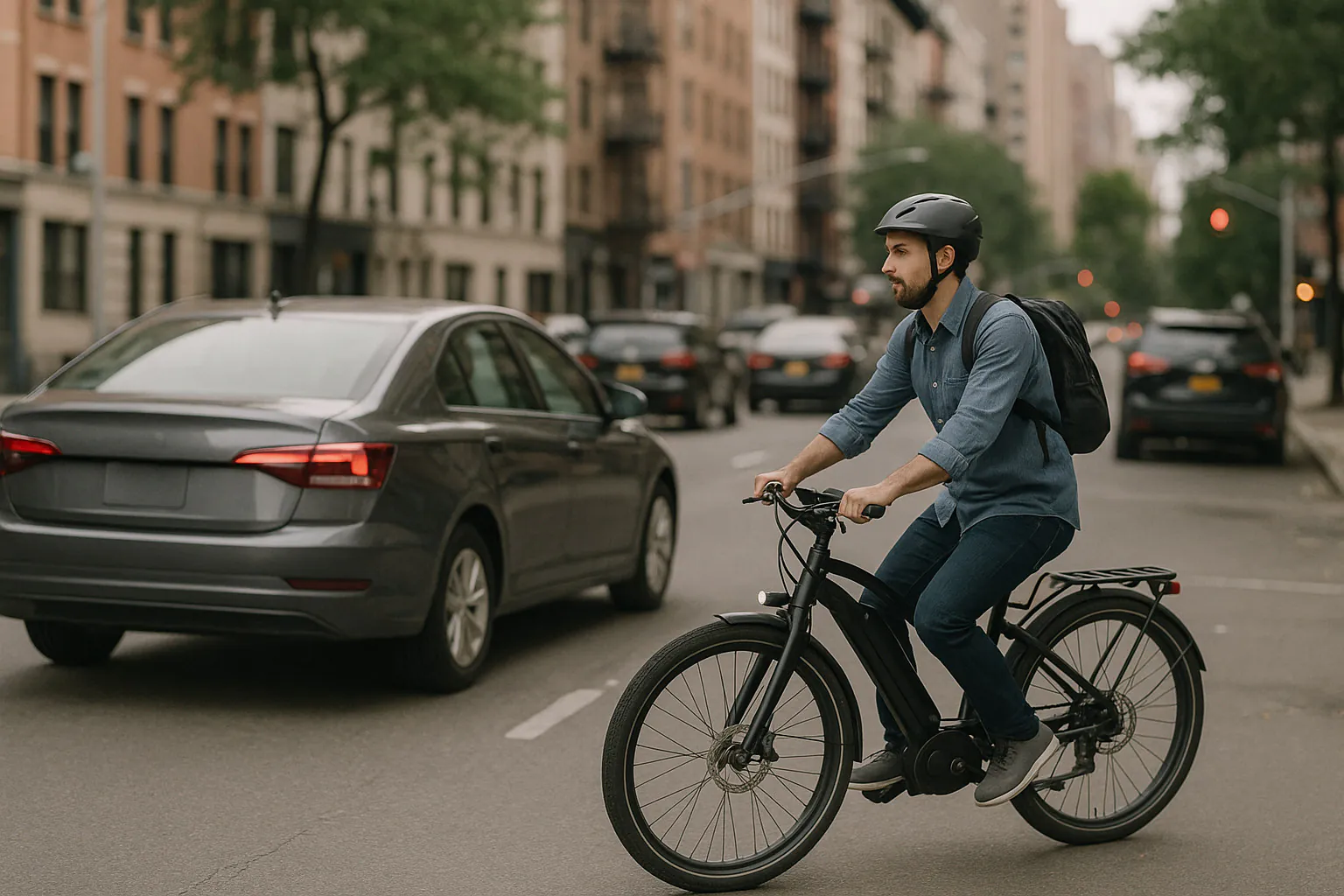
If an e-bike hits your car in New York, stop safely, check everyone for injuries, call the police, exchange information, photograph the scene, and notify your auto insurer. Do not assume the rider is automatically at fault simply because the bike made contact with your vehicle.
The location of the damage, traffic signals, right of way, vehicle movement, video, and witness accounts can all affect responsibility. You should also be prepared for the rider to seek medical benefits or make an injury claim, even if you believe the rider caused the crash.
BILLY COOPER LAW

What Should You Do at the Scene?
Treat the collision as seriously as you would a crash involving two cars. Even a low-speed impact can injure the rider, a passenger in your vehicle, or someone nearby.
- Stop and remain at the scene. Move out of active traffic if it is safe, but do not leave. New York law requires motor vehicle drivers involved in incidents causing injury or property damage to stop and provide identifying and insurance information in the circumstances described by Vehicle and Traffic Law § 600.
- Check for injuries. Call 911 if anyone reports pain, appears disoriented, fell from the e-bike, or may need medical assistance. Do not try to diagnose the rider or argue about whether an ambulance is necessary.
- Request a police response. A report can document the identities of the people involved, the location, vehicle types, visible damage, and initial statements. This is especially important if the rider is injured, leaves the scene, refuses to provide information, or claims that you struck them.
- Exchange and record information. Obtain the rider’s name, address, telephone number, and identification if available. Photograph the e-bike, any manufacturer’s class label, delivery markings, rental-company name, and shared-bike number. Legal e-bikes have specific motor, pedal, width, and speed characteristics under New York’s e-bike definition.
- Photograph more than the damage. Capture the final positions of the car and bike, impact marks, debris, traffic signals, signs, bike lanes, skid marks, visibility, weather, and the full intersection or driveway. Photograph all sides of the e-bike and your vehicle.
- Find witnesses and video. Ask witnesses for their contact information. Note nearby storefronts, homes, buses, traffic cameras, and parked vehicles that may have recorded the collision. Dashcam footage should be downloaded before it is overwritten.
Give the police and your insurer an accurate factual account. Avoid apologizing, accusing the rider, guessing about speed, or agreeing to handle the matter privately before you know whether anyone is injured.
Who Is at Fault When an E-Bike Hits a Car?
The physical contact alone does not establish fault. Under Vehicle and Traffic Law § 1231, bicyclists on roadways generally have the rights and duties applicable to vehicle drivers. New York also imposes additional operating rules on bicycles with electric assist.
An e-bike rider may be responsible for running a red light, riding against traffic, failing to yield, entering the road without warning, or traveling unlawfully on a sidewalk. A driver may share fault for turning across a bike lane, opening a door, pulling from a curb, backing without looking, or failing to exercise reasonable care around a rider.
For example, damage to the middle of your passenger-side door may support your account that a rider entered the intersection after your car was already passing. It does not prove that account by itself. Video showing the traffic signal and each person’s movement would be stronger evidence.
As of September 10, 2026, New York applies two different comparative-fault rules:
- In a property-damage claim, a claimant’s recovery is ordinarily reduced by that person’s percentage of fault.
- In a personal injury action subject to New York’s no-fault law and commenced on or after May 26, 2026, a claimant who is more at fault than the defendant or combined defendants is barred from recovering. The current rule appears in CPLR § 1411, and the effective date is explained by the New York Department of Financial Services.
That distinction can become important when the same collision produces both damage to your car and an injury claim by the rider.
How Will Insurance Handle the Collision?
Car repairs and personal injuries involve different parts of an insurance policy.
If you have collision coverage, you can generally make a claim through your own insurer for covered repairs, subject to your deductible. Your insurer can investigate whether another person or insurance carrier should ultimately reimburse the loss. The Department of Financial Services’ physical-damage guidance explains the inspection and settlement process.
A legal e-bike is excluded from New York’s general definition of a motor vehicle under Vehicle and Traffic Law § 125. Its rider therefore may not have the mandatory auto liability policy that a registered motor vehicle would carry. Ask whether the rider has homeowners, renters, personal liability, commercial, delivery, or other coverage, but do not assume a particular policy applies. Coverage depends on its language and how the e-bike was being used.
If you or a passenger was injured, no-fault benefits ordinarily come from the insurer covering your vehicle. These benefits address qualifying medical expenses, lost earnings, and certain other economic losses regardless of fault. They do not pay to repair your car.
The e-bike rider may also submit a no-fault request or liability claim to your insurer. A no-fault claim is not an admission that you caused the collision. Notify your carrier promptly and let it handle communications, investigate the facts, and provide a defense if a covered liability claim is made.
Which New York Reports and Notice Rules Matter?
Three short rules may affect your next steps:
- Ten-day DMV report: A motor vehicle driver must file an MV-104 crash report within 10 days if the collision caused injury, death, or more than $1,000 in damage to any one person’s property. The requirement comes from Vehicle and Traffic Law § 605.
- Thirty-day no-fault notice: An injured driver or passenger should give the applicable no-fault insurer written notice as soon as reasonably practicable and ordinarily within 30 days. Late notice requires a clear and reasonable justification under New York’s no-fault rules.
- Ninety-day government notice: If a municipal vehicle, dangerous public roadway, or government-controlled construction area contributed to the crash, many claims against cities, counties, towns, villages, or other public entities require a notice of claim within 90 days. General Municipal Law § 50-e governs many—but not all—such claims.
These are not the only possible time limits. The correct rule depends on the parties, injuries, insurance policies, and where the collision occurred.
What Should You Do During the Next 48 Hours?
Report the collision to your insurer and obtain a claim number. Provide photographs, witness information, the police report number, and an accurate description of what happened. If the rider or another insurer contacts you, forward the communication to your carrier rather than debating fault.
Preserve the evidence in its original form. Save dashcam files, phone photographs, messages, repair estimates, towing receipts, medical records, and proof of missed work. Write down what you remember while the sequence of events is still fresh.
Make the car available for inspection before authorizing repairs that would erase impact marks or other useful evidence. You may obtain estimates, but confirm the inspection process with the insurer first. New York consumers retain the right to select their repair shop, although coverage, repair cost, and deductible disputes can still arise.
If you develop pain, dizziness, headaches, restricted movement, or another symptom after leaving the scene, seek appropriate medical care and explain that it followed a traffic collision. This article provides general New York information, not advice for an individual claim.
Why Contact Billy Cooper Law After an E-Bike-Car Collision?
If the incident caused an injury, produced competing accounts of the crash, or led to a claim against you or another responsible party, the evidence should be reviewed before it disappears. Billy Cooper Law’s published New York e-bike accident practice describes reviewing police reports, medical records, witness accounts, crash footage, and accident-reconstruction evidence when appropriate. The firm also handles insurance communications, claim filings, negotiations, and litigation in personal injury matters.
A property-damage-only claim may begin and end with your auto insurer. When someone was hurt or responsibility is genuinely disputed, Billy Cooper Law can help you understand how New York’s e-bike, insurance, and fault rules affect the situation. The firm offers free consultations and handles injury cases on a contingency-fee basis, as stated on its website. Contact Billy Cooper Law to discuss what happened and identify a practical next step.
BILLY COOPER LAW
New York E-Bike-to-Car Accident FAQs
These answers provide general information. The correct analysis can change based on the location, injuries, e-bike classification, available insurance, and evidence.
Is the e-bike rider automatically at fault if the bike hit the side of my car?
No. The point of impact is useful evidence, but it does not decide fault by itself. Investigators will consider traffic signals, right of way, each person’s direction and speed, whether the car was moving or stopped, and whether either person had a reasonable opportunity to avoid the collision.
A photograph of damage to the side of your car may support your account that the rider entered your path. Video, independent witnesses, debris location, and the complete street layout can make that evidence more persuasive. New York traffic rules apply to riders as well as drivers, subject to provisions specific to bicycles and e-bikes.
Sources: New York Vehicle and Traffic Law § 1231; New York Vehicle and Traffic Law § 1242; New York CPLR § 1411.
Can the e-bike rider make a no-fault claim against my car insurance?
Yes, the rider may submit a no-fault claim, although eligibility can depend on the device’s legal classification and how the injury arose from the use or operation of your vehicle. Your insurer—not the rider—will decide whether the submitted claim falls within the policy and New York law.
No-fault benefits are paid without first deciding negligence, so processing such a claim does not mean the insurer agrees that you caused the collision. A separate claim for pain and suffering requires proof of fault and must satisfy New York’s applicable serious-injury and comparative-fault rules.
Sources: New York Insurance Law § 5102; New York DFS No-Fault Insurance FAQs; New York DFS 2026 Motor Vehicle Insurance Reforms.
Are e-bike riders required to carry insurance in New York?
Usually not if the device is a legal bicycle with electric assist. New York excludes qualifying e-bikes from its general motor vehicle definition, and the DMV does not register them as motorcycles, mopeds, or limited-use motorcycles. That means a rider may not have mandatory auto liability insurance available to pay for your damage.
Ask the rider about other possible coverage. A homeowners or renters policy may provide personal liability protection, but exclusions for motorized devices, delivery work, or business use may apply. The policy and circumstances must be reviewed before assuming coverage exists.
Sources: New York DMV Electric Scooters and Bicycles Guidance; New York Vehicle and Traffic Law § 125; New York DFS Homeowners and Tenants Insurance Coverage.
What if the “e-bike” was actually an e-moto or moped?
The classification can materially change the insurance and liability investigation. A qualifying New York e-bike must have operable pedals, a motor under 750 watts, and motor assistance limited to the speeds established for its class. A faster or more powerful device may instead be a moped, motorcycle, or other motor vehicle.
Photograph the device, class label, pedals, manufacturer, model, plate, and vehicle identification information. Do not rely on what the rider calls it. Registration, licensing, insurance, permitted-roadway, and no-fault rules may differ if the device falls outside New York’s legal e-bike definition.
Sources: New York Vehicle and Traffic Law § 102-c; New York DMV Electric Scooters and Bicycles Guidance; New York Attorney General E-Bike and E-Scooter Safety Requirements.
What should I do if the rider was using a shared e-bike?
Do not assume the sharing company is responsible merely because it owns the e-bike. Liability depends on why the collision happened. Account, trip, and maintenance records may help identify the rider or establish the bike’s condition, but obtaining account-level information may require a formal request or legal process.
Sources: New York Vehicle and Traffic Law § 1243; New York DMV MV-104 Crash Report; New York DMV Electric Scooters and Bicycles Guidance.
What if the e-bike rider left the scene?
Call the police and report the collision promptly. Record the rider’s appearance, clothing, direction of travel, bike color, manufacturer, shared-bike number, delivery bag, and anything the rider said. Save dashcam footage and ask nearby businesses or residents to preserve video.
New York has specific reporting rules for bicycle and e-bike incidents involving physical injury. Even when only property was damaged, a prompt report creates a record and may help locate the rider. Notify your insurer as well, because collision coverage may be the most practical repair option if the rider cannot be identified.
Sources: New York State DOT Bicycle FAQs; New York Vehicle and Traffic Law § 603; New York Vehicle and Traffic Law § 603-a.
Can I choose my own repair shop?
Yes. New York allows you to choose the repair shop that works on your vehicle. Your insurer may inspect the damage, prepare its own estimate, and recommend a shop, but you are not required to use the insurer’s preferred facility.
Make the vehicle available for inspection before repairs begin. Ask the shop to photograph hidden damage discovered during disassembly and submit any supplemental estimate to the insurer. Keep copies of estimates, invoices, towing bills, and communications in case the repair scope or value is disputed.
Sources: New York DFS Filing Claims Under Your Own Policy; New York DFS Auto Insurance Information for Consumers.
Can I recover my deductible and rental-car costs?
Possibly. If the rider was responsible, you may seek reimbursement for your deductible and reasonable accident-related losses from the rider or any applicable liability insurer. You will need proof of fault, the amounts paid, and why expenses such as substitute transportation were necessary.
Your own policy may include rental reimbursement, but that coverage is optional and subject to stated limits. If another insurer handles the property claim, disputed fault can reduce the amount offered. Save receipts and avoid assuming every transportation expense will be reimbursed.
Sources: New York DFS Filing Claims Under Your Own Policy; New York Property-Damage Claim Settlement Standards.
Can I still recover for car damage if an insurer says I was partly at fault?
Yes. For a New York property-damage claim, partial responsibility ordinarily reduces recovery in proportion to your assigned fault rather than eliminating it. If your proven damage was $5,000 and you were found 20% responsible, the other party’s share would generally be $4,000.
Do not accept an unsupported percentage simply because an adjuster assigns one. Ask what evidence supports the decision and provide photographs, video, witness information, and traffic-control details. The stricter comparative-fault bar effective May 26, 2026 applies to certain personal injury actions under the no-fault law, not ordinary property-damage claims.
Sources: New York CPLR § 1411; New York DFS 2026 Motor Vehicle Insurance Reforms; New York Property-Damage Claim Settlement Standards.
What if a government vehicle or dangerous road condition contributed?
Treat it as a potential short-deadline government claim. A public vehicle, defective signal, obstructed bike lane, unsafe construction zone, or dangerous roadway condition may have contributed even if the e-bike made the final contact with your car.
Many tort claims against a city, county, town, village, or public corporation require a notice of claim within 90 days. The responsible entity must be identified correctly, and claims involving New York State follow different procedures. Preserve photographs of the condition, exact location, public-vehicle identifying numbers, construction signs, and agency information immediately.
Sources: New York General Municipal Law § 50-e; New York Courts Statute of Limitations and Notice-of-Claim Guidance.
Sources
- Billy Cooper Law New York E-Bike Accident Practice
- New York DMV MV-104 Crash Report
- New York DMV Electric Scooters and Bicycles Guidance
- New York Vehicle and Traffic Law § 600
- New York Vehicle and Traffic Law § 605
- New York Vehicle and Traffic Law § 102-c
- New York Vehicle and Traffic Law § 1231
- New York Vehicle and Traffic Law § 1242
- New York Insurance Law § 5102
- New York CPLR § 1411
- New York DFS No-Fault Insurance FAQs
- New York DFS Filing Claims Under Your Own Policy
- New York DFS 2026 Motor Vehicle Insurance Reforms
- New York General Municipal Law § 50-e
BILLY COOPER LAW
Get the Answers You Need
At Billy Cooper Law, every day we renew our pledge to help injured people get the justice and compensation they deserve. We have a reputation throughout New York and nationally for standing up for our clients, and we take that responsibility seriously by approaching every case with preparation, persistence, and an unwavering commitment to results.