
Soundview NY Slip and Fall Lawyer
A fall can leave you with a fracture, head injury, back pain, missed work, and questions about who should pay for the harm you have suffered. The answer often depends on details that disappear quickly: what caused you to fall, who controlled that part of the property, how long the condition existed, and whether anyone had complained about it before.
Billy Cooper Law represents people injured on unsafe property throughout the Bronx. The firm can investigate the location, preserve evidence, identify the responsible parties, and deal with the insurance companies while you focus on your medical care.
Slip and Fall Lawyers Serving Bronx County
- Bronx County
- Co-op City
- Kingsbridge
- Soundview
- Riverdale
- Fordham
BILLY COOPER LAW

What Billy Cooper Law Brings to Your Case
A slip and fall case is not proven simply by showing that you were hurt on someone else’s property. You may need inspection records, cleaning logs, surveillance footage, weather reports, prior complaints, leases, maintenance contracts, and testimony explaining how long the hazard was present.
Billy Cooper Law’s history dates to 1960, and the firm reports more than 75 years of combined experience. William H. Cooper has practiced since 1991 and has spent decades preparing and trying serious personal injury cases. The firm’s approach begins with listening to what happened and explaining the law in plain English—not passing you from one person to another without answers. (billycooperlaw.com)
Your consultation is free. If the firm accepts your case, you do not pay an upfront attorney’s fee, and no attorney’s fee is due unless the firm obtains compensation for you.
Billy Cooper Law does not maintain an office in Soundview. It represents Bronx clients from its White Plains NY office and its New York NY location at 4746 Broadway, which is available by appointment. (billycooperlaw.com)
Why Falls in Soundview Require a Local Investigation
Soundview contains private apartment buildings, large public housing campuses, stores, schools, parks, sidewalks, transportation facilities, and ongoing construction. A fall outside a building on Rosedale Avenue may involve a different owner and notice procedure than a fall in a store near Bruckner Boulevard or on a walkway inside a NYCHA development.
Even the word “sidewalk” can hide several legal questions. The adjoining property owner may be responsible for the sidewalk slab, while the City, a utility, or another entity may control a nearby curb, pedestrian ramp, tree well, access cover, or construction cut. NYC DOT’s sidewalk guidance explains why identifying the precise location of a defect is so important. (nyc.gov)
Apartment-building cases can be just as complicated. The owner, managing agent, commercial tenant, maintenance company, or snow-removal contractor may each have different responsibilities. If the property is publicly owned or managed, special claim rules may apply before a lawsuit can begin.
A Soundview Property Snapshot
A few local numbers show why falls here often require a careful examination of building ownership, common-area maintenance, and management records:
- NYCHA’s official development map reported 1,258 apartments at the Soundview development as of January 1, 2017.
- The same map reported 1,497 apartments at Sotomayor Houses as of January 1, 2017.
- In 2022, NYCHA described Sack Wern Houses as a seven-building development with approximately 849 residents. Its June 2024 property map identifies residential buildings along Lafayette Avenue, Croes Avenue, Noble Avenue, and Beach Avenue.
- Casa Celina opened in Soundview in 2024 as a 16-story building with 204 apartments designed for older New Yorkers, including 62 apartments reserved for seniors who had experienced homelessness.
- In 2025, the New York City Public Housing Preservation Trust announced a $93 million modernization covering 226 apartments in two Bronx River Addition buildings in the Soundview neighborhood. (nyc.gov)
These numbers do not suggest that every building is unsafe. They show the scale of the residential property in and around Soundview—and how much potentially relevant evidence may exist in work orders, inspection records, repair histories, surveillance systems, and resident complaints.
Where Slip and Fall Injuries Happen in Soundview
Apartment buildings and public housing
Many local cases begin in lobbies, stairwells, elevators, laundry rooms, entranceways, courtyards, and connecting walkways. Common hazards include:
- Water tracked into a lobby
- Broken or uneven steps
- Missing or loose handrails
- Poor lighting
- Torn carpeting or damaged flooring
- Leaks from pipes, ceilings, or radiators
- Ice near entrances and exterior stairs
- Debris left in a common area
- Defective elevator thresholds
At a NYCHA or PACT-managed property, the development name alone may not identify the correct defendant. Current ownership, management, and maintenance responsibilities must be confirmed through the NYCHA property directory.
Sidewalks and pedestrian routes
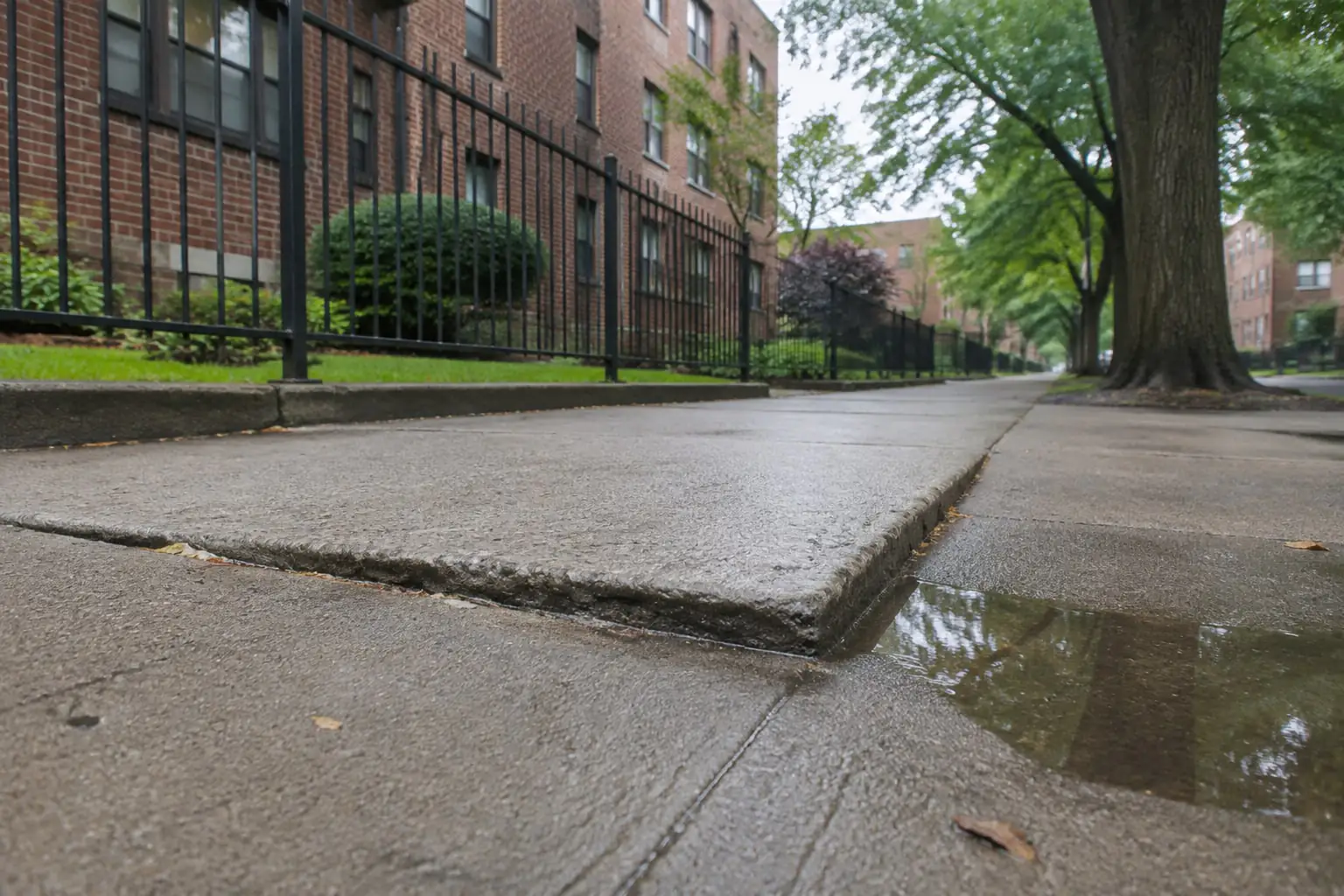
Raised slabs, cracks, holes, construction cuts, ice, pooled water, and broken pavement can cause serious falls. Sidewalk cases frequently turn on measurements, lighting, crowding, weather, nearby construction, and whether the condition was difficult to see or cross safely.
Photographs should show more than a close-up of the defect. They should also capture the building address, storefront, curb, surrounding pavement, lighting, and anything that may have blocked your view.
Stores and commercial properties
A fall in a grocery store, restaurant, pharmacy, or other business may involve a spill, leaking refrigeration unit, unsecured mat, cluttered aisle, damaged flooring, or water near an entrance.
These cases often depend on inspection practices. A store may argue that a spill happened only seconds before the accident. Cleaning logs, employee testimony, receipts, surveillance video, and witness accounts may tell a different story.
Parks, schools, and transportation facilities
Falls in Soundview Park, on public-school property, near a bus facility, or at a publicly controlled waterfront or transportation location can involve a government agency or public authority. That changes more than the defendant’s name. It can also change how and where notice must be served.
Construction and repair areas
Temporary ramps, loose materials, uncovered openings, debris, cords, and unmarked elevation changes can endanger residents, visitors, and workers. A worker injured in a fall may have workers’ compensation benefits and a separate claim against an owner, contractor, or other third party.
Slip and Fall Cases Billy Cooper Law Handles
Billy Cooper Law represents people injured in matters involving:
- Residential building falls, including lobby, hallway, stairway, and elevator-area accidents
- Commercial property accidents in stores, restaurants, offices, and other businesses
- Sidewalk falls caused by broken pavement, raised slabs, ice, or other defects
- Parking lot falls involving potholes, poor lighting, snow, ice, or drainage problems
- Supermarket falls caused by spills, leaking equipment, debris, and unsafe aisles
- Falls inside homes, rental properties, and privately owned residences
- Subway and station falls involving platforms, stairs, escalators, and other transit property
- Construction fall accidents involving ladders, scaffolds, rooftops, and unprotected openings
Some accidents involve more than one category. A fall outside a grocery store, for example, may require an investigation into the store’s lease, the landlord’s sidewalk responsibilities, a snow-removal contract, and municipal records.
What to Do After a Fall
Your health comes first. Seek medical attention and describe every area that hurts, even if one injury seems more serious than the others. Head, neck, back, knee, shoulder, and wrist injuries may become more noticeable after the initial shock wears off.
If you can do so safely:
- Report the accident. Tell the manager, superintendent, property owner, security officer, or appropriate agency. Ask for a copy or photograph of the incident report.
- Photograph the condition. Take wide and close views before the area is cleaned, repaired, salted, or blocked off.
- Record the exact location. Note the address, nearest storefront, building entrance, stair number, floor, or apartment-development name.
- Get witness information. A witness may know how long the hazard existed or whether earlier complaints were made.
- Preserve your shoes and clothing. Do not throw them away or alter them.
- Save your records. Keep medical paperwork, receipts, work notes, transportation expenses, and messages exchanged with the property owner.
- Be careful with insurance calls. You can provide basic identifying information without guessing about fault, your medical condition, or what you did or did not see.
Do not sign a broad medical authorization or accept a quick settlement before you understand your diagnosis and the full effect of the injury.
Evidence That Can Decide a Slip and Fall Case
Property conditions change quickly. A spill is mopped. Ice melts. A broken step is repaired. Surveillance video is overwritten.
Depending on where you fell, important evidence may include:
- Photographs and measurements of the hazard
- Surveillance video from the property and neighboring buildings
- Incident and security reports
- Cleaning and inspection logs
- Work orders and repair records
- Prior tenant, customer, or 311 complaints
- HPD, DOB, NYCHA, or NYC DOT records
- Leases and property-management agreements
- Snow-removal and maintenance contracts
- Weather and temperature records
- Employee schedules and testimony
- Building-code provisions that applied when the property was built or altered
- Ambulance, emergency-room, and follow-up medical records
A preservation demand sent promptly can place an owner or business on notice that video and documents connected to the accident must not be destroyed.
New York Law Governing Slip and Fall Claims
The owner must have created the danger or had notice of it
To establish a typical slip and fall claim, you generally need evidence that the defendant created the dangerous condition, actually knew about it, or should have discovered it through reasonable inspection.
Constructive notice usually requires proof that the condition was visible and apparent and existed long enough for the responsible party to find and correct it. A general awareness that floors sometimes become wet or that litter occasionally appears is usually not enough. Gordon v. American Museum of Natural History remains a central New York decision on this issue. (nycourts.gov)
That is why cleaning routines and inspection records matter. The practical question is often not merely whether a business had a policy, but whether anyone followed it before the accident.
There is no automatic measurement rule for trip hazards
A property owner may argue that a crack, hole, or height difference was too small to be dangerous. New York courts do not apply one minimum measurement to every case.
The court must consider the defect’s dimensions along with its shape, appearance, location, lighting, surrounding conditions, and whether it was difficult to see or cross safely. The Court of Appeals explained this fact-specific approach in Hutchinson v. Sheridan Hill House Corp., a case arising from a Bronx sidewalk fall. (nycourts.gov)
Snow and ice cases have additional rules
Under New York’s storm-in-progress doctrine, a property owner’s duty to remedy snow or ice created by a winter storm may be suspended while the storm continues and for a reasonable cleanup period afterward. The rule does not automatically resolve every weather case.
Questions may remain about whether the ice came from an earlier storm, whether snow-removal work made the condition worse, when precipitation actually ended, and what maintenance steps were taken. Recent First Department decisions continue to show that weather records, inspection testimony, mats, warning signs, salting, and actual cleanup practices can determine the outcome. (nycourts.gov)
An obvious condition does not always end the claim
A property owner may argue that you should have seen the hazard. That can affect comparative fault, but it does not always eliminate the owner’s responsibility to maintain reasonably safe property.
Likewise, you are not required to prove that you were completely fault-free. Under CPLR § 1411, compensation in a non-motor-vehicle negligence case is generally reduced by the injured person’s percentage of fault rather than automatically barred. (nysenate.gov)
BILLY COOPER LAW
How Long Do You Have to File?
Under CPLR § 214, most New York negligence actions must be filed within three years of the injury. That does not mean it is safe to wait three years. Video, witnesses, repair records, and physical evidence may disappear much sooner. (nysenate.gov)
Government-related claims can have substantially shorter deadlines. General Municipal Law § 50-e often requires a notice of claim within 90 days, while General Municipal Law § 50-i generally requires qualifying municipal personal injury actions to be started within one year and 90 days. Different statutes and service requirements may apply to NYCHA, transit entities, and other public authorities. (nysenate.gov)
If a City agency, public housing development, school, park, bus, ferry facility, or public sidewalk may be involved, find out which deadline applies immediately.
Who May Be Responsible?
Depending on where and why you fell, a claim may involve:
- The property owner
- A landlord or managing agent
- A commercial tenant
- A store or restaurant operator
- A cleaning or maintenance company
- A snow-removal contractor
- A construction contractor
- A utility company
- NYCHA or a PACT property manager
- The City of New York
- A transit authority or other public entity
- More than one responsible party
Control matters. A company may own the building but have assigned daily maintenance to a manager. A commercial tenant may be responsible inside the store while the landlord remains responsible for structural repairs or exterior areas. A contractor may share liability if its work created or made a dangerous condition worse.
What Compensation May Be Available?
The value of a claim depends on the injury and how it changes your life—not simply where you fell.
Compensation may include:
- Medical bills and rehabilitation costs
- Future medical care
- Lost wages
- Reduced future earning ability
- Transportation and other injury-related expenses
- Pain and suffering
- Loss of mobility or independence
- Permanent scarring, disability, or impairment
A serious fracture may require surgery, hardware, physical therapy, and months away from work. A head or spinal injury may affect your health and earning ability for years. Medical opinions, employment records, and a clear account of your daily limitations help establish those losses.
How Insurance Usually Works
A premises claim is commonly handled through a property owner’s, landlord’s, business’s, or contractor’s liability insurer. The insurer will investigate whether its policyholder was negligent and whether it can place some or all of the blame on you.
Your health insurance may pay for treatment while the liability case is pending. Depending on the coverage and benefits involved, an insurer or government health program may later assert a reimbursement claim against a recovery.
If you were working when you fell, workers’ compensation may cover medical treatment and part of your lost wages even if a separate claim against a property owner, contractor, or other third party is also possible.
Falls on City, NYCHA, or Transit Property
Before filing a government-related claim, the correct entity must be identified. The City, NYCHA, NYC Health + Hospitals, the MTA, the New York City Transit Authority, and private contractors are legally separate. Sending papers to one does not necessarily protect a claim against another.
For a City claim, the New York City Comptroller’s personal injury claim guidance explains the 90-day notice period and the information required about the accident location and injuries. (comptroller.nyc.gov)
Sidewalk claims require particular care because New York City law often places maintenance responsibility on the adjoining property owner. Exceptions and separate rules may apply to qualifying owner-occupied residential properties and to defects involving curbs, ramps, utility equipment, tree-related conditions, or City work.
Local Medical Care, Records, and Courts
Soundview is served by the NYPD 43rd Precinct at 900 Fteley Avenue. Police, 911, body-camera, and incident records may be relevant when officers or emergency personnel responded to a serious fall. (home4.nyc.gov)
Major Bronx trauma facilities include NYC Health + Hospitals/Jacobi, an adult Level I trauma center and burn center, and NYC Health + Hospitals/Lincoln, which also operates a Level I trauma center. Emergency and follow-up records help document when symptoms began, what testing showed, and how the injury progressed. (nychealthandhospitals.org)
When Bronx County is the proper venue, substantial personal injury cases may proceed in the Bronx Supreme Court Civil Term at 851 Grand Concourse. The correct court depends on the parties, claim value, and government entities involved. (a856-gbol.nyc.gov)
How Billy Cooper Law Investigates a Fall
The investigation begins with the exact location and an unhurried account of what happened. The firm can then:
- Document and measure the accident scene
- Confirm ownership and management responsibilities
- Review leases and maintenance contracts
- Send demands to preserve surveillance footage
- Obtain incident reports, complaints, work orders, and inspection records
- Identify prior repairs or similar problems
- Review weather evidence in snow and ice cases
- Interview witnesses and property employees
- Evaluate building and safety-code issues
- Organize medical evidence and employment losses
- Consult engineers, medical professionals, or other specialists when needed
- Handle communications with liability insurers and defense attorneys
A good investigation must address both sides of the case. That includes anticipating arguments that the condition was recent, obvious, weather-related, too small to matter, or caused by your own inattention.
Types of Injury Cases We Handle in Soundview NY
Additional Legal Resources
- New York premises liability claims
- What to do after a slip and fall in New York
- Meet the Billy Cooper Law team
- Contact Billy Cooper Law
Tell Us What Happened
You do not need to know who owned the sidewalk, who managed the building, or which insurance company is involved before you call. Those are questions the investigation can answer.
Tell Billy Cooper Law where you fell, what caused it, and how the injury has affected your work and daily life. The firm will listen, explain the issues it sees, and discuss your options.
Call (718) 866-3311 for the New York NY location, which is available by appointment, or (914) 730-5789 for the White Plains NY office. You may also request a free consultation online.
BILLY COOPER LAW
Soundview NY Slip and Fall FAQs
These answers provide general information about New York injury claims and related concerns. The rules depend on the facts; this is not individual legal or medical advice.
Does falling on someone else’s property automatically create a claim?
No. A fall alone does not establish negligence. A premises claim generally requires evidence of a dangerous condition, a basis for holding the defendant responsible and a connection between that condition and the injury. In a typical slip-and-fall case, whether the defendant created the hazard or had notice of it is central.
Record the precise spot, what caused the loss of footing and who controlled the area. Photographs, witness accounts and inspection records can help distinguish an actionable condition from an unexplained fall. Avoid guessing how long a spill existed if you did not see it beforehand. The investigation should connect specific facts to responsibility rather than assuming that property ownership or an injury by itself proves the case.
Sources: Dorsa v National Amusements: Unsafe Conditions and Evidence; Branham v Loews Orpheum Cinemas: Constructive Notice.
What if I have no photographs from the time of my fall?
The absence of immediate photographs does not automatically end the inquiry. Witness accounts, incident reports, surveillance video, maintenance records and other evidence may help establish the condition and its timing. Later photographs can be useful, but they should be identified honestly as later images rather than presented as a record of the accident moment.
Write down what you remember while it is fresh, including the location, lighting, surface and people nearby. Identify possible cameras and tell counsel promptly because recordings can be overwritten. New York disclosure rules provide mechanisms for seeking relevant records, but the availability and significance of any particular item must be assessed. Preserve originals and avoid altering the scene merely to recreate how you believe it looked.
Sources: CPLR § 3101: Disclosure of Evidence; CPLR § 3126: Disclosure Sanctions.
Can I still recover if I was distracted or partly responsible?
Possibly. For an ordinary premises-injury claim outside the motor-vehicle no-fault framework, New York generally reduces damages in proportion to the injured person’s fault rather than treating every contribution as a complete bar. The defendant may nevertheless dispute both responsibility for the condition and the share of fault attributed to each person.
Keep evidence of visibility, lighting, handrails, footwear and the route you were using. Explain the circumstances accurately, including anything you were carrying or doing at the time. An insurer’s assertion that you should have seen the hazard is not a final court determination. Counsel can assess comparative fault alongside the separate questions of whether the defendant created or knew about the dangerous condition and whether it caused the injury.
Sources: CPLR § 1411: Comparative Fault; Dorsa v National Amusements: Unsafe Conditions and Evidence.
How long do I have to bring a fall-injury claim in Soundview NY?
Many New York negligence actions have a three-year limitation period, but government-related claims can require much earlier action. A notice of claim against a public corporation is often required within 90 days. The correct deadline depends on the defendant, legal theory and applicable exceptions, so the general three-year period should not be used as a reason to wait.
Identify the accident date, exact address and any owner, tenant or public agency connected with the site. An incident report to a building employee does not necessarily satisfy a statutory notice requirement. Save the report and correspondence, but have the legal deadlines checked separately. Early investigation also gives a better opportunity to locate records and witnesses while the relevant information is still available.
Sources: CPLR § 214: Limitation Periods; General Municipal Law § 50-e: Notice of Claim.
Does a store have to know about a spill before it can be responsible?
Responsibility may depend on whether the store created the spill or had actual or constructive notice of it. Constructive notice generally concerns a condition that was apparent and present long enough to allow discovery and correction. A spill’s existence when someone falls does not, by itself, establish every part of that analysis.
Record what the substance looked like, where it was located and whether anyone described an earlier complaint or cleanup. Preserve those statements accurately without inferring a duration you did not observe. Video, inspection schedules and maintenance records may help evaluate the sequence of events. The legal significance depends on the evidence and the applicable duty; a general belief that a store should always be safe cannot replace proof about the specific condition.
Sources: Branham v Loews Orpheum Cinemas: Constructive Notice; Dorsa v National Amusements: Unsafe Conditions and Evidence.
What should I preserve after a fall in an apartment building?
Preserve the exact location and the records showing the condition, including prior complaints, repair requests, photographs and communications with management. A lobby, stairwell, courtyard or inside apartment can raise different questions about control and responsibility. Do not assume that the name on the building sign identifies every potentially responsible party.
Keep copies of what you reported and when you reported it, and identify witnesses who actually saw the condition or the fall. Relevant leases, inspection records and management agreements may be requested through appropriate legal procedures. Avoid changing or discarding damaged personal items while the claim is being evaluated. The investigation should establish the responsible party’s connection to the hazard and notice rather than treating every building-related injury as automatically compensable.
Sources: CPLR § 3101: Disclosure of Evidence; Dorsa v National Amusements: Unsafe Conditions and Evidence.
What if I fell on public property or at a public housing development?
Special procedures may apply, so identify the public entity promptly. The correct defendant is not always obvious from the address or the appearance of the property. Government notice requirements are separate from ordinary reporting to staff, and claims against New York State follow procedures distinct from claims against many local public corporations.
Record the building, entrance, stairway or sidewalk segment precisely, and retain any incident number and employee correspondence. Have counsel determine ownership, operation and the applicable notice and filing rules. Do not assume that a maintenance request, police report or verbal complaint preserves a lawsuit. Because statutory requirements can depend on the entity and the type of claim, individualized deadline review is important before deciding that there is time to wait.
Sources: General Municipal Law § 50-e: Notice of Claim; Court of Claims Act § 10: Claims Against New York State.
What if headache or dizziness starts after I have gone home?
Seek medical advice promptly after new symptoms following a head impact. CDC guidance explains that concussion symptoms can appear hours or days later. Worsening headache, repeated vomiting, seizures, slurred speech, marked confusion or difficulty waking are emergency warning signs; call 911 or obtain emergency care immediately if these occur.
Tell the clinician when the fall happened, whether your head or body took a blow and when each symptom began. Ask for written guidance about returning to work, driving and other activities, and report symptoms that worsen or fail to improve. Medical assessment addresses your health; a symptom diary or this webpage cannot diagnose a concussion or establish the legal cause of an injury.
Sources: CDC: Symptoms of Mild TBI and Concussion; CDC: What to Do After a Mild TBI or Concussion.
What if I fell while working at someone else’s property?
A work-related fall may involve workers’ compensation and a separate claim against a responsible third party. Coverage depends on employment and the circumstances of the injury. Workers’ compensation does not generally require proof that the employer was negligent, while a third-party premises claim requires its own factual and legal basis.
Preserve work assignments, incident reports, photographs and information about the property owner and contractors. Tell counsel about any benefits claim before settling with another party. New York’s third-party provisions address the relationship between compensation and other recoveries, including reimbursement and settlement issues. Do not assume that receiving benefits eliminates every possible claim, or that a separate recovery can be accepted without affecting existing rights and obligations.
Sources: Workers’ Compensation Law § 10: Work-Related Injuries; Workers’ Compensation Law § 29: Third-Party Claims.
Does a fall injury have to meet the car-accident serious-injury threshold?
An ordinary premises-injury claim is generally not governed by the special no-fault serious-injury threshold used in covered motor-vehicle actions. That does not mean every fall produces a compensable case. The claimant still needs to establish responsibility, causation and actual injury, and the precise circumstances must be checked if a vehicle was involved.
Keep treatment records, bills, work-loss documentation and information about how the injury affects daily activities. Those records help evaluate the nature and extent of the claimed harm without relying on a diagnosis alone. A general case-value estimate cannot substitute for evidence about the individual injury and the defendant’s conduct. Counsel can determine which legal framework applies and what proof is needed for the particular claim.
Sources: Insurance Law § 5104: Personal Injury Actions; Dorsa v National Amusements: Unsafe Conditions and Evidence.
Sources
Billy Cooper Law
- Billy Cooper Law — Official Website
- Personal Injury
- Premises Liability Practice
- Billy Cooper Attorney Profile
- Meet the Team
- Contact and Office Information
- Residential Building Accidents
- Commercial Property Accidents
- Sidewalk Falls
- Parking Lot Falls
- Supermarket Falls
- Home Falls
- Subway Accidents
- Construction Fall Accidents
- What to Do After a Slip and Fall in New York
Soundview and Local Government
- NYCHA Developments and 2026 Property Directory
- NYCHA Official Development Map
- NYCHA Sack Wern Property Map
- NYCHA Sack Wern Rehabilitation Announcement
- NYCHA and HPD Casa Celina Announcement
- Bronx River Addition Modernization Announcement
- NYC DOT Sidewalk Maintenance and Liability
- New York City Comptroller Personal Injury Claim FAQs
- NYPD 43rd Precinct
- NYC Health + Hospitals/Jacobi
- NYC Health + Hospitals/Lincoln
- Bronx Supreme Court Civil Term
New York Law
- CPLR § 214 — Personal Injury Limitations Period
- CPLR § 1411 — Comparative Fault
- General Municipal Law § 50-e — Notice of Claim
- General Municipal Law § 50-i — Municipal Lawsuit Requirements
- Gordon v. American Museum of Natural History
- Hutchinson v. Sheridan Hill House Corp.
- Cupo v. Karfunkel
- Solazzo v. New York City Transit Authority
- Alvizurez v. North State Realty Associates LLC
- Rodney v. 840 Westchester Avenue LLC



Get the Answers You Need
At Billy Cooper Law, every day we renew our pledge to help injured people get the justice and compensation they deserve. We have a reputation throughout New York and nationally for standing up for our clients, and we take that responsibility seriously by approaching every case with preparation, persistence, and an unwavering commitment to results.