
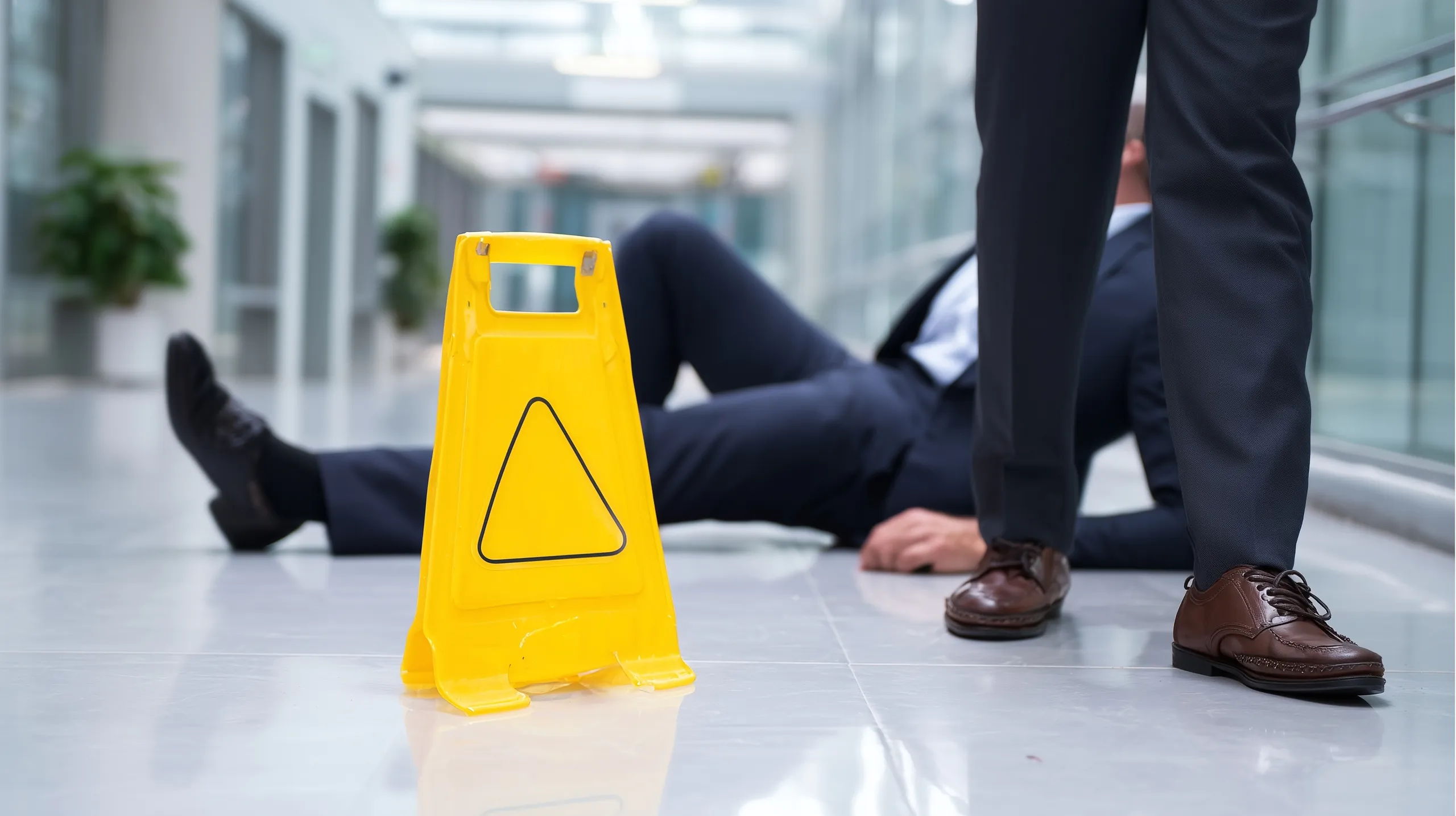
If you’ve been injured in a slip and fall in NY, the most important steps are:
- Get medical care immediately
- Report the fall to the property owner or business
- Photograph the hazard and surrounding area
- Preserve evidence and witness information
- Speak with a lawyer before giving statements to insurance companies
Under New York law, slip-and-fall claims are governed by several longstanding doctrines that remain active in 2026, including CPLR § 214 (New York’s three-year statute of limitations for negligence claims), New York Multiple Dwelling Law § 78 (landlord duty to maintain residential premises in safe repair), and common-law premises liability standards established by cases like Gordon v. American Museum of Natural History and Solazzo v. New York City Transit Authority.
A fall can leave you dealing with pain, medical appointments, missed work, and uncertainty about what happens next. Whether the incident occurred in Westchester County — including White Plains, Yonkers, New Rochelle, Mount Vernon, Scarsdale, Mount Kisco, or elsewhere — the actions you take in the first hours and days after the accident can directly affect your health and your legal claim.
BILLY COOPER LAW

What Should You Do Immediately After a Slip and Fall in NY?
Get Medical Help Right Away
Even if you think your injuries are minor, seek medical attention immediately. Head injuries, spinal injuries, ligament damage, and internal injuries may not fully appear until hours or days later.
In Westchester County, injured people often seek treatment at:
- Westchester Medical Center
- White Plains Hospital
- Phelps Hospital
- Northern Westchester Hospital
Take these steps immediately:
- Call 911 if the injuries are serious
- Go to the emergency room or urgent care the same day
- Tell doctors exactly how the fall happened
- Report every symptom, including dizziness, headaches, numbness, or back pain
- Follow discharge instructions carefully
- Keep copies of all records and bills
Note on WMC: Westchester Medical Center is a municipal hospital operating under the Westchester County Health Care Corporation. If a separate medical malpractice claim arises from care you received there, shorter deadlines apply (90 days for the Notice of Claim, 1 year and 90 days to file suit under General Municipal Law § 50-e and § 50-i). For most slip and fall cases, this won’t apply — the underlying premises liability claim runs on the standard timeline — but it’s worth knowing.
Follow Through With Treatment
Insurance companies often argue that gaps in treatment mean the injuries were not serious.
To protect both your health and your claim:
- Attend all follow-up appointments
- Complete physical therapy if prescribed
- Follow activity restrictions
- Keep a journal documenting pain and limitations
- Save receipts for medications, braces, transportation, and medical equipment
Why Is Reporting the Accident So Important?
Report It to the Property Owner or Business
Always report the incident as soon as possible.
If the fall occurred at a grocery store, apartment building, restaurant, retail store, parking lot, or office property:
- Notify a manager, superintendent, landlord, or property representative
- Ask for a written incident report
- Request a copy before leaving
- Write down the name and title of the employee you spoke with
- Avoid speculating about fault or minimizing your injuries
If you fall on municipal property — a public sidewalk, government building, park, or transit station — identifying the correct agency quickly is critical because of New York’s Prior Written Notice rule. Under this doctrine, you generally cannot sue a city, county, town, or village unless the municipality had actual written notice of the specific defect before your fall.
Two narrow exceptions exist: the municipality affirmatively created the condition through its own work, or a special use by an adjacent party caused the defect. A 90-day Notice of Claim deadline applies under General Municipal Law § 50-e, and your attorney will need to pull municipal records to confirm whether prior written notice was on file. A separate NYC rule (NYC Administrative Code § 7-210) shifts sidewalk liability to the abutting property owner for most commercial and large residential buildings — so the proper defendant analysis is fact-specific. See the legal framework section below for the full doctrine.
Protect Your Claim
Delays create problems in slip-and-fall cases.
If an accident is not promptly reported, property owners and insurers may argue:
- The dangerous condition never existed
- The condition was fixed before anyone could inspect it
- The injuries happened somewhere else
- The hazard appeared only moments before the incident
Prompt reporting creates a documented timeline that can help preserve evidence later.
What Evidence Should You Collect at the Scene?
Document Everything You Can
Photographs and videos are often some of the most important evidence in a NY slip-and-fall case.
If you can safely do so, document:
- The exact condition that caused the fall
- Water, ice, snow, debris, broken flooring, loose carpeting, or uneven pavement
- Missing warning signs or cones
- Lighting conditions
- Footprints, shopping cart tracks, or dirty buildup
- The surrounding area from multiple angles
- Weather conditions if outdoors
- Your visible injuries
Take close-up photos and wide-angle photos showing the full scene.
Request Surveillance Footage Preservation
Surveillance footage can disappear quickly.
There is NO statutory retention window in NY for commercial surveillance footage. Commercial surveillance systems typically overwrite on loops anywhere from 24–72 hours on lower-end systems to 7–30 days on more robust systems.
Because of that, action should happen fast.
Important steps include:
- Have an attorney send a written preservation letter within 24–48 hours if possible
- Do not wait longer than the first week
- Request footage from approximately six hours before the fall through two to three hours afterward
- Request footage from all relevant camera angles, entrances, exits, and surrounding areas
If footage is destroyed after a preservation letter is sent, an “adverse inference” instruction may be available under New York spoliation doctrine. That means the court may permit a jury to infer the missing evidence would have been unfavorable to the property owner.
Talk to Witnesses
Witnesses can help confirm:
- How long the condition existed
- Whether employees knew about it
- Whether others nearly slipped before you
- Whether warning signs were missing
Get:
- Full names
- Phone numbers
- Email addresses
- Short written or recorded statements if possible
Do not assume witnesses will remain available later.
Preserve Physical Evidence
Do not throw away or alter anything connected to the incident.
Preserve:
- Shoes
- Clothing
- Jackets
- Bags
- Mobility devices
Do not wash items immediately after the fall. Moisture, dirt, salt residue, grease, or other substances may later become important evidence.
What Laws Protect You After a Slip and Fall in NY?
NY Premises Liability Framework
New York slip-and-fall cases are generally based on common-law negligence principles.
Gordon v. American Museum of Natural History, 67 NY2d 836 (1986) established the core constructive notice framework still used today. To prove a slip and fall case in NY, you generally must show the property owner had actual notice (they knew about the hazard) or constructive notice (the hazard existed long enough that they should have known). Under Gordon v. American Museum of Natural History, the defect must be (a) visible and apparent, and (b) must have existed for a sufficient length of time before the accident to permit the owner’s employees to discover and remedy it.
Recent NY case law tightened the recurring-condition pathway. In Levitt v. Tops Markets, LLC, 2025 NY Slip Op 04060 (3d Dept, July 3, 2025), the court dismissed a slip-and-fall claim where the plaintiff’s only evidence was that a produce manager occasionally sees spilled products — the court held that showed only “a general awareness that a dangerous condition might exist,” which is legally insufficient to establish constructive notice of the particular condition that caused the fall. The recurring-condition notice theory requires evidence of the specific dangerous condition in the specific area, not a general acknowledgment that hazards of that type may occur. See also Black v. Kohl’s Dept. Stores, Inc., 80 AD3d 958 (3d Dept 2011).
For residential buildings, Multiple Dwelling Law § 78 imposes a broad safety obligation on landlords.
Landlords of residential buildings have a nondelegable duty to maintain safe conditions under Multiple Dwelling Law § 78. The duty extends to the full premises — interior common areas (stairs, hallways, vestibules), exterior approaches, parking areas, and sidewalks abutting the building. An owner cannot defeat this duty by claiming they “don’t manage the building” or that they delegated maintenance to a tenant or property manager — the statutory duty stays with the owner. For residential buildings outside New York City and Buffalo — which includes all of Westchester County — Multiple Residence Law § 174 establishes the same class of landlord maintenance duty.
Municipal Property Defendants: The Prior Written Notice Rule
When the defendant is a city, county, town, or village, New York’s Prior Written Notice rule applies — and it changes the analysis significantly. Unlike a slip-and-fall against a private business or homeowner (where the Gordon constructive-notice framework above applies), a slip-and-fall against a municipality generally requires proof that the municipality had actual written notice of the specific defect, filed with the designated municipal officer, before your accident. Constructive notice — proof that the condition existed long enough that the municipality should have known — is generally not sufficient.
The statutory architecture: General Municipal Law § 50-e sets the 90-day Notice of Claim deadline; § 50-i sets a strict outer deadline of one year and 90 days to file suit. County Law § 52, Town Law § 65-a, and Village Law § 6-628 authorize each county, town, and village to enact its own Prior Written Notice local law. In New York City, NYC Administrative Code § 7-201(c)(2) (the “Pothole Law”) governs streets, highways, sidewalks, and crosswalks, requiring notice to the Commissioner of Transportation or a designated recipient.
The Two Narrow Exceptions
The New York Court of Appeals has recognized only two exceptions to the rule:
- Affirmative creation. Where the municipality affirmatively created the dangerous condition through its own work (e.g., a negligent repair). Under Yarborough v. City of New York, 10 N.Y.3d 726 (2008), this exception generally requires that the municipal work immediately result in the dangerous condition — a defect that develops over weeks or months after a repair does not qualify.
- Special use. Where the municipality (or an adjacent party) derives a particularized benefit from the area beyond the general public benefit, and that special use is connected to the defective condition.
Both exceptions are construed narrowly. Amabile v. City of Buffalo, 93 N.Y.2d 471 (1999), is the foundational Court of Appeals statement of the doctrine.
Snow and Ice — A Different Rule
For snow and ice cases, the San Marco rule changes the calculus. In San Marco v. Village/Town of Mount Kisco, 16 N.Y.3d 111 (2010), the Court of Appeals held that municipal snow-removal activity (plowing, salting, sanding) that subsequently creates or exacerbates an ice hazard can satisfy the affirmative-creation exception — even if the dangerous ice condition develops over time as snow melts and refreezes. The “immediately results” limitation from Yarborough does not apply in the snow/ice context. This matters across Westchester because San Marco directly involved Mount Kisco and is frequently litigated throughout the region.
A recent plaintiff-favorable development: in Calabrese v. City of Albany, 2024 NY Slip Op 06289 (Ct. App. Dec. 17, 2024), the Court of Appeals held that electronic submissions through a city’s online portal can in some jurisdictions satisfy the “written notice” requirement — though municipalities have begun amending their local laws in response.
Sidewalks in New York City — Liability Shifts to the Property Owner
NYC Administrative Code § 7-210, enacted in 2003, shifts sidewalk maintenance liability from the City of New York to the abutting property owner for most commercial properties, apartment buildings, and other large residential buildings. The City retains liability only for sidewalks fronting 1-, 2-, or 3-family owner-occupied residential homes, and for curbs and pedestrian ramps. If your fall occurred on an NYC sidewalk, the proper defendant may be the adjacent property owner — not the City — and the Prior Written Notice rule does not apply in the same way.
“Storm in Progress” Doctrine (Winter Cases)
Winter weather cases follow a separate framework.
Under Solazzo v. New York City Transit Authority, 6 NY3d 734 (2005), property owners generally aren’t liable for slip-and-fall injuries that occur while a storm is actively ongoing — or for a reasonable time after the storm ends. The duty to clear snow and ice resumes after that reasonable window.
There is an important exception.
If a property owner begins snow or ice removal efforts during the storm and those efforts create or worsen dangerous conditions, the storm-in-progress defense can be waived for the treated area.
In Powers v. State of New York, CV-25-0227 (3d Dept, March 26, 2026), the court held that salting passes performed five to seven hours before a fall established constructive notice of residual slippery conditions. The storm-in-progress defense was separately rejected because the weather event — pockets of freezing rain — did not constitute a qualifying ongoing hazardous weather condition sufficient to invoke the doctrine.
Pure Comparative Negligence under CPLR § 1411
CPLR § 1411 governs comparative fault in New York.
New York follows pure comparative negligence under CPLR § 1411. Your recovery may be reduced by your share of fault, but you can still recover damages — even if you were partially responsible for the fall.
Property owners often argue that injured people:
- Were distracted
- Ignored warning signs
- Wore improper footwear
- Failed to watch where they were walking
That does not automatically bar recovery.
Statute of Limitations
CPLR § 214 controls most personal injury filing deadlines.
Under CPLR § 214, you generally have three years to file a personal injury lawsuit.
Different deadlines apply for municipal claims.
If you fell on municipal property — a public sidewalk, park, transit station, or government building — you must file a Notice of Claim within 90 days under General Municipal Law § 50-e. A separate outer deadline under General Municipal Law § 50-i requires the lawsuit itself to be commenced within one year and 90 days after the date of the accident (two years for wrongful death). This deadline runs from the date of the accident and is not extended by a 50-h examination or other procedural steps.
Missing these deadlines can permanently prevent recovery.
BILLY COOPER LAW
What Should You Avoid Doing After a Slip and Fall?
Be Careful With Insurance Companies
Insurance adjusters often contact injured people quickly after a fall.
Be cautious about:
- Giving recorded statements
- Signing broad medical authorizations
- Accepting early settlement offers
- Guessing about injuries before treatment is complete
Statements made early in the case can later be used against you.
Stay Off Social Media
Photos, videos, comments, and check-ins can become evidence.
Insurance companies may review:
- Vacation photos
- Exercise posts
- Event attendance
- Comments about the accident
- Messages discussing injuries
Even harmless posts can be taken out of context.
Don’t Delay Medical Care
Waiting too long to seek treatment creates problems.
Defense lawyers commonly argue that treatment gaps mean:
- The injury was minor
- The injury healed quickly
- Something else caused the condition
Prompt treatment creates a clearer connection between the fall and the injury.
What Compensation Can You Recover After a Slip and Fall?
Economic Damages
Economic damages may include:
- Medical expenses
- Future medical care
- Lost wages
- Reduced earning capacity
- Rehabilitation costs
- Transportation expenses related to treatment
Non-Economic Damages
Non-economic damages may include:
- Pain and suffering
- Emotional distress
- Loss of enjoyment of life
- Permanent limitations
- Scarring or disfigurement
For additional information about damages in NY injury cases, see the firm’s personal injury page.
Why Should You Speak With a Lawyer Early?
Multiple Parties May Be Responsible
Several different entities may share responsibility for a dangerous condition, including:
- Property owners
- Retail tenants
- Management companies
- Maintenance contractors
- Snow removal companies
Early investigation can help identify who controlled the area where the fall occurred.
Municipal Cases Are Especially Time-Critical
If your fall occurred on municipal property, the procedural stakes are higher. The 90-day Notice of Claim deadline begins on the date of the accident — not the date you retain counsel. An attorney handling a municipal case will typically need to file Freedom of Information Law (FOIL) requests to determine whether the municipality had prior written notice of the defect on file, document any evidence supporting an exception (affirmative creation or special use), and confirm the correct designated officer for the Notice of Claim. Even small procedural errors — like serving notice on the wrong municipal officer — can permanently bar the claim under Gorman v. Town of Huntington, which requires strict compliance with the statutory designee requirement. Moving fast on a municipal case is not optional; it’s structural.
Local Court Knowledge Matters
Many Westchester County premises liability lawsuits are handled in the Westchester County Supreme Court.
Local procedures, municipal notice requirements, surveillance preservation issues, and weather-related defenses can all affect how a case develops.
Learn More About Your Options
You can also learn more about premises liability claims through Billy Cooper Law’s premises liability practice area page.
Published Writings by Billy Cooper
- When the Video Disappears: Missing Footage in Injury Cases — Billy Cooper, New York Law Journal, June 24, 2026. Billy explains why accident footage may be missing or overwritten and how preserving recordings can matter in an injury investigation.
NOTABLE RESULTS
Selected results in Billy Cooper Law’s broader personal injury practice:
$9,000,000 settlement · $2,005,000 settlement
Read more about these results
- $9,000,000 settlement — Tank explosion
A man suffered extensive burns and loss of his dominant hand in a tank explosion in Westchester County.
- $2,005,000 settlement — Construction-site roof fall
A worker fell from a roof after inadequate safety equipment was provided on a Rockland County job site.
These are reported gross results, before fees, expenses, and applicable liens. They are not estimates of another claim’s value. Read the firm’s published case results.
Prior results do not guarantee a similar outcome. Each case is different and must be evaluated on its own facts.
WHAT OUR CLIENTS SAY
General feedback about working with Billy Cooper Law:
“Wonderful experience. Very knowledgeable and responsive!”
— Lara C.
“He cares. He just cares.”
— Carmelo Curra
Professional Recognition

Recognition applies to the named attorneys and selection years. See the linked profiles for details.
Related Billy Cooper Law Videos and Social Posts
- Icy Driveways and Property-Owner Responsibility — Facebook.
- Billy Cooper Law official YouTube channel — official profile.
- Billy Cooper Law official Instagram profile — official profile.
- Billy Cooper Law official LinkedIn profile — official profile.
- Slip and Trip-and-Fall Claims — Facebook.
Frequently Asked Questions
How long do I have to file a slip and fall lawsuit in NY?
Under CPLR § 214, you generally have three years to file a personal injury lawsuit. If the accident involved municipal property, you must typically file a Notice of Claim within 90 days under General Municipal Law § 50-e. A separate outer deadline under General Municipal Law § 50-i requires the lawsuit itself to be commenced within one year and 90 days after the date of the accident (two years for wrongful death).
What do I have to prove to win a slip and fall case in NY?
You generally must prove the property owner owed a duty of care, failed to maintain safe conditions, and caused your injuries. Under Gordon v. American Museum of Natural History, 67 NY2d 836 (1986), constructive notice requires proof that the condition was visible and apparent and existed long enough for the owner to discover and fix it. Recent case law, including Levitt v. Tops Markets, LLC (2025), also makes clear that general awareness of possible hazards is not enough — the owner must have known about the specific recurring condition. When the defendant is a municipality — city, county, town, or village — a different rule applies. Under New York’s Prior Written Notice doctrine, you generally must show the municipality had prior written notice of the specific defect filed with the designated municipal officer before your accident; the Gordon constructive-notice framework does not save the claim against a municipal defendant unless one of two narrow exceptions applies (the municipality affirmatively created the condition, or a special use by an adjacent party caused it). See the “Municipal Property Defendants” section above for the full framework.
What if I slipped on snow or ice?
Under Solazzo v. New York City Transit Authority, 6 NY3d 734 (2005), property owners generally are not liable while a storm is actively ongoing or during a reasonable cleanup period afterward. However, if the owner began snow or ice removal efforts during the storm and created or worsened dangerous conditions, the defense may not apply to the treated area.
What if I was partially at fault for the fall?
New York follows pure comparative negligence under CPLR § 1411. Your compensation may be reduced by your percentage of fault, but you may still recover damages even if you were partially responsible.
Can I sue if I fell at a grocery store, retail store, or restaurant?
Yes. Commercial property owners owe customers a duty to maintain reasonably safe premises. Most cases focus on whether the business had actual or constructive notice of the dangerous condition. Under the current framework, showing that a hazard category sometimes occurs is not enough — there must be evidence of the specific recurring condition and the owner’s awareness of it.
What if I fell on a public sidewalk?
If the sidewalk was owned or maintained by a municipality, strict notice deadlines may apply. Under General Municipal Law § 50-e, a Notice of Claim generally must be filed within 90 days. Under General Municipal Law § 50-i, the lawsuit itself must be filed within one year and 90 days of the accident. New York’s Prior Written Notice rule generally requires that the municipality had actual written notice of the specific defect before your accident; constructive notice is not enough against a municipal defendant unless one of two narrow exceptions applies — the municipality affirmatively created the condition, or a special use by an adjacent party caused it. Depending on the location, adjacent private property owners may also have maintenance responsibilities.
What if I fell on a sidewalk in New York City?
NYC sidewalks are governed by a special rule. Under NYC Administrative Code § 7-210, the abutting property owner — not the City — is generally liable for sidewalks fronting commercial buildings and large residential buildings. The City retains liability only for sidewalks fronting 1-, 2-, or 3-family owner-occupied residential homes, and for curbs and pedestrian ramps. If the City is the proper defendant, the Prior Written Notice rule under NYC Administrative Code § 7-201(c)(2) applies, requiring written notice to the Commissioner of Transportation or a designated recipient before the City can be held liable. Determining which party is the proper defendant is fact-specific and benefits from prompt legal counsel.
Take the First Step Toward Protecting Yourself
A slip and fall can leave you dealing with medical treatment, lost income, and uncertainty about what comes next. The actions you take immediately after the accident — documenting the scene, preserving evidence, reporting the incident, and seeking medical care — can make a significant difference later.
If you were injured in Westchester County — including White Plains, Yonkers, New Rochelle, Mount Vernon, Scarsdale, Mount Kisco, or elsewhere — Billy Cooper Law offers free consultations to discuss your options and explain the next steps. Call (914) 730-5789 to learn more.
Related Practice Resources
Related Reading and Practice Resources
BILLY COOPER LAW


Get the Answers You Need
At Billy Cooper Law, every day we renew our pledge to help injured people get the justice and compensation they deserve. We have a reputation throughout New York and nationally for standing up for our clients, and we take that responsibility seriously by approaching every case with preparation, persistence, and an unwavering commitment to results.