
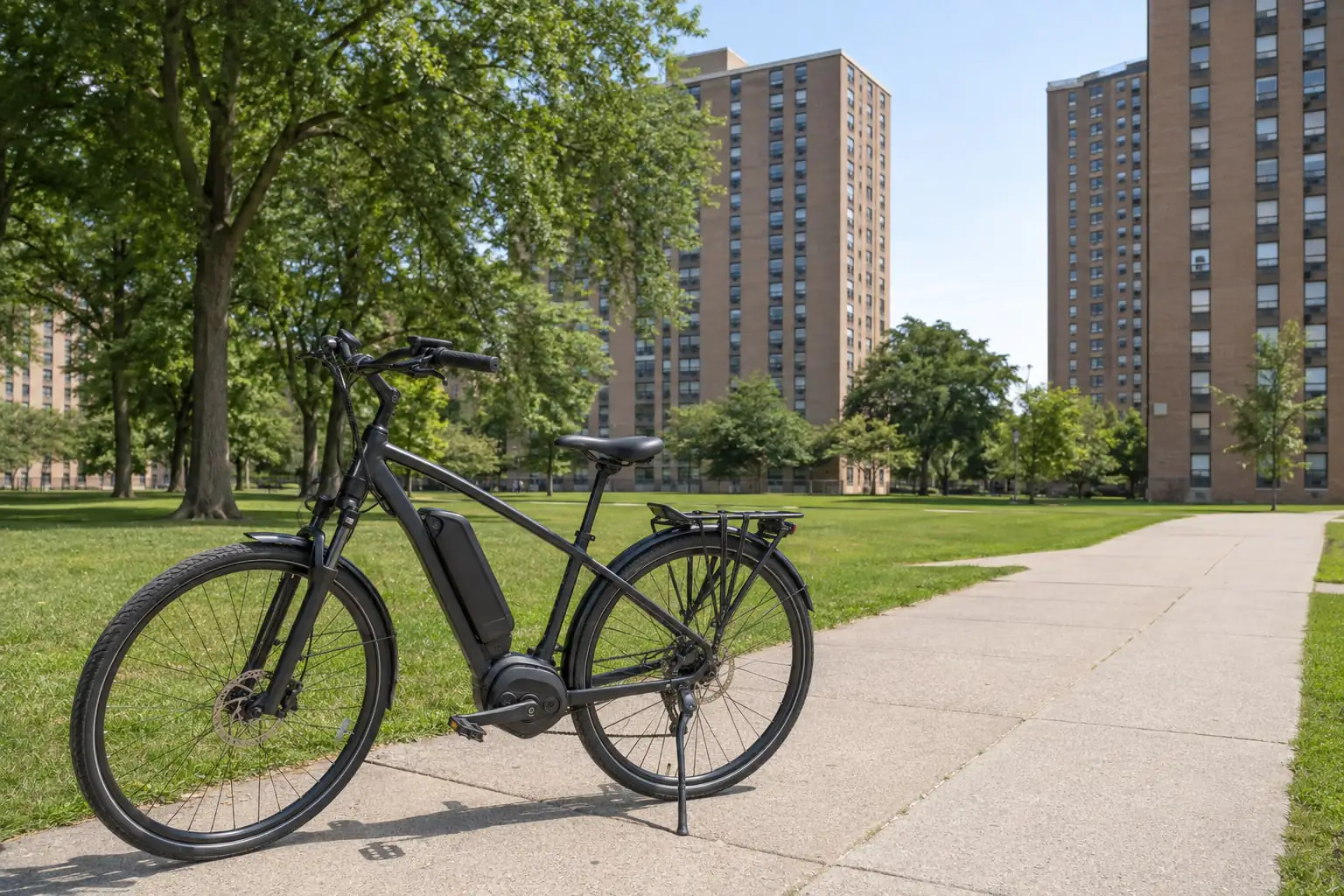
Co-op City NY E-Bike Accident Lawyer
An e-bike crash can leave you with serious injuries, a damaged bike, missed work, and several insurance companies asking questions before you know what happened. If a car, bus, dangerous roadway, or defective bike contributed to the crash, the most important evidence may already be at risk of disappearing.
Co-op City cases require particular attention to location. A crash on Baychester Avenue may involve different records and responsible parties than one near a Riverbay garage, shopping-center entrance, bus stop, or internal access road. Billy Cooper Law can identify who controlled the accident location, preserve available evidence, and explain what comes next.
Types of Injury Cases We Handle in Co-op City NY
E-Bike Accident Lawyers Serving Bronx County
- Bronx County
- Co-op City
- Kingsbridge
- Soundview
- Riverdale
- Fordham
BILLY COOPER LAW

Why Injured Riders Turn to Billy Cooper Law
When you contact Billy Cooper Law, you can speak directly with an attorney who will take the time to hear what happened and answer your questions. That matters in an e-bike case because the first conversation should identify immediate concerns: medical treatment, insurance notices, video preservation, bike inspection, and possible government deadlines.
The firm’s published case results include substantial recoveries in Bronx County pedestrian and motor vehicle cases. Those results do not predict what will happen in another case, but they show experience handling serious injuries involving vulnerable road users.
Billy Cooper Law offers free consultations and handles personal injury cases on a contingency-fee basis. There is no upfront attorney’s fee, and the firm is paid only if compensation is recovered.
The firm does not list an office in Co-op City. Its verified locations are at 245 Main Street, Suite 510 in White Plains NY and 4746 Broadway in New York NY, available by appointment. Current telephone and office information is available on the firm’s contact page.
Why an E-Bike Crash in Co-op City Can Become Complicated Quickly
Co-op City is a large, interconnected residential community with apartment buildings, townhouse areas, garages, schools, shopping centers, bus stops, parking facilities, and internal access routes. It also has its own Department of Public Safety.
That layout creates an important question after a crash: Who controlled the place where it happened?
A collision on a public street may involve NYC roadway records, signal timing, permits, or municipal vehicles. A crash near a garage or internal driveway may require records from Riverbay management or its contractors. An accident at a shopping-center entrance may involve a separate property owner, security company, or commercial tenant.
The location also determines where video may exist. Useful footage might come from a residential building, parking garage, business, bus, traffic camera, delivery vehicle, or doorbell system. Much of that video is routinely overwritten, so early preservation requests can make a significant difference.
A Local Snapshot of Rider Risk
The numbers show why a careful investigation matters.
In its 2024 Bicycle Crash Data report, NYC DOT recorded 71 crashes between motor vehicles and motorized two-wheelers in the 45th Precinct, which covers Co-op City. Those crashes resulted in 63 motorized two-wheeler injuries and two rider fatalities. The category is broader than e-bikes alone and also includes devices such as mopeds, motorcycles, and stand-up scooters, but it reflects the risks riders face when sharing the road with larger vehicles.
A separate NYC DOT safety study of Baychester Avenue documented 83 injuries between 2020 and 2024, including four severe injuries. The study found that 46% of crashes occurred during school arrival and dismissal periods.
Those patterns matter because e-bike crashes are often caused by a combination of turning traffic, limited visibility, school activity, bus movements, curbside loading, and drivers entering or leaving parking areas.
Where E-Bike Injuries Happen Around Co-op City
Busy intersections and turning lanes
Bartow Avenue, Baychester Avenue, and Co-op City Boulevard bring together local traffic, buses, delivery vehicles, shoppers, students, pedestrians, and drivers approaching major highway connections.
Drivers making left or right turns may look for other cars without noticing an e-bike traveling through the intersection. A rider can also be struck when a driver exits a parking area, crosses a bike route, or turns through a crosswalk.
Shopping-center and garage entrances
Parking facilities create frequent conflicts involving backing vehicles, drivers focused on finding spaces, obstructed sight lines, loading activity, and cars entering or leaving the roadway.
Evidence in these cases may include garage access records, security reports, surveillance footage, maintenance records, leases, and agreements identifying who was responsible for the property.
Bus stops and curbside activity
Stopped buses, double-parked vehicles, rideshare pickups, delivery vans, and cars pulling away from the curb can force an e-bike rider into moving traffic. A bus may also block the view between a rider and a turning driver.
When a bus is involved, identifying the actual operator is essential. “The MTA” is not a single legal defendant, and different transit entities can have different claim procedures.
Parked-car doorings
A driver or passenger who opens a door into a rider’s path can cause a direct collision or force the rider into another lane. Photographs of the door, vehicle position, nearby cameras, road markings, and resulting bike damage can help establish what happened.
Roadway and property hazards
Potholes, uneven pavement, construction plates, debris, poor lighting, defective drainage, and unsafe lane design can destabilize an e-bike. These cases often depend on who created the hazard, who controlled the property, and whether the responsible party had notice before the crash.
E-Bike Accident Cases Billy Cooper Law Handles
Billy Cooper Law represents riders injured in:
- E-bike accidents
- Collisions involving cars
- Truck and commercial vehicle accidents
- Bus accidents
- Uber and Lyft accidents
- Collisions involving bicycles or other riders
- Crashes caused by unsafe private property conditions or other premises liability
- Accidents involving defective bikes, batteries, brakes, throttles, or components covered by products liability
- Delivery and other job-related work accidents
- Catastrophic injuries, including traumatic brain injuries and spinal cord injuries
- Fatal crashes resulting in wrongful death
What to Do After an E-Bike Accident
Get medical care
Call 911 if you may have suffered a head injury, fracture, internal injury, spinal injury, or other serious trauma. Adrenaline can hide symptoms, especially after a rider has been thrown from the bike.
Tell your medical providers how the crash happened and describe every area that hurts. Follow-up care is important both for your recovery and for documenting injuries that may not have been fully apparent at the scene.
Report the crash
Ask the NYPD to respond and prepare a collision report. If the accident happened on Co-op City property, also report it to Co-op City Public Safety or the relevant property manager. A property report may help identify witnesses and cameras, but it does not replace a police report or any formal government claim requirement.
Document the exact location
Photograph the road, intersection, driveway, garage entrance, traffic controls, lane markings, debris, lighting, construction, and nearby cameras. Include wide photographs showing how vehicles and riders approach the location.
Record the nearest building number, business, intersection, or property entrance. A precise location may determine which entity had control and where evidence can be found.
Gather identifying information
Obtain the driver’s name, plate number, insurance information, employer, and vehicle owner if possible. If a commercial vehicle or bus was involved, photograph fleet numbers, company markings, route information, and any identifying decals.
Ask witnesses for their names and contact information. Do not assume the police report will include everyone who saw the crash.
Preserve the e-bike
Do not repair, modify, charge, sell, or discard the bike, battery, helmet, or damaged clothing before they can be evaluated. A damaged controller, brake, throttle, tire, frame, or battery may help explain the crash.
Save purchase records, repair invoices, manuals, photographs, app data, and communications with the seller or manufacturer.
Be careful with insurance calls
You may need to notify an insurer promptly, but you do not have to speculate about speed, distance, or fault. Avoid giving a recorded statement to another party’s insurer before understanding how it may be used.
Evidence That Can Strengthen an E-Bike Claim
Depending on how the crash occurred, useful evidence may include:
- NYPD collision reports and 911 records
- Co-op City Public Safety or property incident reports
- Building, garage, store, and parking-lot surveillance
- Bus or commercial-vehicle camera footage
- Dashcam and rideshare video
- Traffic-camera footage and signal records
- Witness statements
- Vehicle event-data recorder information
- Driver phone and navigation records
- Delivery-app routes, order histories, and time records
- Photographs of the scene, bike, vehicle, and injuries
- The e-bike’s controller, display, battery, throttle, and brakes
- Purchase, maintenance, and repair records
- Roadwork permits, inspection records, complaints, and maintenance files
- Medical records and documentation of missed work
Some of this material may be available only briefly. Preservation letters can ask businesses, property managers, transit entities, vehicle owners, and other parties not to erase or destroy it.
New York E-Bike Rules That May Affect the Case
New York recognizes three classes of legal e-bikes. NYC DOT’s current e-bike guidance explains the differences between pedal-assist, throttle-assisted, and Class 3 bikes.
In New York City:
- A rider must generally be at least 16.
- E-bikes may use qualifying vehicle lanes and bike lanes.
- E-bikes should not be operated on sidewalks.
- E-bikes and e-scooters may not be operated above 15 mph on city streets.
- Class 3 e-bike riders must wear helmets.
- Delivery workers and riders under 18 are subject to additional helmet requirements.
The legal classification of the device can become important. A vehicle marketed as an “e-bike” may actually function as a moped or illegal high-speed device if it lacks operable pedals or exceeds legal power and speed limits.
That does not automatically decide who caused the crash. It does mean the bike should be preserved so its actual design, programming, and condition can be examined rather than debated from photographs.
BILLY COOPER LAW
Insurance and No-Fault Benefits
When an e-bike rider is struck by a motor vehicle, New York no-fault insurance may cover an initial layer of accident-related medical expenses and lost income, regardless of who caused the collision.
Basic no-fault coverage generally provides up to $50,000 per person for qualifying economic losses. The correct insurer is often the insurer for the vehicle that struck the rider. If the vehicle was uninsured or left the scene, coverage may instead come from an applicable household auto policy or the Motor Vehicle Accident Indemnification Corporation.
No-fault deadlines arrive much sooner than the deadline for filing a lawsuit. The New York Department of Financial Services explains that written notice generally must be provided within 30 days. Medical bills generally must be submitted within 45 days of treatment, while proof of lost earnings generally must be submitted within 90 days.
If a hit-and-run vehicle was involved, reporting the accident to the proper authority promptly is particularly important.
No-fault does not ordinarily pay for pain and suffering or damage to the e-bike. Those losses may require a separate liability claim.
Filing Deadlines and the 2026 Changes to New York Motor Vehicle Law
Most negligence-based personal injury lawsuits in New York must be filed within three years under CPLR § 214. A wrongful death action generally must be filed within two years of the death under EPTL § 5-4.1.
Those are not the only deadlines.
The serious-injury requirement
An e-bike rider seeking pain-and-suffering damages after a motor vehicle collision may need to satisfy the serious-injury standard in Insurance Law § 5102 and Insurance Law § 5104.
New York amended that standard in 2026. For actions commenced on or after May 26 2026, the former category covering certain nonpermanent injuries that disrupted substantially all usual activities for 90 of the first 180 days was removed. Remaining categories include fractures, significant disfigurement, permanent loss of use, permanent consequential limitations, and significant limitations of a body function or system.
Objective medical evidence is therefore especially important. Imaging, specialist findings, surgical records, range-of-motion measurements, and documentation of permanent limitations can shape whether the claim satisfies the threshold.
Comparative fault also changed
The 2026 reforms also changed comparative fault for personal injury cases subject to New York’s no-fault law.
Under the current CPLR § 1411, a claimant in an Insurance Law Article 51 case may be barred from recovery if the claimant’s share of fault is greater than the combined fault of the parties being sued. At 50% fault or less, damages can still be recovered but are reduced by the claimant’s percentage.
Cases outside Article 51 generally remain subject to pure comparative negligence, under which partial fault reduces compensation but does not completely bar the claim.
For e-bike riders, this makes immediate fault investigation more important. Insurers may focus on speed, traffic signals, sidewalk use, lighting, lane position, and whether the rider’s device met the legal definition of an e-bike.
Who May Be Responsible for an E-Bike Crash?
Responsibility may extend beyond the person who made the immediate mistake.
Potentially liable parties include:
- A negligent driver who failed to yield, turned across the rider’s path, opened a door, followed too closely, or drove while distracted.
- The vehicle owner. Under Vehicle and Traffic Law § 388, an owner may be responsible for negligence by someone using the vehicle with permission.
- An employer or fleet operator when the driver was working at the time of the crash.
- A rideshare or delivery company when commercial activity and company insurance were involved.
- A bus or transit entity if a bus struck the rider, forced the rider into danger, or contributed to the crash.
- A property owner or manager responsible for an unsafe driveway, garage, parking area, access road, or construction condition.
- A government agency responsible for a defective public roadway, signal, sign, or municipal vehicle.
- A bike manufacturer, distributor, repair shop, or seller if defective brakes, a throttle malfunction, frame failure, battery problem, or negligent repair caused the accident.
- Another rider or pedestrian whose unsafe conduct contributed to the collision.
A strong investigation asks not only who was present, but who owned the vehicle, controlled the property, employed the driver, maintained the roadway, or supplied the defective component.
Compensation After a Serious E-Bike Injury
The losses recoverable depend on how the crash happened, the insurance available, and whether the serious-injury threshold applies.
A claim may seek compensation for:
- Emergency treatment and hospitalization
- Surgery, rehabilitation, and therapy
- Future medical care
- Lost income
- Reduced future earning capacity
- Home assistance and transportation expenses
- E-bike and personal-property damage
- Pain and suffering
- Emotional distress
- Scarring and disfigurement
- Loss of mobility or independence
- Permanent disability
- Wrongful death losses
If the rider was making deliveries or performing other work, workers’ compensation or occupational insurance may also need to be reviewed. A separate claim may still exist against a negligent driver, property owner, manufacturer, or other third party.
When a Government or Transit Entity May Be Involved
A government claim may arise when an e-bike crash involves a city vehicle, public bus, defective public street, traffic signal, construction project, or state-controlled property.
Claims against New York City and many other public entities generally require a Notice of Claim within 90 days under General Municipal Law § 50-e. A lawsuit covered by General Municipal Law § 50-i generally must be commenced within one year and 90 days.
Claims involving the New York City Transit Authority may be subject to the separate requirements in Public Authorities Law § 1212. A negligence claim against New York State may require filing and service within 90 days under Court of Claims Act § 10, unless a proper notice of intention is used.
Identifying the correct entity is part of the legal work. A report to the NYPD, Co-op City Public Safety, 311, or a property manager does not automatically satisfy a formal Notice of Claim requirement.
Local Medical, Reporting, and Court Resources
Call 911 for emergency police, fire, or medical assistance.
- NYC Health + Hospitals/Jacobi is located at 1400 Pelham Parkway South in Bronx NY.
- The NYPD 45th Precinct covers Co-op City and is located at 2877 Barkley Avenue in Bronx NY.
- The Co-op City Department of Public Safety operates from 2049 Bartow Avenue.
- Civil cases filed in Bronx County may proceed through the Bronx County Supreme Court, Civil Term at 851 Grand Concourse in Bronx NY.
Where a lawsuit is filed depends on the parties, accident location, and applicable venue rules.
How Billy Cooper Law Investigates an E-Bike Accident
The investigation begins by establishing the exact location, device type, vehicles involved, and the rider’s medical condition.
The firm may then:
- Determine who owned and controlled the crash location
- Request police, public safety, and incident reports
- Send preservation demands for video and electronic records
- Locate and interview witnesses
- Inspect the e-bike, battery, brakes, throttle, and damaged equipment
- Obtain available vehicle data and commercial records
- Investigate the driver’s employment and insurance coverage
- Review roadway plans, permits, complaints, and repair history
- Coordinate no-fault and other insurance claims
- Work with medical providers and appropriate experts
- Document how the injuries affect work, mobility, and daily life
The goal is to build the case before evidence is overwritten, repaired, discarded, or forgotten.
Related Billy Cooper Law Resources
- Personal Injury
- New York E-Bike Accident Lawyer
- New York Motor Vehicle Accident Lawyer
- New York Bicycle Accident Lawyer
- New York Pedestrian Accident Lawyer
- New York Catastrophic Injury Lawyer
- New York Wrongful Death Lawyer
Talk With Billy Cooper Law About What Happened
Tell the firm where the crash occurred, what struck you, whether you were working, and where the e-bike is now. Billy Cooper Law can help determine which insurance applies, who may be responsible, and what evidence needs to be preserved.
Call (718) 866-3311 for the firm’s New York City location or (914) 730-5789 for the White Plains office. You can also contact Billy Cooper Law online to request a free consultation.
BILLY COOPER LAW
Co-op City NY E-Bike Accident FAQs
These answers provide general information about New York injury claims and related concerns. The rules depend on the facts; this is not individual legal or medical advice.
Can no-fault insurance pay my medical bills after a Co-op City e-bike crash?
It may, when your injuries arise from a collision with a covered motor vehicle. A qualifying e-bike rider generally seeks no-fault benefits through the striking vehicle’s insurer. The device’s legal classification matters: a modified machine treated as a motorcycle can present different coverage issues. Basic economic-loss coverage is subject to a $50,000 combined limit and statutory restrictions.
Give the appropriate insurer written notice promptly; the usual deadline is 30 days, with a limited exception requiring written justification for delay. Keep claim forms, medical bills, wage records and proof of submission. No-fault benefits do not automatically compensate you for pain and suffering or damage to the bicycle.
Sources: New York DFS: No-Fault Insurance FAQs; New York Insurance Law § 5102: Covered Losses and Definitions.
What should I do if the driver leaves the scene?
Report the collision to police promptly and preserve anything that can identify the vehicle. Depending on available insurance and eligibility, an unknown or uninsured vehicle may lead to a claim through a household auto policy or the Motor Vehicle Accident Indemnification Corporation. MVAIC is not an automatic substitute for every missing insurance policy.
Its statutory conditions include special reporting and filing requirements; hit-and-run matters generally require a police report within 24 hours or as soon as reasonably possible, subject to the law’s exceptions. Save witness contacts, camera locations and the police incident number. Have the available coverage and deadlines reviewed promptly rather than waiting for the driver to be identified.
Sources: New York Insurance Law § 5208: MVAIC Notice Requirements; New York DFS: Claims Involving Unknown or Uninsured Vehicles.
Does being partly at fault prevent me from recovering compensation?
It can in some New York motor-vehicle injury cases, but partial fault does not produce the same result in every claim. Current CPLR § 1411 distinguishes personal-injury actions subject to Insurance Law Article 51 from other cases. For covered actions, a claimant’s fault greater than the opposing parties’ combined fault can bar recovery; otherwise, the award is reduced proportionately.
Other injury claims generally retain proportional reduction without that statutory bar. The 2026 amendments and their applicability must be checked for the particular action. Preserve photographs, witness accounts and information about visibility, direction of travel and signals. An insurer’s initial fault assessment is not a court determination of your entitlement to damages.
Sources: CPLR § 1411: Comparative Fault; New York DFS: 2026 Motor Vehicle Insurance Reforms.
Can I seek pain-and-suffering damages for an e-bike injury?
Potentially, but an injury action between covered persons under New York’s no-fault law generally requires a qualifying serious injury to recover noneconomic damages. A fracture is one statutory category; certain significant or permanent functional limitations are others. Pain, a diagnosis or time away from work alone does not establish every required element.
The current definition no longer includes the former 90/180-day category. The 2026 reform’s applicability should be evaluated for the action involved. Medical findings must connect the qualifying injury to the collision, and liability remains a separate issue. Keep examination records, imaging reports and documentation of functional restrictions so counsel can evaluate the relevant statutory category rather than relying on a settlement estimate.
Sources: New York Insurance Law § 5102(d): Serious Injury; New York Insurance Law § 5104: Personal Injury Actions; New York DFS: 2026 Motor Vehicle Insurance Reforms.
How long do I have to bring a claim after an e-bike accident?
Many New York negligence lawsuits have a three-year limitation period, but that is not a safe deadline for every step after a crash. A claim involving a public corporation can require notice within 90 days. Claims against New York State follow separate Court of Claims procedures, which can also demand action within 90 days.
The defendant, type of claim and applicable exceptions determine the actual schedule. A police report or an ordinary insurance claim does not necessarily satisfy a government notice requirement. Identify the accident date, exact location and possible responsible parties at the outset, and have all deadlines checked before assuming you can wait to decide whether to pursue the matter.
Sources: CPLR § 214: Three-Year Limitation Periods; General Municipal Law § 50-e: Notice of Claim; Court of Claims Act § 10: Claims Against New York State.
Which e-bike operating rules matter in Co-op City NY?
The device’s class, the road and applicable local rules all matter. New York’s electric-assist bicycle definition requires operable pedals and limits motor power and width. State law generally restricts electric-assist bicycles to roads posted at 30 mph or less unless an applicable local provision changes the rule, and sidewalk use generally requires local authorization.
Class 3 bicycles are restricted to a city with at least one million residents; that geographic rule does not make every route in the Bronx lawful for every device. Record the exact roadway, posted signs and bicycle specifications if a collision occurs. Preserve the bicycle without changing its equipment while its classification is evaluated. A riding restriction and legal responsibility for a particular collision are separate questions.
Sources: Vehicle and Traffic Law § 1242: E-Bike Operating Rules; Vehicle and Traffic Law § 102-c: Electric-Assist Bicycle Classes.
Does not wearing a helmet automatically defeat an injury claim?
No. Helmet use and responsibility for causing a collision are separate issues. New York’s bicycle helmet statute expressly limits the civil consequences of violating that section. The relevant requirements depend on the rider’s age, device classification and applicable local rules; do not assume that every electric two-wheeler is governed by the same provision.
Do not assume either that an insurer can automatically deny the entire case or that helmet evidence is irrelevant under every possible legal theory. The rider’s age, device classification, applicable provision and injuries matter. Preserve any helmet and photographs from the scene, and obtain a medical evaluation for a suspected head injury. Counsel can assess the governing protections against the facts of the particular claim.
Sources: Vehicle and Traffic Law § 1238: Helmets and Civil-Claim Protections; Vehicle and Traffic Law § 1242: E-Bike Operating Restrictions.
What if headache or dizziness starts after I have gone home?
Seek medical advice promptly after new symptoms following a head impact. CDC guidance explains that concussion symptoms can appear hours or days later. Worsening headache, repeated vomiting, seizures, slurred speech, marked confusion or difficulty waking are emergency warning signs; call 911 or obtain emergency care immediately if these occur.
Tell the clinician when the crash happened, whether your head or body took a blow and when each symptom began. Ask for written guidance about returning to work, driving and other activities, and report symptoms that worsen or fail to improve. Medical assessment addresses your health; a symptom diary or this webpage cannot diagnose a concussion or establish the legal cause of an injury.
Sources: CDC: Symptoms of Mild TBI and Concussion; CDC: What to Do After a Mild TBI or Concussion.
What if I was injured while making an e-bike delivery?
A work-related crash may involve workers’ compensation as well as a claim against a responsible third party. New York generally provides compensation for covered employees injured in the course of employment without requiring proof that the employer was negligent. Whether a delivery rider is a covered employee must be evaluated; a platform’s label alone should not be treated as the complete answer.
A separate case against a negligent driver or another third party may also be possible. Workers’ Compensation Law § 29 addresses these overlapping claims, including reimbursement and settlement issues. Preserve dispatch messages, delivery records and pay information, and obtain advice before signing a release that could affect benefits or another claim.
Sources: Workers’ Compensation Law § 10: Work-Related Injuries; Workers’ Compensation Law § 29: Third-Party Claims.
What if my e-bike was modified or its motor was more powerful than allowed?
The device may fall outside New York’s electric-assist bicycle definition, which can change the rules relevant to the claim. The statutory definition requires operable pedals, a width no greater than 36 inches and an electric motor rated below 750 watts, together with the applicable class limits. A product’s advertising name does not establish its legal classification.
Preserve the frame, battery, motor, controller and purchase information so the original specifications and any changes can be examined. Do not discard or alter the equipment while its classification is in question. Operating restrictions and insurance eligibility require separate review; a modification does not by itself establish which person caused the collision.
Sources: Vehicle and Traffic Law § 102-c: Electric-Assist Bicycle Definition; Vehicle and Traffic Law § 1242: E-Bike Operating Restrictions.
Sources
Billy Cooper Law
- Billy Cooper Law
- Billy Cooper Law E-Bike Accident Practice
- Personal Injury
- Billy Cooper Law Case Results
- Billy Cooper Law Contact and Office Information
Co-op City and Local Safety Data
- About Co-op City
- Co-op City Department of Public Safety
- NYC DOT 2024 Bicycle Crash Data
- NYC DOT Baychester Avenue Safety Improvement Plan
- NYC DOT E-Bikes in New York City
- NYC DOT Bicycle and E-Bike Laws, Rules, and Regulations
Insurance and New York Law
- New York Department of Financial Services No-Fault Insurance FAQs
- New York Department of Financial Services 2026 Motor Vehicle Insurance Reforms
- CPLR § 214 — Personal Injury Limitation Period
- CPLR § 1411 — Comparative Fault
- Insurance Law § 5102 — No-Fault Definitions and Serious Injury
- Insurance Law § 5104 — Motor Vehicle Personal Injury Actions
- Vehicle and Traffic Law § 388 — Vehicle Owner Liability
- Vehicle and Traffic Law § 1242 — E-Bike Requirements
- General Municipal Law § 50-e — Notice of Claim
- General Municipal Law § 50-i — Municipal Tort Actions
- Public Authorities Law § 1212 — Claims Against the New York City Transit Authority
- Court of Claims Act § 10 — Claims Against New York State
- EPTL § 5-4.1 — Wrongful Death Actions
Local Institutions

Get the Answers You Need
At Billy Cooper Law, every day we renew our pledge to help injured people get the justice and compensation they deserve. We have a reputation throughout New York and nationally for standing up for our clients, and we take that responsibility seriously by approaching every case with preparation, persistence, and an unwavering commitment to results.