

Yonkers NY Slip and Fall Lawyer
A fall can disrupt your life in seconds. You may be dealing with a fracture, concussion, torn ligament, back injury, missed work, or the possibility of surgery. Meanwhile, the property owner’s insurance company may already be asking for a statement. You do not need to know exactly who was responsible before speaking with a lawyer. In Yonkers, the answer may depend on who owned the property, who controlled the area, whether maintenance was outsourced, and whether a government or transit agency was involved. Billy Cooper Law represents people injured by unsafe property conditions throughout Yonkers and Westchester County. The firm can investigate what caused your fall, identify the responsible parties, preserve evidence, and explain what comes next.
Slip and Fall Lawyers Serving Westchester County
Why Injured People Turn to Billy Cooper Law
A serious fall deserves more than a quick insurance claim. It requires a lawyer who will look beyond the emergency room bill and understand how the injury affects your work, mobility, independence, and future care. From its White Plains office, Billy Cooper Law serves clients throughout Yonkers and the surrounding area. The firm offers more than 75 years of combined experience, and William H. Cooper has been recognized by Super Lawyers from 2024 through 2026. Spanish-language assistance is available. Consultations are free, and the firm handles personal injury cases on a contingency basis, so there is no upfront legal fee. (billycooperlaw.com) Just as important, the firm prepares injury cases with trial in mind. That preparation matters when an insurer disputes how long a hazard existed, argues that you should have seen it, or claims that your injuries came from something else.Why Slip and Fall Cases Are Different in Yonkers NY
Yonkers combines dense residential neighborhoods, apartment buildings, major retail properties, busy sidewalks, parking structures, and Metro-North facilities. A single block can include property controlled by a private owner, commercial tenant, management company, contractor, transit authority, or the City of Yonkers. That makes identifying the right defendant one of the first challenges. A fall outside a Central Park Avenue store may involve the retailer, the shopping-center owner, and a snow-removal contractor. A broken stair in an apartment building may require a review of landlord records, management agreements, and prior tenant complaints. A sidewalk case near Getty Square may raise questions about private maintenance duties and the City’s prior-written-notice law. A station accident may involve Metro-North rather than the City. These distinctions affect the evidence you need and the deadlines that apply.Types of Injury Cases We Handle in Yonkers NY
Yonkers had 11,749.9 residents per square mile in 2020, creating constant use of sidewalks, entrances, stairs, stores, and transit areas. Only 46.2% of occupied homes were owner-occupied during 2020–2024, meaning rental properties and landlord-controlled common areas are a significant part of the local housing picture. (census.gov) The Census Bureau also reports that 17.6% of Yonkers residents are 65 or older. Falls can seriously affect anyone, but older adults are especially vulnerable to hip fractures, head trauma, and a loss of mobility. Yonkers businesses recorded approximately $3.4 billion in retail sales in 2022, reflecting the volume of activity in stores, shopping centers, parking lots, and commercial entrances. (census.gov) Transit adds another layer. Metro-North’s Hudson Line recorded approximately 13.78 million rides in 2024, a 13.8% increase from 2023. For a fall near a Yonkers station, determining whether Metro-North, a contractor, the City, or an adjacent private owner controlled the exact location may be critical. (mta.info) These figures do not prove negligence. They explain why property control, inspection practices, and early evidence preservation matter so much here.Where Falls Commonly Happen in Yonkers
Retail centers and supermarkets
Properties such as Cross County Center, Ridge Hill, and the commercial corridors along Central Park Avenue attract steady foot traffic. Spills, wet entrance mats, food debris, tracked-in rain, and snowmelt may appear and disappear quickly. Surveillance video, inspection logs, cleaning schedules, and employee testimony can show when a hazard developed and whether staff had enough time to address it.Apartment buildings and rental properties
Falls in vestibules, hallways, stairwells, laundry rooms, courtyards, and exterior walkways often involve more than one responsible party. The building owner may employ a management company or superintendent, while another company handles cleaning or snow removal. New York’s Multiple Dwelling Law § 78 requires owners to keep multiple dwellings and their lots in good repair. The facts still matter: where the hazard was located, who controlled that area, what complaints were made, and whether anyone attempted a repair. (nysenate.gov)Sidewalks, curbs, and crosswalks
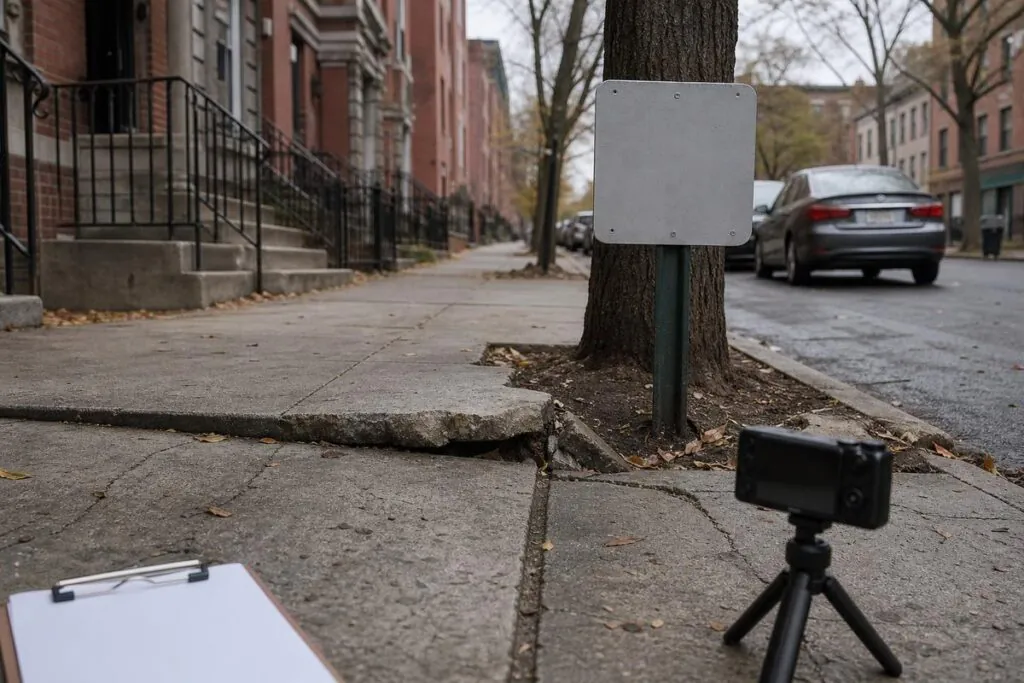
A sidewalk case in Yonkers can be more complicated than it first appears. Responsibility may depend on the type of defect, adjacent property, prior repair work, permits, tree roots, utilities, and whether the City received legally sufficient written notice. Photographs should capture more than the raised slab or hole. The surrounding curb, building frontage, utility covers, tree wells, drainage, lighting, and nearby construction may help identify who created or controlled the condition.Metro-North and waterfront areas
A fall on station stairs, a platform, a pedestrian approach, or property near the Yonkers waterfront requires a precise location analysis. Areas that appear connected may be owned or maintained by different entities. A few feet can determine which agency receives notice, what records exist, and which filing deadline controls.Parking lots and garages
Parking-lot falls often involve potholes, broken pavement, poor lighting, drainage problems, ice, or changes in elevation between parking spaces and walkways. Leases and maintenance contracts may divide responsibility among an owner, tenant, management company, and contractor.Slip and Fall Cases Billy Cooper Law Handles
Billy Cooper Law represents people injured in:- Sidewalk falls involving broken pavement, raised slabs, tree roots, ice, or unsafe curbs
- Parking lot falls caused by potholes, poor lighting, drainage problems, snow, or ice
- Supermarket and grocery store falls involving spills, produce, leaking refrigeration units, clutter, or missing warning signs
- Falls inside private homes caused by unsafe stairs, flooring, walkways, or lighting
- Apartment and residential building accidents involving common areas, entrances, stairwells, and landlord-controlled property
- Commercial building and business accidents in stores, offices, restaurants, hotels, and shopping centers
- Premises liability claims involving snow, ice, wet floors, defective stairs, inadequate lighting, or poor maintenance
- Construction-site falls, which may involve separate protections under New York’s Labor Law
What to Do After a Fall
Your health comes first. After that, focus on preserving information that may be gone within hours.- Get medical attention. Call 911 for a serious injury. Even if you leave the scene on your own, seek prompt care for pain, dizziness, weakness, numbness, limited movement, or a head impact.
- Report the accident. Notify the store manager, landlord, superintendent, security officer, or property owner. Ask for an incident-report number or a copy of the report.
- Photograph the hazard. Take close photographs and wider views showing the surrounding area. For a sidewalk defect, include a ruler, coin, or other scale if it can be done safely.
- Record the exact location. Save the address and note the nearest storefront, building entrance, parking space, platform, stairway, or intersection.
- Get witness information. A witness may have seen the fall, the hazard, prior complaints, or unsuccessful cleanup attempts.
- Keep your shoes and clothing. Place them somewhere safe without washing, repairing, or discarding them.
- Do not speculate about fault. It is fine to explain what happened. Avoid guessing how long the condition existed or saying that you were “fine” before you understand your injuries.
- Be careful with insurance calls. You may be asked for a recorded statement or broad medical authorization before the responsible parties have preserved their own evidence.
Evidence That Can Make the Difference
Slip and fall cases are often decided by evidence that is not automatically given to the injured person. Important evidence may include:- Surveillance and doorbell-camera footage
- Incident and security reports
- Cleaning and inspection logs
- Snow-removal and salting records
- Weather and temperature data
- Maintenance contracts
- Leases and management agreements
- Work orders, permits, and repair invoices
- Prior complaints and code violations
- Photographs from before and after the accident
- Employee schedules and witness statements
- Medical records and proof of lost income
What New York Law Requires You to Prove
A property owner is not automatically liable whenever someone falls. You generally must connect the injury to an unreasonably dangerous condition and show that the defendant created the condition, knew about it, or should have discovered it through reasonable inspection. Under Gordon v. American Museum of Natural History, constructive notice generally requires evidence that the condition was visible and apparent and existed long enough for the responsible party to discover and correct it. A general awareness that spills or ice sometimes occur is not necessarily enough. (nycourts.gov) This is why inspection records and surveillance footage matter. If a store cannot show when an aisle was last checked, or video shows a puddle remaining near an entrance, that evidence may help establish notice.Small defects are not judged by measurement alone
Property owners often argue that a crack, depression, or height difference was too small to be dangerous. New York does recognize a “trivial defect” defense, but there is no automatic rule based on inches alone. Courts consider the defect’s depth, width, shape, appearance, lighting, location, surrounding traffic, and whether the condition acted like a trap. The Court of Appeals made clear in Hutchinson v. Sheridan Hill House Corp. that the full circumstances matter. (nycourts.gov)Snow and ice cases require a careful timeline
Under New York’s storm-in-progress doctrine, property owners generally receive a reasonable opportunity to address naturally accumulating snow or ice after a storm ends. They are not ordinarily required to keep every exposed surface continuously clear during active precipitation. (nycourts.gov) That does not end every winter case. Liability may still exist if negligent plowing, shoveling, drainage, or salting created or made the condition worse, or if the ice came from an older untreated accumulation. Yonkers law also requires owners or their designees to clear abutting sidewalks. Snow ending during the day must generally be removed within six hours; after nighttime snowfall, removal is required before noon the following day. Those local requirements are relevant, but they do not replace the need to prove negligence under New York law. (ecode360.com)BILLY COOPER LAW
Who May Be Responsible?
Depending on where and how the fall happened, a claim may involve:- The property owner
- A commercial tenant
- A landlord or building manager
- A condominium or cooperative
- A cleaning company
- A snow-removal contractor
- A security or maintenance company
- A construction contractor
- The City of Yonkers
- Westchester County
- Metro-North or another public authority
- A utility company that opened or repaired the sidewalk
What If You Were Partly at Fault?
Insurance companies frequently argue that injured people were distracted, wearing the wrong shoes, using a phone, or failing to watch where they were walking. In an ordinary premises case, CPLR § 1411 generally allows recovery even when the injured person shares some responsibility. Compensation is reduced by that person’s percentage of fault rather than eliminated entirely. (billycooperlaw.com) An “open and obvious” condition does not automatically excuse negligent property maintenance in every case. Visibility, lighting, distractions, crowding, and whether there was a safe alternative route may all matter.Compensation After a Serious Fall
A claim should reflect what the injury has actually taken from you—not just the first medical bill. Depending on the evidence, compensation may address:- Emergency treatment and hospitalization
- Surgery, physical therapy, and rehabilitation
- Future medical care
- Lost wages
- Reduced earning ability
- Pain and suffering
- Loss of mobility or independence
- Scarring or permanent impairment
- Transportation and other injury-related expenses
- Household assistance and accessibility needs
Deadlines for Yonkers NY Slip and Fall Claims
Most New York negligence actions for personal injury must be filed within three years under CPLR § 214. (nysenate.gov) That does not mean you should wait. Surveillance can be erased, snow can melt, sidewalks can be repaired, employees can leave, and witnesses can become difficult to locate. Much shorter deadlines may apply when a city, county, public authority, school district, or other government entity is involved.Claims against the City of Yonkers
A tort claim against the City generally requires a Notice of Claim under General Municipal Law § 50-e within 90 days. A lawsuit is generally subject to the separate one-year-and-90-day deadline in General Municipal Law § 50-i. (nysenate.gov) The City may also demand testimony at a General Municipal Law § 50-h hearing before a lawsuit begins. Transit and other public-authority claims may follow different statutes. The controlling entity should be identified immediately rather than assumed from the appearance of the property.Yonkers Has a Separate Prior-Written-Notice Rule
A Notice of Claim filed after an accident is not the same as prior written notice of a defect. Section C24-11 of the Yonkers City Charter generally requires proof that the City received legally sufficient written notice of a dangerous street, sidewalk, curb, or crosswalk condition before the accident. In Parker v. City of Yonkers, the Appellate Division upheld dismissal after the City showed that it had not received the required prior written notice of a sidewalk raised by tree roots. (nycourts.gov) Recognized exceptions may apply when the City affirmatively created the condition through negligence or when a special use of the property conferred a benefit on the City. These exceptions are narrow and fact-specific. Recent Yonkers cases continue to enforce the prior-written-notice requirement for sidewalks and curbs. (law.justia.com) A lawyer investigating a municipal fall may therefore need to examine:- Department of Public Works complaint records
- Prior written repair requests
- Work orders and paving records
- Permits issued to contractors or utilities
- Tree-maintenance records
- Photographs from earlier inspections
- Evidence that municipal work immediately created the defect
- The use and ownership of the specific location
Local Courts, Medical Care, and Agencies
If you need immediate medical attention, call 911. St. John’s Riverside Hospital operates a 24-hour emergency department at its Andrus Pavilion on North Broadway in Yonkers. Its emergency services include evaluation and treatment for fractures, sprains, head injuries, and other serious conditions. (riversidehealth.org) Slip and fall lawsuits seeking damages beyond the jurisdiction of lower courts are commonly filed in Westchester County Supreme Court at 111 Dr. Martin Luther King Jr. Boulevard in White Plains NY. (nycourts.gov) Depending on the location, an investigation may also involve the Yonkers Department of Public Works, the Department of Housing and Buildings, the City Clerk, Metro-North, or a private property manager. The Yonkers City Clerk serves as a custodian of City records, while public-record requests and municipal searches can help establish ownership, maintenance history, and prior notice. (yonkersny.gov)How Billy Cooper Law Investigates a Fall
A useful investigation starts with the exact location and the condition that caused the fall. Billy Cooper Law may:- Confirm ownership and identify every entity that controlled the property.
- Send preservation notices for surveillance footage, inspection logs, and electronic records.
- Photograph and measure the condition before it changes.
- Obtain leases, management contracts, and snow-removal agreements.
- Search for complaints, violations, permits, and prior repairs.
- Interview witnesses and employees.
- Review weather records in snow and ice cases.
- Examine footwear, photographs, and medical records.
- Work with medical, engineering, safety, or vocational professionals when needed.
- Document how the injury affects work, daily activities, and future care.
Frequently Asked Questions
Can I bring a claim if no incident report was prepared?
Possibly. An incident report is helpful, but photographs, witnesses, medical records, surveillance footage, phone records, and later communications can also establish when and where the fall happened. Report it in writing as soon as you can.Who is responsible for a sidewalk fall in Yonkers?
It depends on the defect, property ownership, local maintenance duties, and who created or controlled the condition. If the City is a potential defendant, the 90-day Notice of Claim deadline and Yonkers prior-written-notice requirement must also be considered.Can I recover if I fell while it was snowing?
The storm-in-progress doctrine can make the claim more difficult, but it does not answer every case. Older ice, defective drainage, negligent snow removal, or work that made the surface more dangerous may change the analysis.What if I did not see the hazard?
That does not automatically defeat your claim. The condition’s color, lighting, location, surrounding foot traffic, and whether you had a safe route around it may all matter.What if the store says it deleted the video?
Deletion is not always the end of the investigation. Other cameras, witnesses, inspection records, transaction times, cleaning logs, and electronic communications may help. The timing of the deletion and whether the business had received a preservation request can also matter.Can I make a claim after falling at a friend’s or relative’s home?
A claim is generally handled through homeowners or renters insurance rather than as a demand for the homeowner to pay personally. The evidence must still show that an unsafe condition caused the injury and that the responsible person knew or should have known about it.How long will a slip and fall case take?
The timeline depends on the injury, treatment, liability dispute, available insurance, and whether a lawsuit is necessary. A case should not be resolved before the medical consequences are reasonably understood.What does it cost to speak with Billy Cooper Law?
The consultation is free. The firm handles personal injury cases on a contingency basis, so there is no upfront legal fee and no legal fee unless compensation is recovered. (billycooperlaw.com)What happens when I contact the firm?
You can explain where the fall happened, what caused it, when it occurred, and what injuries you suffered. The firm can then discuss possible responsible parties, immediate evidence concerns, deadlines, and whether further investigation is appropriate.Related Resources
- premises liability claims
- personal injury representation
- What to do after a slip and fall in New York
- Sidewalk fall claims
- Parking lot fall claims
- Supermarket fall claims
- Contact Billy Cooper Law
Tell Us What Happened
If you were injured in a Yonkers store, apartment building, parking lot, station, or public walkway, you do not have to determine ownership and liability on your own. Tell Billy Cooper Law where you fell and what caused it. The firm can identify the records that need to be preserved, explain the deadlines that may apply, and answer your questions. Call (914) 730-5789 or contact Billy Cooper Law online for a free consultation. If a government or transit agency may control the location, ask about the applicable deadlines as soon as possible.NOTABLE RESULTS
Selected results in Billy Cooper Law’s broader personal injury practice:
$970,000 settlement
Read more about these results
- $970,000 settlement — Rental-home explosion
An improperly maintained rental home exploded in Westchester County, leading to injury and wrongful-death claims.
These are reported gross results, before fees, expenses, and applicable liens. They are not estimates of another claim’s value. Read the firm’s published case results.
Prior results do not guarantee a similar outcome. Each case is different and must be evaluated on its own facts.
WHAT OUR CLIENTS SAY
General feedback about working with Billy Cooper Law:
“Wonderful experience. Very knowledgeable and responsive!”
— Lara C.
“He cares. He just cares.”
— Carmelo Curra
Professional Recognition

Recognition applies to the named attorneys and selection years. See the linked profiles for details.
Related Billy Cooper Law Videos and Social Posts
- Icy Driveways and Property-Owner Responsibility — Facebook.
- Billy Cooper Law official YouTube channel — Youtube — official account.
- Billy Cooper Law official Instagram profile — Instagram — official account.
- Billy Cooper Law official Linkedin profile — Linkedin — official account.
- Slip and Trip-and-Fall Claims — Facebook.
Published Articles by Billy Cooper
- When the Video Disappears: Liability, Missing Footage, and the Modern New York Injury Case — New York Law Journal · June 23, 2026.
Billy Cooper discusses video evidence that is missing, incomplete, or overwritten in New York injury litigation.
Sources
Billy Cooper Law
- Billy Cooper Law premises liability practice
- Billy Cooper Law personal injury practice
- William H. Cooper attorney profile
- Billy Cooper Law contact and office information
- What to do after a New York slip and fall
- Parking lot fall practice
- Sidewalk fall practice
- Supermarket fall practice
- Home fall practice
- Residential building accident practice
- Commercial property accident practice
- Construction fall accident practice
Local Information
- U.S. Census Bureau QuickFacts for Yonkers NY
- MTA Metro-North 2024 Annual Ridership Report
- Yonkers snow and ice removal requirements
- Yonkers sidewalk repair requirements
- Yonkers City Clerk
- Westchester County Supreme and County Court
- St. John’s Riverside Hospital emergency services
- St. John’s Riverside Hospital Andrus Pavilion
New York Law
- CPLR § 214 — personal injury filing period
- CPLR § 1411 — comparative fault
- General Municipal Law § 50-e — Notice of Claim
- General Municipal Law § 50-i — municipal lawsuit requirements
- Multiple Dwelling Law § 78 — repairs and owner responsibilities
- Gordon v. American Museum of Natural History
- Hutchinson v. Sheridan Hill House Corp.
- Solazzo v. New York City Transit Authority
- Parker v. City of Yonkers
- Cohen v. City of Yonkers
- Diaz v. City of Yonkers
Related Articles

Get the Answers You Need
At Billy Cooper Law, every day we renew our pledge to help injured people get the justice and compensation they deserve. We have a reputation throughout New York and nationally for standing up for our clients, and we take that responsibility seriously by approaching every case with preparation, persistence, and an unwavering commitment to results.