
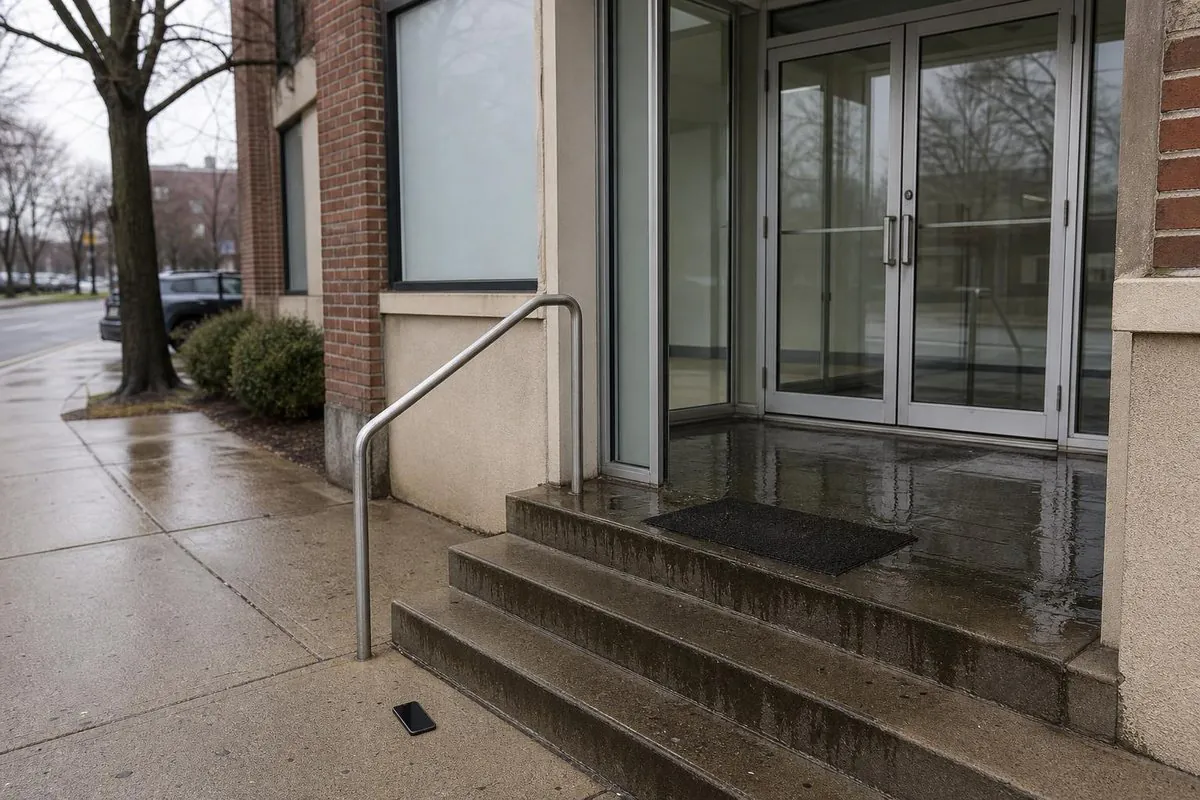
A wet entrance can turn an ordinary errand into a painful injury—fast. In Yonkers, this tends to happen in exactly the places where people move quickly and look up instead of down: vestibules, revolving-door areas, tile just past the inner doors, and the “two steps where you transition” from outdoor weather to indoor shopping. On a rainy day along Central Park Avenue, during winter slush season near parking decks, or when crowds track water through an entryway, the hazard can be present for minutes—and then disappear when staff mop, swap a mat, or reposition a cone.
If you’re physically able (or with help from a friend), your goal is simple: preserve accurate, time-sensitive evidence before the scene changes. That does not mean arguing with staff, blocking cleanup, or making accusations. It means calmly capturing what you saw—quickly, safely, and in a way that later helps answer questions like: Where was the water? How large was it? Were mats and warnings in place? Was the wet area in the normal walking path?
Not legal or medical advice. This article is general information for New York. If you have severe pain, a possible head injury, numbness, or you can’t bear weight, seek medical care right away.
BILLY COOPER LAW

The “first 3 minutes” plan: document without getting in anyone’s way
Wet-entrance evidence is perishable. Once the floor is mopped or the mat is moved, a later dispute can become “Was it really wet there?” or “How wet was it?” A good approach is to use your phone like a scene camera and work in this order:
- Safety check (10–20 seconds). If you might be seriously hurt, call 911 or ask someone nearby to call. If you hit your head, treat it seriously even if you feel “okay.”
- One continuous “orientation” video (10–20 seconds). Start recording from a few steps back and capture: the doors you used, the vestibule, your path of travel, and the general area where you slipped.
- Wide photos (30–60 seconds). From multiple angles, capture fixed landmarks: door frames, aisles, service desk, a visible clock, or a sign. The point is to make the location unmistakable.
- Close-up photos (30–60 seconds). Capture what makes the floor slippery: puddling, sheen on tile, track marks, saturated mat edges, curled mat corners, and the “gap” between mat coverage and the spot where your foot lost traction.
Practical phone tips that make your images more useful
- Don’t zoom first. Step back, capture the area, then move in.
- Use light to reveal shine. If the floor has a reflective surface, low-angle video (tilting slightly downward) often shows a wet “sheen” better than a straight-down photo.
- Include a reference object without altering the scene. If something is already on the ground (your receipt, a shopping bag, a cart wheel nearby), wide photos can help show scale—without you moving anything.
- Don’t stage the hazard. Don’t spread water, don’t reposition mats, and don’t move cones. Document what’s there.
What matters most in a wet-entrance slip-and-fall (New York context)
New York premises-liability claims often turn on whether the responsible party used reasonable care to keep the property safe under the circumstances, and whether they created the hazardous condition or had actual or constructive notice of it.
That legal framework is one reason the best documentation doesn’t stop at “there was water.” Strong documentation tends to show:
- The walking path: where a typical customer steps immediately after entering
- The hazard’s visibility: whether the wetness could be seen (sheen, puddle edges, track marks)
- The size and placement: wet area relative to doors, mats, registers, and main traffic routes
- Warnings and precautions: cones, caution signs, umbrella bag stations, runners, mats (including whether mats were bunched, undersized, or saturated)
You’re not required to “prove the whole case” at the doorway. You’re trying to preserve the facts that are hardest to reconstruct later.
Don’t wait for permission—but do stay respectful
A common worry is: “Am I allowed to take pictures in a store?” A private business can set and enforce policies, and staff may ask you to stop or to move. The best practice is to take a few quick photos/video immediately, then comply with reasonable instructions.
If staff are cleaning for safety, don’t interfere. You can say something as simple as:
- “I understand you need to clean it. I’m just taking a few photos of the area where I slipped.”
In many situations, 20–40 seconds of calm documentation is all you get.
Preserve the other evidence people forget: shoes, clothing, and your notes
Wet-entrance cases are often argued around traction, mats, and whether the wet area was “substantial” versus momentary. Preserve what you can:
- Shoes: photograph the soles and tread; don’t scrub them.
- Clothing: if you landed on a wet floor, photograph damp areas on pants/coat.
- Same-day note: write a short, time-stamped note on your phone with: which entrance, where you fell (“two steps past inner doors, right edge of mat”), the direction you were walking, and what you observed.
Also save proof you were there (digital receipt, bank alert, loyalty-app check-in). A time anchor can matter when the store later checks cameras.
Ask for an incident report—and keep your description factual
Reporting the incident is often the moment a store’s internal documentation begins. Even if they won’t give you a copy, you can write down the basics:
- Manager’s name and title
- Exact time you reported it
- Whether they took photos
- Any report/claim number
- Whether you requested camera footage preservation
Stick to what you personally observed (“water on tile just beyond the mat,” “no cone in that area,” “mat ended before the wet zone”). Avoid guessing about causes (“a pipe must have leaked”). If you’re unsure, say you’re unsure.
Move quickly to preserve surveillance video (it can be overwritten)
Many Yonkers retail entrances have multiple cameras: outside-facing, vestibule, inside-facing, and sometimes a camera aimed toward checkout lanes that still captures the doorway area. Video is often overwritten on a routine schedule.
If you can, ask (politely) the same day:
- Whether the entrance is covered by cameras
- That footage be preserved for a specific time window (for example, 30–60 minutes before and after the fall)
Then follow up in writing as soon as possible (often through counsel) to the correct corporate entity or risk department. Specificity helps: location, date, time, entrance name, and camera areas.
When Yonkers location details matter (and how to capture them)
A local detail that frequently becomes important: Yonkers shopping areas often have multiple access points—street entrance, parking-garage entrance, side doors near loading zones, or mall/connected-tenant entrances.
To avoid “wrong doorway” confusion later, document:
- Which door you used (street vs garage; north vs south entrance)
- Any visible store signage or suite number near that door
- Whether the wet area was in the vestibule (between doors) or inside the sales floor
Also consider the “transition surfaces” common in the area: metal threshold strips, rubber runners, tile-to-mat changes, and sloped entry ramps. A wide shot capturing the whole transition area can be more valuable than ten tight close-ups.
Deadlines are not evidence-preservation timelines
Even when New York’s filing deadline is measured in years, the “real” deadline for evidence is often days—or less. Video can be overwritten, mats get swapped, and the entryway returns to normal.
Also, if the fall occurred on public property or involved a public entity (for example, a municipal facility), New York may require a notice of claim on a much shorter timeline than typical private-property cases.
How Billy Cooper Law can help after a wet-entrance fall
If you slip at a wet store entrance in Yonkers, the floor may be cleaned before you have a chance to understand what caused the fall. You may have photographs but still be unsure who was responsible for the mats, inspections, or warnings. At Billy Cooper Law, we help injured shoppers investigate those questions and preserve the available evidence.
We review the entrance layout, photographs, witness accounts, incident reports, and available surveillance video, and examine relevant cleaning or inspection records. We consider who controlled the area and what the evidence shows about notice of the condition. We also gather medical information to document the injury and explain the legal options and deadlines that may apply, while keeping the focus on the actual circumstances of your fall.
Related Billy Cooper Law resources (premises / slip-and-fall)
- Premises liability
- Yonkers slip and fall
- Parking lot falls
- Sidewalk falls
- Residential building accidents
- Home fall injuries
- Westchester County personal injury
BILLY COOPER LAW
NOTABLE RESULTS
Billy Cooper Law publishes the following results. This is a broader unsafe-property outcome involving maintenance of a rental home, rather than a slip-and-fall or sidewalk recovery.
$970,000 settlement
Read more about these results
- $970,000 settlement: Rental-home explosion attributed to improper maintenance caused injuries and wrongful death in Westchester County. Read the source account.
Read the firm’s published results
Prior results do not guarantee a similar outcome. Each case is different and must be evaluated on its own facts.
Published Writings by William Cooper
Related reading on preserving video evidence in injury cases:
- When the Video Disappears: Liability, Missing Footage, and the Modern New York Injury Case — Billy Cooper, New York Law Journal, June 23, 2026.
WHAT OUR CLIENTS SAY
General feedback about working with Billy Cooper Law:
“Wonderful experience. Very knowledgeable and responsive!”
— Lara C.
“He cares. He just cares.”
— Carmelo Curra
Professional Recognition

Recognition applies to the named attorneys and selection years. See the linked profiles for details.
Yonkers slip-and-fall documentation FAQs (New York)
These FAQs are general educational information for New York slip-and-fall scenarios, tailored to the practical reality that a wet Yonkers entrance can be cleaned or changed quickly. If you’re hurt, prioritize medical care first, then document what you can safely document.
What should I photograph first after a wet entrance fall in Yonkers?
Start with context that anchors location—because the entrance may look different minutes later. If you can safely do so, take a short continuous video showing: outside conditions near the door, the vestibule, the exact entry path, and where you slipped. Then take wide photos from multiple angles that include fixed landmarks (door frames, displays, service desk) so it’s unmistakably the correct entrance.
Next, take close-ups that show the hazard itself: puddling, wet sheen on tile, track marks, saturated mat edges, curled mat corners, and the distance between mats/warnings and the wet zone. New York cases discussing constructive notice commonly turn on whether the condition was “visible and apparent” and how long it was present—so your images should show where the water was, how extensive it was, and how a shopper would encounter it.
Sources: Marte v Tishman Constr. Corp. (2024 NY Slip Op 00231), Aberger v Camp Loyaltown, Inc. (2021 NY Slip Op 01188), New York Premises Liability Lawyer | Billy Cooper Law
Should I request an incident report, and what details should it include?
Yes. Ask a manager to make an incident report, and ask for a reference number or the manager’s name and title so you can identify the report later. Even if the store won’t provide a copy immediately, you can write down the essentials: the exact time you reported it, which entrance it happened at (street vs garage, etc.), and where you fell (“two steps past inner doors, at the right edge of the mat”).
Keep your description factual and specific. A useful way to organize details is the same basic structure New York law requires in many municipal notices: time, place, and manner (what happened and where), plus the injuries you’re aware of. In a store setting, also note whether warning cones/signs were present, whether mats were in place and how far they extended, and whether you requested preservation of security video. Those details can help keep everyone focused on the same facts later.
Sources: NYS Open Legislation | NYSenate.gov (General Municipal Law § 50-e), New York Premises Liability Lawyer | Billy Cooper Law
How can I preserve security video before it’s overwritten?
Treat surveillance footage like a melting ice cube: it may exist now, and it may be gone soon. Ask a manager the same day whether the entrance area is covered by cameras and request that video from a defined window (often 30–60 minutes before and after the incident) be preserved. Then follow up in writing to the correct entity (corporate office, risk department, property manager), identifying the store location, entrance used, time range, and camera areas (outside-facing, vestibule, inside-facing).
New York courts discuss spoliation standards and the duty to preserve evidence—especially electronic information—once litigation is reasonably anticipated. While you can’t force a business to hand over footage on demand, a prompt, specific written request helps show that preservation was raised early. If the case later becomes disputed, counsel may use formal discovery tools and court procedures to seek video and related records (like inspection/cleaning logs).
Sources: VOOM HD Holdings LLC v EchoStar Satellite L.L.C. (93 AD3d 33) (Official Reports PDF), Pegasus Aviation I, Inc. v Varig Logistica S.A. (26 NY3d 543) (Official Reports PDF), New York Premises Liability Lawyer | Billy Cooper Law
Do I need to prove the store knew about the water to have a New York slip-and-fall claim?
Often, yes—in the sense that notice is frequently a core issue. Many New York slip-and-fall cases focus on whether the responsible party created the condition or had actual notice or constructive notice of it. Constructive notice arguments typically examine whether the condition was “visible and apparent” and existed long enough for staff to discover and fix it.
That’s why wet-entrance documentation isn’t just about proving “the floor was wet.” Your photos/video should help show where the water was, how extensive it appeared (track marks versus a tiny fresh drop), and what safety measures were (or weren’t) present (mats, cones, warnings). Even if no one saw you fall, evidence like surveillance video, cleaning logs, and your immediate photographs may help establish what the entrance looked like before it was changed.
Sources: Steisel v Golden Reef Diner (2008 NY Slip Op 31837(U)) (NY Official Reports PDF), Marte v Tishman Constr. Corp. (2024 NY Slip Op 00231), New York Premises Liability Lawyer | Billy Cooper Law
What if it was raining or snowing—does that change how a wet entrance case is evaluated?
Weather can matter a lot in New York because courts often apply the “storm in progress” doctrine in snow-and-ice cases. In general terms, the rule is commonly described as relieving (or suspending) a property owner’s duty to remedy storm-related slippery conditions while the storm is ongoing and for a reasonable time afterward. Whether the doctrine applies can be fact-specific—what kind of precipitation, when it started/stopped, and what the condition actually was.
Rain and tracked-in moisture can also raise practical questions: was the wetness the kind of routine dampness you’d expect right at the door, or was it unusually extensive (for example, a large pooling area beyond the mat coverage)? Your documentation helps by showing the exact location and extent of wetness, whether mats and warnings were reasonably placed, and whether the slippery area was in the normal travel path for shoppers entering from a garage or street.
Sources: Isabel v New York City Hous. Auth. (2019 NY Slip Op 02506), Battaglia v MDC Concourse Ctr., LLC (2020 NY Slip Op 01115), New York Premises Liability Lawyer | Billy Cooper Law
How long do I have to file a slip-and-fall lawsuit in New York?
Many New York negligence cases seeking damages for personal injury—including many slip-and-fall cases—are commonly subject to a three-year statute of limitations measured from the date of the accident. New York Courts publish a statute-of-limitations timetable that lists “Slip and fall” under a three-year period and references CPLR 214(5). The New York State Senate’s Open Legislation site publishes the CPLR provisions.
Two important cautions: (1) different facts can trigger different deadlines, and (2) the legal filing deadline is not the same as the evidence deadline. Video may be overwritten quickly, the entrance configuration may change, and witnesses may become hard to locate. So even if you believe you have time, it’s usually wise to preserve evidence and get legal guidance early—especially if you’re unsure whether a public entity, transit agency, or contractor controlled the area.
Sources: Statute of Limitations Timetable | New York Courts, NYS Open Legislation | NYSenate.gov (CPLR § 214)
What if I fell at a Yonkers municipal building, park facility, or other public property?
If a public entity may be responsible, timelines can be much shorter than the typical three-year negligence period. New York’s General Municipal Law contains provisions requiring a notice of claim in many tort cases against public corporations, and it commonly must be served within 90 days in covered situations. Separate provisions address requirements for starting the lawsuit and include a “one year and ninety days” commencement requirement in many municipal-defendant cases.
The practical Yonkers challenge is identifying the correct party early. Depending on the location, the responsible entity might be the City of Yonkers, Westchester County, a public authority, or another public body—and serving the wrong entity wastes time. If you fell at a municipal building entrance, a park facility, or another government-controlled location (or you’re not sure who controls it), it’s worth confirming notice requirements immediately so you don’t lose rights while focusing on recovery.
Sources: NYS Open Legislation | NYSenate.gov (General Municipal Law § 50-e), NYS Open Legislation | NYSenate.gov (General Municipal Law § 50-i), Westchester County, NY Personal Injury Lawyer | Billy Cooper Law
Is it okay to record video or audio in New York while I document the scene?
Generally, photos and silent video focused on the floor condition (wet tile, mats, cones, entrance layout) are the least risky way to document what happened. Audio recording raises separate issues because New York’s eavesdropping laws focus on recording certain communications without consent, and the statutory definitions and offense provisions are found in New York Penal Law Article 250.
If you do record audio, the safest practice is to avoid capturing conversations you are not part of, avoid filming into back rooms or employee-only areas, and comply if staff ask you to stop recording or to move. In many cases, you can still document effectively with silent video, still photos, and a written note made immediately after the incident. If you need to preserve what someone told you, you can write it down (who said it, when, and the exact words you remember) rather than trying to record a private conversation.
Sources: NYS Open Legislation | NYSenate.gov (Penal Law § 250.00), NYS Open Legislation | NYSenate.gov (Penal Law § 250.05), New York | The Reporters Committee for Freedom of the Press
I hit my head but felt “fine”—what symptoms should prompt medical attention?
Head injuries can be deceptive. The CDC notes that symptoms of mild traumatic brain injury (mild TBI) or concussion can appear right away or may not show up for hours or days, and it urges people to seek emergency care if danger signs are present. The NIH similarly advises seeking medical attention right away if symptoms of traumatic brain injury appear, especially within the first 24 hours after a head injury.
Practical takeaway: if you struck your head, tell a medical provider exactly what happened (including any loss of consciousness, confusion, nausea, worsening headache, repeated vomiting, unusual behavior, or problems with coordination). If you live alone, consider asking someone to check on you. Even if your fall started as “just a slip,” prompt evaluation can protect your health and also creates a contemporaneous medical record describing the mechanism of injury.
Sources: Symptoms of Mild TBI and Concussion | CDC, Traumatic Brain Injury (TBI) | NIH Health, Traumatic brain injury: MedlinePlus Medical Encyclopedia
What local Yonkers/Westchester resources can help right after a fall?
For a true emergency, call 911. For urgent help in the City of Yonkers, the City’s Yonkers Police Department page lists the department’s non-emergency number and also discusses mobile 911 call routing and a direct emergency line. While police are not typically needed for routine store incidents, knowing the right contact channel can matter if there’s an immediate safety concern or you need assistance.
For medical evaluation, consider going to the closest emergency department appropriate for your symptoms. Local options include emergency services information published by Westchester Medical Center Health Network and St. John’s Riverside Hospital in Yonkers. If you later need help navigating Supreme Court processes (for example, understanding forms or where to go), New York Courts lists the Westchester County Supreme Court Help Center in White Plains with its address and contact information.
Sources: Police Department | Yonkers, NY, Emergency Services – Westchester Medical Center Health Network, Emergency – St. Johns Riverside Hospital, Westchester County Supreme Court Help Center | New York Courts
BILLY COOPER LAW


Get the Answers You Need
At Billy Cooper Law, every day we renew our pledge to help injured people get the justice and compensation they deserve. We have a reputation throughout New York and nationally for standing up for our clients, and we take that responsibility seriously by approaching every case with preparation, persistence, and an unwavering commitment to results.

Related Billy Cooper Law Videos and Social Posts