
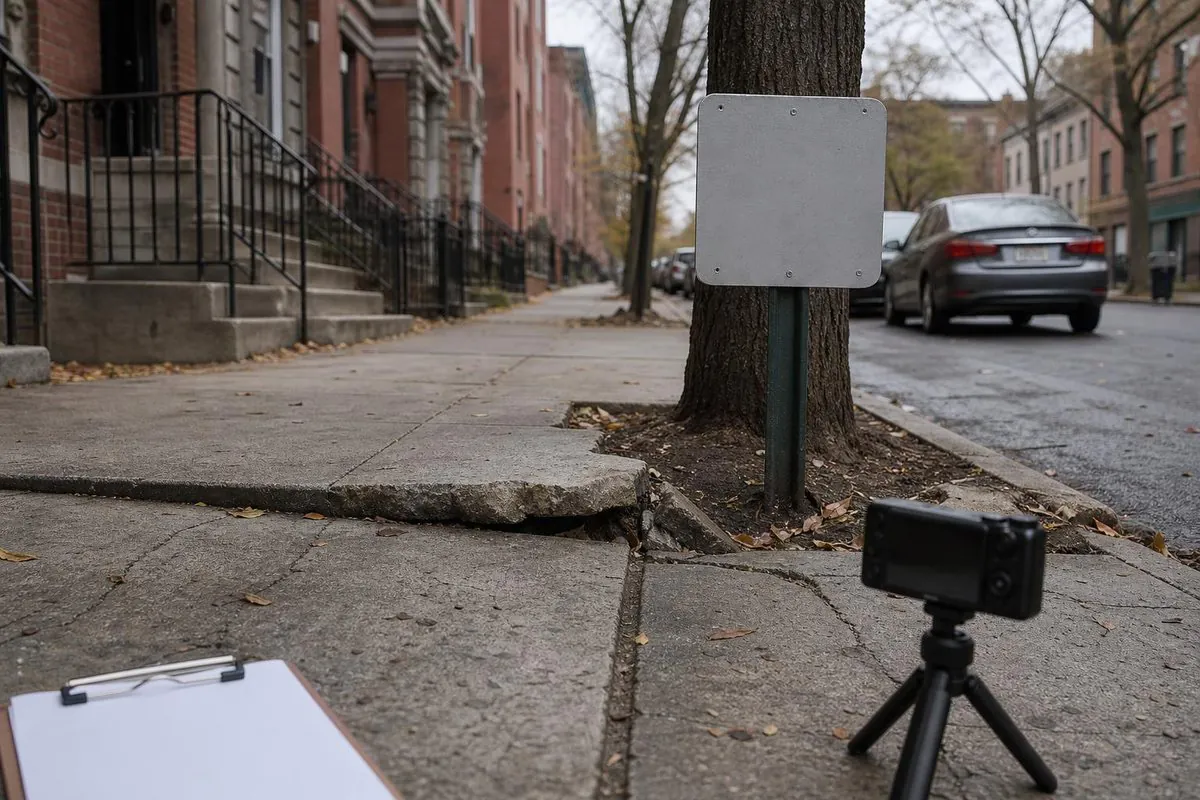
A Bronx trip-and-fall claim can rise or fall on evidence you may not know exists—official NYC records created when a sidewalk defect is inspected, cited, reported, or repaired. In New York City, these records matter because sidewalk conditions change fast. A “trip hazard” you photograph a week later may be patched, ground down, plated over, or fully replaced.
NYC “sidewalk notices” are not one single document. They’re a collection of verifiable paper trails that can help answer the investigation questions that decide many premises liability cases:
- Who legally had the maintenance duty at this exact spot?
- Was liability shifted to an abutting property owner, or could NYC be involved?
- If NYC could be a defendant, can you prove the kind of “prior written notice” NYC law often requires?
- Did a contractor or utility perform street work that may have created or worsened the defect?
Below is a New York State–focused, Bronx-specific guide to how sidewalk notices can help investigate a trip-and-fall claim—what to look for, what to request, and what deadlines to treat as urgent.
BILLY COOPER LAW

What counts as a “sidewalk notice” in NYC (and what usually doesn’t)
In everyday life, “notice” might mean cones, caution tape, or a handwritten sign. In a legal investigation, a useful sidewalk notice is typically a record that is (1) tied to a specific location, (2) tied to a specific condition (crack, uneven flag, collapse, hardware trip hazard, snow/ice), and (3) created or kept in the regular course of agency or business activity.
Common NYC sidewalk-notice sources include:
- NYC DOT sidewalk enforcement records, including Notices of Sidewalk Violation.
- NYC’s defect “prior written notice” records when the City might be a defendant.
- Big Apple maps (in some cases) when prior written notice is being litigated.
- NYC311 service requests and the related NYC Open Data dataset (often best used as timeline “leads”).
- DOT street-work permits and street-work documentation identifying contractors/utilities.
- FOIL/OpenRecords responses that produce the above records in usable form.
Not every “notice” is legally equal. A 311 entry may help you find where to dig, but it may not satisfy a legal prior-written-notice rule by itself. Likewise, a DOT violation can strongly support that a defect existed, but it does not automatically prove the defect caused the fall or that a defendant breached a duty.
A Bronx-specific reality: sidewalks can change quickly, especially on major corridors
Bronx sidewalk conditions can shift rapidly because high-foot-traffic areas attract repeated repairs and street work. NYC has also publicly announced major corridor changes in the Bronx. For example, NYC announced that construction began on a Fordham Road redesign on July 22, 2026, adding offset bus lanes and related street changes. Even if your injury has nothing to do with that project, it illustrates a key point for evidence: by the time an injured person returns to the scene, the walking surface may already be different.
Because conditions can be altered quickly, the most reliable “time-stamps” often come from official records—violations, permits, inspection logs, and written acknowledgements—paired with early photos and medical documentation.
The legal starting point in NYC: Administrative Code § 7-210 shifts many sidewalk cases to the abutting owner
In New York City, sidewalk liability is heavily shaped by NYC Administrative Code § 7-210. The New York Court of Appeals has explained that § 7-210 unambiguously imposes a duty on certain real property owners to maintain sidewalks abutting their land in a reasonably safe condition, and that the statute imposes liability for personal injury claims arising from an owner’s negligent sidewalk maintenance (including, in the Court’s discussion, negligent failure to remove snow and ice). In that same decision, the Court quoted § 7-210’s text describing the duty, the liability rule, and the statutory exception for certain owner-occupied one-, two-, or three-family residential property used exclusively for residential purposes.
For Bronx investigations, § 7-210 changes the “who do we sue?” question. Your attorney often begins with the exact accident location, identifies the abutting parcel, and then evaluates property type, occupancy, and whether the sidewalk segment is tied to a corner quadrant. In practice, a sidewalk-notice paper trail (e.g., a DOT violation) can help identify who DOT treated as the responsible party and when the condition was formally documented.
When NYC might still be involved: Administrative Code § 7-201(c)(2) and “prior written notice”
Even in a city where § 7-210 shifts many sidewalk claims to private owners, the City can still be implicated in certain scenarios (for example, where City property or City work is at issue, or where an exception to § 7-210 may apply). When NYC is a potential defendant for a defect claim, NYC’s prior written notice statute frequently becomes the gatekeeper.
Administrative Code § 7-201(c)(2) provides, in substance, that many defect-based injury suits against NYC cannot be maintained unless written notice of the defective, unsafe, dangerous, or obstructed condition was actually given to the Commissioner of Transportation (or an authorized recipient), or certain alternatives apply, and there was a failure or neglect within fifteen days after receipt of notice to fix or make the location reasonably safe. Related provisions in § 7-201 address DOT recordkeeping, including indexed records and written acknowledgements.
Appellate decisions discuss this framework and explain that once a municipal defendant makes a prima facie showing of lack of prior written notice, the burden shifts to the plaintiff to raise an issue of fact or demonstrate a recognized exception (commonly discussed as affirmative creation of the defect through negligence or special use).
How NYC DOT sidewalk violation records can help investigate a Bronx trip-and-fall
A NYC DOT Notice of Sidewalk Violation can be one of the most useful “sidewalk notices” because it is DOT documenting a defect at a specific location.
NYC DOT’s sidewalk guidance explains that NYC relies on property owners to maintain sidewalks adjacent to their property and that property owners are potentially liable for personal injuries caused by failure to maintain sidewalks free of defects. DOT also explains that a property owner has 75 days to make a repair after a Notice of Sidewalk Violation is received and that DOT may have work performed and the Department of Finance bill the owner if repairs aren’t completed.
NYC DOT’s published property owner guide adds details that can matter to an injury investigation:
- It states there is no fine or penalty associated with a sidewalk violation.
- It states a copy of the notice is filed with the County Clerk and remains on file until the Clerk receives official notification that satisfactory repairs were made.
For a Bronx trip-and-fall claim, these records can help anchor a timeline, point to related inspection materials, and support a case theory when the sidewalk is repaired soon after the incident.
Big Apple maps: potentially helpful, but only if the map matches the defect
Big Apple maps are most relevant when the City’s prior written notice is in dispute. Courts have recognized that a Big Apple map submitted to NYC DOT may serve as prior written notice of a defective condition in appropriate cases. But the New York Court of Appeals has emphasized the key limitation: the notice must correspond to the defect that caused the injury. A mismatch between the coded symbol and the alleged defect can defeat a claim of prior written notice.
In practical terms, that means a Bronx investigation involving NYC often requires: the correct pre-incident map for the precise location, the legend/symbol definitions, and proof tying the symbol to the same defect (not just something “nearby”).
Permits and street-work records: finding the contractor/utility layer
Even when an abutting owner has a statutory sidewalk duty, street work can bring additional responsible parties into the picture. Patchwork flags, temporary plates, protruding hardware, restoration seams, and similar issues sometimes appear after utility or contractor work.
NYC DOT’s Street Works Permits guidance explains that DOT permits and construction-related procedures are addressed through DOT’s permitting systems and the Street Works Manual. Those records can help identify who was permitted to work at or near the location, the timing, and the type of work. Permits do not automatically prove fault, and they are not a substitute for NYC’s prior written notice rules. But they are often one of the fastest ways to identify a third party whose work may be relevant.
NYC311 and NYC Open Data: use them as leads and timeline builders
NYC311 provides public guidance about sidewalk violations and how to request or follow up on a violation. Separately, NYC publishes a 311 service request dataset through NYC Open Data (“311 Service Requests from 2010 to Present”), and NYC has published update notes explaining changes to the dataset structure.
For Bronx investigations, 311 records can be useful to establish a basic chronology: who complained, what category the City used, which agency was routed the complaint, and whether the location had repeated reports. But 311 is usually best treated as a lead generator—then followed by FOIL/OpenRecords requests for the underlying DOT records.
FOIL/OpenRecords: the formal path to sidewalk-notice records
NYC DOT’s FOIL page confirms that the public can request DOT records under New York’s Freedom of Information Law and strongly recommends submitting FOIL requests electronically via NYC’s OpenRecords Portal. Because sidewalk evidence can change quickly, timely FOIL/OpenRecords requests can be important.
For a Bronx sidewalk trip-and-fall claim, common record targets include: sidewalk violation documentation, inspection history, repair/work orders, Big Apple map references (when applicable), and street-work permit-related records for the location and time window.
Practical next steps after a Bronx sidewalk trip-and-fall (evidence-focused)
If you can do so safely, or with help, these steps often make sidewalk-notice investigations more effective:
- Record the exact location (address and cross streets) and photograph a building number/storefront.
- Photograph the scene as soon as possible: wide shot + close-up + something for scale.
- Write down conditions: lighting, weather, crowding, obstructions, and the exact “trip point.”
- Preserve footwear and clothing.
- Identify witnesses and obtain contact info.
- Note any visible signs of recent street work (fresh concrete, plates, cones, saw-cuts, construction fencing).
- Consider early record requests (311 leads + FOIL/OpenRecords for DOT records).
Deadlines: treat them as urgent, especially if NYC might be involved
Most Bronx trip-and-fall cases operate on two overlapping “clocks”:
- CPLR § 214(5) provides a three-year limitations period for many personal injury actions against private defendants, subject to exceptions.
- For claims involving public entities, General Municipal Law § 50-e (notice of claim requirements) and § 50-i (requirements for commencing certain actions) can create much shorter timelines.
NYC’s Comptroller also publishes personal injury claim FAQs describing the notice-of-claim process and emphasizes that notices of claim cannot be filed by email.
Local Bronx public resources (relevance: records, process, and orientation)
If you need general court-directory orientation (not legal advice), New York Courts provides a Bronx County Civil Court directory and lists the address as 851 Grand Concourse, Bronx, NY 10451. New York Courts also provides a Bronx County Supreme Civil Court Help Center page at the same address.
For records gathering, NYC DOT’s FOIL guidance and NYC OpenRecords are directly relevant for obtaining DOT records tied to sidewalk violations, inspections, and written notices.
How Billy Cooper Law investigates Bronx sidewalk injuries
After a fall on a Bronx sidewalk, you may be unsure who was supposed to repair the defect or whether anyone had already reported it. A sidewalk notice can be useful, but it may not identify every responsible party or prove that the same condition caused your fall. At Billy Cooper Law, we investigate the location and the records that may help answer those questions.
We review available DOT notices, permits, complaint and repair records, photographs, and witness accounts, and consider whether further records should be requested through FOIL. We examine who owned or controlled the area, how the condition developed, and which notice requirements may apply. We also document your injuries and explain the available legal options rather than treating one violation record as the entire case.
Our firm serves injured clients in the Bronx, New York City, Westchester, and Rockland County. William H. Cooper was admitted in New York in 1991 and has received Super Lawyers recognition for 2024–2026. Those qualifications and the firm’s reported verdicts and settlements provide background for evaluating counsel; responsibility in your case still depends on its facts and applicable law.
Learn more about our firm and related services: Premises Liability; Sidewalk Accidents; Commercial Buildings and Businesses; Residential Buildings; Fordham (Bronx) Slip and Fall.
BILLY COOPER LAW
FAQs: NYC sidewalk notices and Bronx trip-and-fall investigations
These FAQs provide general information about NYC sidewalk notices and evidence-gathering steps commonly used in Bronx trip-and-fall investigations.
What is a NYC DOT Notice of Sidewalk Violation, and what can it show in a Bronx trip-and-fall claim?
A NYC DOT Notice of Sidewalk Violation is an official notice issued to a property owner stating DOT found the sidewalk defective. In a Bronx trip-and-fall investigation, it can help show that DOT formally documented a defect at or near a specific address and may support a timeline for when the condition existed.
A violation is not automatic proof that the defect caused your fall or that the owner acted negligently. But DOT explains that owners have a repair window after receiving a violation, and the City’s sidewalk guide explains that violations are filed with the County Clerk until satisfactory repairs are officially recorded—details that can help investigators “time-stamp” what happened.
Sources: NYC DOT – Sidewalks; NYC Sidewalks: A Property Owner’s Guide to Address Sidewalk Defects (PDF).
How can I try to obtain sidewalk violation records tied to a Bronx address?
A practical starting point is NYC311’s Sidewalk Violation and Repair guidance, which explains how to request or follow up on an existing sidewalk violation or lien and how to request a copy of a violation. If you have a violation number, that can make the request easier; if not, the exact address and date range become more important.
For more detailed records, NYC DOT’s FOIL page explains that the public may request DOT records under FOIL and strongly recommends submitting requests electronically through NYC’s OpenRecords Portal. FOIL/OpenRecords requests can be used to seek DOT inspection history, violation documentation, and repair-related records linked to the location.
Sources: Sidewalk Violation and Repair · NYC311; NYC DOT – Freedom of Information Law Requests; OpenRecords Portal – Records.
Who is usually responsible for a Bronx sidewalk trip-and-fall: the City or the abutting property owner?
In NYC, the analysis often begins with Administrative Code § 7-210. The New York Court of Appeals has explained that § 7-210 imposes a nondelegable duty on certain real property owners to maintain City sidewalks abutting their land in a reasonably safe condition and quoted the statute’s duty and liability language.
The Court also quoted the statute’s exception for certain owner-occupied one-, two-, or three-family residential property used exclusively for residential purposes. Because Bronx neighborhoods include mixed-use buildings, corners, and 1–3 family homes, responsibility is frequently determined by exact location, property type, and control—not assumptions.
Sources: Xiang Fu He v Troon Mgt., Inc., et al., No. 73 (NY Court of Appeals Oct. 24, 2019) (PDF); NYC DOT – Sidewalks.
If NYC might be a defendant, what does “prior written notice” mean for a sidewalk defect claim?
NYC’s prior written notice rule is a major issue in defect cases against the City. Court decisions summarize that Administrative Code § 7-201(c)(2) requires plaintiffs to show NYC received prior written notice of the alleged defect as a prerequisite to maintaining an action, and the statute’s text is frequently quoted in those decisions.
Related provisions of § 7-201 address DOT’s notice-record system, including indexed records and acknowledgements. Appellate decisions also describe the framework and recognize limited exceptions (commonly discussed as affirmative creation of the defect or special use). Which rule applies in a Bronx case depends on the facts and the record trail.
Sources: II. PRIOR WRITTEN NOTICE (2024 NY Slip Op 36106) (PDF); Legislation Text – Int 0192-2002; Morejon v New York City Tr. Auth. (2023 NY Slip Op 03007).
Can Big Apple maps help prove NYC had prior written notice of a Bronx sidewalk defect?
In some cases, yes. Appellate courts have stated that a Big Apple map submitted to NYC DOT may serve as prior written notice of a defective condition. Big Apple map issues tend to appear when NYC is a potential defendant and the case turns on whether qualifying written notice existed before the incident.
But Big Apple maps are only helpful if the map symbol and location match the defect that allegedly caused the fall. The New York Court of Appeals has emphasized that notice must correspond to the defect on which the claim is based, so “a symbol nearby” or a symbol describing a different condition may not be enough.
Sources: Ghumann v City of New York (Appellate Division, Second Department) (PDF); New York Reports, 3d Series, Volume 11 (includes D’Onofrio v City of New York, 11 NY3d 581).
What street-work records can help identify a contractor or utility in a Bronx sidewalk trip-and-fall investigation?
Street-work records can matter when a trip hazard may be connected to restoration work, patchwork, plates, or hardware left after utility or contractor activity. NYC DOT’s Street Works Permits page explains that construction-related DOT permits are addressed through DOT’s permitting systems and points to the Street Works Manual for broader guidance.
The Street Works Manual contains permit and construction-management information that can help investigators understand what types of permits apply and what documentation may exist for a work location. Permit records are not the same thing as “prior written notice” for NYC defect claims, but they can be critical for identifying the entities that performed work at the location and the timing.
Sources: NYC DOT – Street Works Permits; Street Works Manual New York City Department of Transportation (PDF).
How can NYC311 and NYC Open Data help build a Bronx sidewalk-case timeline (and what are their limits)?
NYC311 guidance can help you understand how sidewalk violations are handled and how to request or follow up on a violation or lien. For timeline-building, NYC Open Data publishes a 311 service request dataset that can help show whether a location had repeated complaints and how requests were categorized and routed.
However, 311 entries are best viewed as investigative leads. Whether NYC had the specific form of notice required for a defect claim against the City is a separate legal question. In practice, attorneys often use 311 and Open Data to identify dates and agencies, then pursue DOT records through FOIL/OpenRecords to obtain the documents that may be needed in litigation.
Sources: Sidewalk Violation and Repair · NYC311; 311 Service Requests from 2010 to Present | NYC Open Data; 311 Service Requests Updates – NYC Open Data.
How do FOIL and OpenRecords requests help obtain NYC DOT sidewalk-notice records?
FOIL is the main tool the public uses to request many NYC agency records. NYC DOT’s FOIL page confirms that the public may request DOT records under FOIL and strongly recommends submitting FOIL requests electronically through NYC’s OpenRecords Portal.
In a Bronx sidewalk trip-and-fall investigation, FOIL/OpenRecords requests are often used to seek DOT inspection history, sidewalk violation documentation, repair/work orders, and street-work-related records tied to the location and time window. Clear location data (address, cross streets) and a defined date range usually improve the quality and speed of responses.
Sources: NYC DOT – Freedom of Information Law Requests; OpenRecords Portal – Records.
What deadlines are most important in Bronx sidewalk injury cases?
For many personal injury actions in New York against private defendants, CPLR § 214(5) provides a three-year limitations period, subject to exceptions and other statutory rules. That timeline often applies when the likely defendants are private property owners, businesses, landlords, or property managers.
If a public entity may be involved, deadlines can be much shorter. General Municipal Law § 50-e addresses notice-of-claim rules in covered cases, and GML § 50-i addresses requirements for commencing certain actions. NYC’s Comptroller also publishes personal injury claim FAQs describing the notice-of-claim process and emphasizing that notices of claim cannot be filed by email.
Sources: NYS Open Legislation | NYSenate.gov – CPLR § 214 Actions to be commenced within three years; NYS Open Legislation | NYSenate.gov – General Municipal Law § 50-e Notice of claim; NYS Open Legislation | NYSenate.gov – General Municipal Law § 50-i Presentation of claims and commencement of actions; Personal Injury Claim FAQs – Office of the New York City Comptroller Mark Levine.
What medical documentation is most important after a Bronx trip-and-fall, and why does it affect the investigation?
Your health comes first, and early medical evaluation can matter even if symptoms seem mild at first. CDC notes that some mild TBI/concussion symptoms may appear right away while others may not appear for hours or days, and CDC advises seeking emergency medical care for danger signs. Peer-reviewed medical literature also describes mild traumatic brain injury as a clinical entity with variable symptoms and recovery patterns.
Falls can also cause wrist fractures. AAOS explains that scaphoid fractures commonly occur after a fall onto an outstretched hand and describes symptoms such as swelling and pain near the base of the thumb. Medical reviews and meta-analyses discuss imaging approaches for suspected scaphoid fractures. From a claim standpoint, timely records help document symptoms, diagnosis, and mechanism.
Sources: Symptoms of Mild TBI and Concussion | Traumatic Brain Injury & Concussion | CDC; Mild Traumatic Brain Injury – PMC; Scaphoid Fracture of the Wrist – OrthoInfo – AAOS; Diagnosing Suspected Scaphoid Fractures: A Systematic Review and Meta-analysis – PMC.
BILLY COOPER LAW
NOTABLE RESULTS
Billy Cooper Law publishes the following results. This is a broader unsafe-property outcome involving maintenance of a rental home, rather than a slip-and-fall or sidewalk recovery.
$970,000 settlement
Read more about these results
- $970,000 settlement: Rental-home explosion attributed to improper maintenance caused injuries and wrongful death in Westchester County. Read the source account.
Read the firm’s published results
Prior results do not guarantee a similar outcome. Each case is different and must be evaluated on its own facts.


Get the Answers You Need
At Billy Cooper Law, every day we renew our pledge to help injured people get the justice and compensation they deserve. We have a reputation throughout New York and nationally for standing up for our clients, and we take that responsibility seriously by approaching every case with preparation, persistence, and an unwavering commitment to results.