
Bushwick NY Slip and Fall Lawyer
A fall can leave you with more than a painful injury. You may be unable to work, unsure who controlled the property, and already receiving calls from an insurance company. Meanwhile, the spill may be cleaned, the broken step repaired, or the security video erased.
Billy Cooper Law represents people injured in slip and trip accidents in Bushwick NY. The firm can determine who was responsible for the property, preserve evidence, and explain the deadlines that apply before you speak with an insurer.
Slip and Fall Lawyers Serving Kings County (Brooklyn)
- Kings County (Brooklyn)
- Bedford-Stuyvesant
- Bushwick
- Crown Heights
- Flatbush
- Williamsburg
- Borough Park
- Bensonhurst
- Sunset Park
- Bay Ridge
- East New York
BILLY COOPER LAW

Why Choose Billy Cooper Law After a Serious Fall?
Slip and fall cases often depend on details that disappear quickly: the condition of the floor, how long a spill was present, when a staircase was last inspected, or who was contractually responsible for clearing ice.
Billy Cooper Law reports that it has represented thousands of people injured in slip and trip accidents. William H. Cooper has practiced in New York since 1991, and the firm reports more than $41 million in verdicts and settlements. Those credentials matter when a fall results in surgery, a lasting disability, or a dispute over whether the property owner had notice of the danger. Learn more about Billy Cooper Law’s premises liability practice. (billycooperlaw.com)
The firm offers free consultations and handles personal injury matters on a contingency basis. There is no upfront attorney’s fee, and the firm is paid only if it obtains compensation for you. Attorney Anieska J. Garcia is bilingual in English and Spanish. (billycooperlaw.com)
Why Bushwick Slip and Fall Cases Require a Local Investigation
A Bushwick fall may happen in an apartment stairwell, outside a mixed-use building, inside a grocery store, on a subway entrance stairway, or beside construction work. Each location raises different questions about ownership and control.
A storefront tenant may maintain the floor inside a business while the building owner remains responsible for structural conditions. A managing agent may oversee an apartment building’s common areas. A contractor may have recently opened or patched the sidewalk. A public authority may control subway property. The name on the awning rarely tells the whole story.
Bushwick’s housing conditions also make building records important. In 2024, the neighborhood had 114.3 serious housing code violations and 384.3 total housing code violations per 1,000 privately owned rental units. Its homeownership rate was 17.1%. Those figures do not prove negligence at any particular building, but they help explain why deeds, management agreements, HPD records, tenant complaints, and repair histories may matter after a residential fall. Review the NYU Furman Center’s Bushwick housing data. (furmancenter.org)
Falls can cause particularly serious harm to older adults. New York City’s 2018 Bushwick Community Health Profile reported 1,261 fall-related hospitalizations per 100,000 residents age 65 and older during 2012–2014. Citywide claim data also shows how often public sidewalks become the subject of injury allegations: in fiscal year 2023, New York City received 2,350 sidewalk personal injury claims and paid $53.5 million in sidewalk claim settlements and judgments. See the Bushwick Community Health Profile and the New York City Comptroller’s Annual Claims Report. (nyc.gov)
Where Slip and Fall Injuries Happen in Bushwick
Apartment buildings
Falls in residential buildings may involve:
- Broken or uneven stairs
- Loose handrails
- Poorly lit hallways
- Wet lobby floors
- Leaking pipes
- Loose tiles or carpeting
- Snow or ice at entrances
- Debris in common areas
- Defective cellar doors or basement steps
New York’s Multiple Dwelling Law § 78 requires multiple dwellings and their lots to be kept in good repair. A claim still requires proof connecting an unsafe condition to the fall, but inspection records, repair requests, text messages to a superintendent, and prior complaints may show what the owner or manager knew. (nysenate.gov)
Stores, restaurants, and markets
A commercial fall may be caused by spilled liquid, tracked-in rain, damaged flooring, loose entrance mats, poorly placed merchandise, or an unmarked change in floor elevation.
These cases often turn on timing. It matters whether an employee created the condition, whether anyone reported it, when the area was last inspected, and whether video shows the hazard before the fall. Cleaning schedules and inspection logs can be important, but they must be compared with what employees actually did.
Sidewalks and building entrances
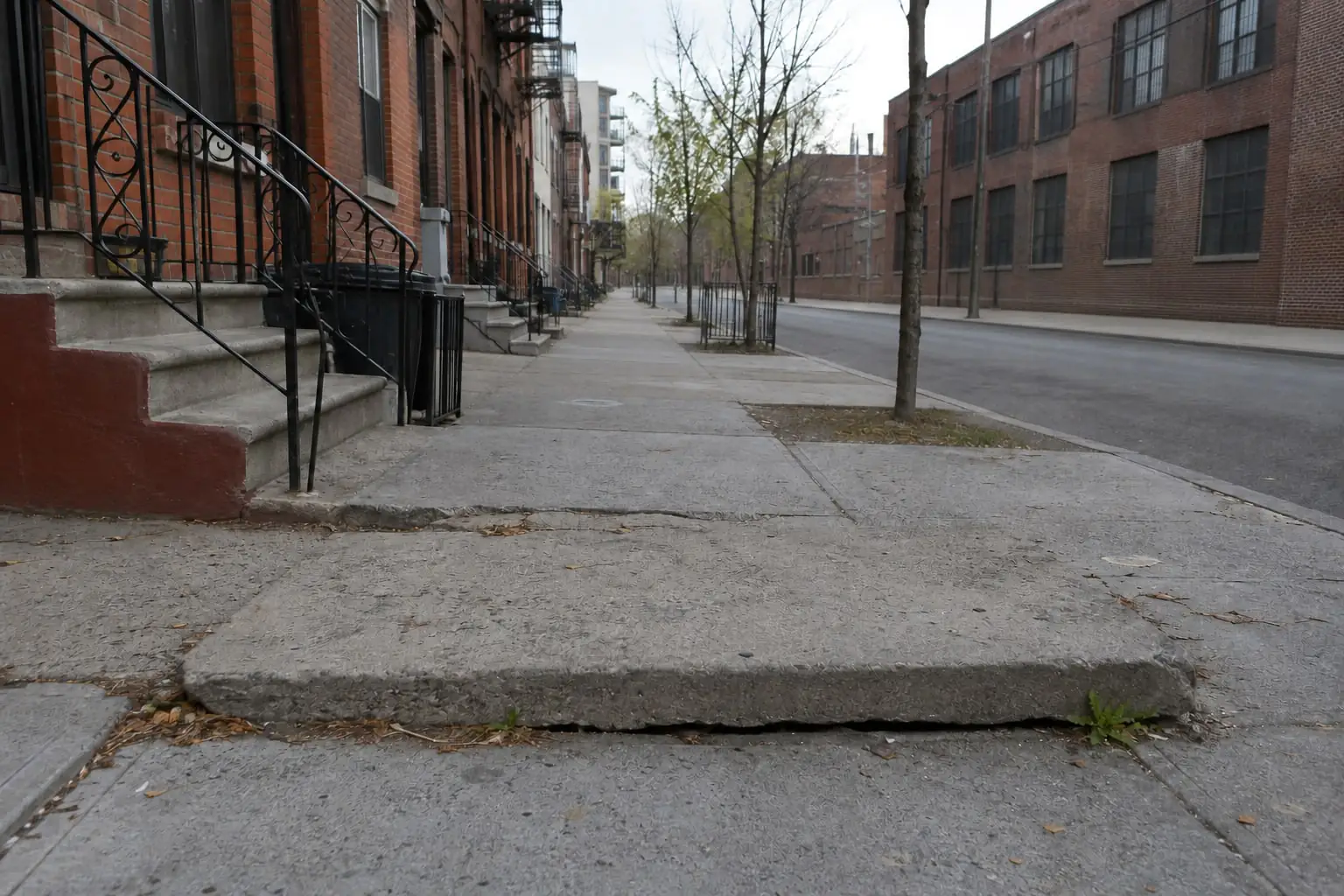
A raised sidewalk flag, cracked pavement, broken curb, cellar door, tree-root condition, utility cover, or temporary asphalt patch may cause a serious trip. The precise location matters because responsibility can change within a few feet.
Under New York City Administrative Code § 7-210, an abutting property owner is generally responsible for maintaining the sidewalk in a reasonably safe condition. An exception applies to qualifying one-, two-, or three-family residential properties that are owner-occupied and used exclusively for residential purposes. Curbs, tree wells, utility structures, subway grates, and work performed by another entity may require a different analysis. (codelibrary.amlegal.com)
Subway entrances and other public property
Bushwick residents use stations along the L, M, J, and Z lines. A fall on station stairs or transit property may involve worn treads, water accumulation, ice, poor lighting, or a defective walking surface.
Transit cases are different from ordinary claims against private property owners. The correct defendant must be identified, and special notice requirements may apply. Station video, maintenance records, incident reports, employee logs, and weather data should be requested quickly.
Slip and Fall Cases Billy Cooper Law Handles
The firm represents people injured in:
- Supermarket and grocery store falls
- Residential building accidents
- Commercial building and business falls
- Sidewalk falls
- Parking lot falls
- Falls inside private homes
- Snow and ice accidents
- Stairway and handrail accidents
- Falls caused by leaks, poor drainage, or inadequate lighting
- Trips over construction debris or temporary pavement
You do not need to know whether your accident should be called a slip and fall, trip and fall, or premises liability case. What matters is what caused you to lose your footing and whether the evidence can still be found.
What to Do After a Slip and Fall in Bushwick
Get medical care
Call 911 for a possible head injury, fracture, spinal injury, severe bleeding, loss of consciousness, or any other emergency. Some injuries become more apparent after the initial shock wears off, so do not assume you are unhurt simply because you were able to stand.
Tell your medical providers how the fall happened and identify every injured area. Follow-up care also matters. Gaps in treatment can affect your health and give an insurer room to argue that the injury was not serious.
Report the accident
Notify the owner, manager, superintendent, or business before leaving, if your condition allows. Ask for an incident report and write down the name and job title of the person who took your report.
Be accurate and brief. Do not guess how long the condition existed, accept blame, or sign a statement you do not understand.
Photograph the condition
Take both close and wide photographs. A close image may show a crack or puddle, while a wider image establishes where it was in relation to the entrance, stairs, storefront, property line, or path of travel.
For a sidewalk fall, photograph the nearest building number, intersection, cellar door, tree well, utility cover, subway entrance, and storefront. That context may determine who controlled the location.
Identify witnesses and cameras
Get names and contact information from anyone who saw the fall or the dangerous condition. Look for cameras on nearby stores, apartment buildings, doorbells, subway property, and construction sites.
Do not assume the footage will be saved. Many systems automatically overwrite recordings.
Preserve what you were wearing
Keep your shoes and clothing in their existing condition. Do not throw them away or continue wearing the shoes. An insurer may later claim that your footwear—not the property condition—caused the accident.
Be careful with insurance calls
A property insurer may ask for a recorded statement or a broad medical authorization. You can provide necessary identifying information without speculating about fault or signing away access to unrelated medical history. Consider speaking with a lawyer first.
Evidence That Can Prove a Slip and Fall Claim
Useful evidence may include:
- Photographs and video of the hazard
- Surveillance recordings
- Witness statements
- Incident and accident reports
- Cleaning and inspection logs
- Maintenance and repair records
- Work orders and invoices
- Complaints from tenants or customers
- HPD and Department of Buildings records
- 311 complaint histories
- Deeds, leases, and property-management agreements
- Snow-removal and salting records
- Weather observations
- Construction permits and contractor records
- Medical records
- Employment and wage records
- The shoes and clothing worn during the fall
The most important evidence varies by case. A grocery-store spill may turn on surveillance and inspection practices. A broken staircase case may depend on repair requests and building records. An ice case may require detailed weather information and snow-removal logs.
What Must Be Proven Under New York Law?
A fall on someone else’s property does not automatically establish negligence. Generally, the evidence must show that a dangerous condition caused the injury and that the responsible party:
- Created the condition;
- Knew about it; or
- Should have discovered it through reasonable inspection and maintenance.
For constructive notice, the condition ordinarily must have been visible and apparent and present long enough to be found and corrected. That rule comes from Gordon v. American Museum of Natural History, a leading New York Court of Appeals decision. (nycourts.gov)
This is why a general statement that “floors sometimes get wet” is rarely enough. The investigation must focus on the specific puddle, defect, loose mat, or accumulation that caused your fall.
What If the Crack or Height Difference Was Small?
New York does not use a fixed measurement that automatically makes every small defect harmless. Courts consider the defect’s dimensions along with its shape, edges, lighting, color contrast, location, surrounding conditions, and effect on people walking through the area.
In Hutchinson v. Sheridan Hill House Corp., the Court of Appeals explained that size alone does not decide whether a defect is too trivial to support a claim. A relatively small condition may still be dangerous when poor lighting, an irregular edge, crowding, or its position in a busy path makes it harder to see or avoid. (nycourts.gov)
Photographs taken soon after the accident are often the best way to preserve those surrounding circumstances.
Snow and Ice Falls in Bushwick
Property owners frequently argue that they did not have to remove snow or ice while precipitation was still falling. New York’s storm-in-progress rule can protect an owner from liability for conditions created during an ongoing storm or for a reasonable period afterward. The exact timing of the snow, sleet, rain, temperature changes, cleanup work, and fall may therefore be decisive. Solazzo v. New York City Transit Authority discusses this rule. (nycourts.gov)
New York City also requires responsible owners, occupants, and others in charge of property to clear snow and ice from public sidewalks within four hours after precipitation ends, excluding the period between 9 p.m. and 7 a.m. The sanitation deadline does not answer every civil-liability question, but it can become part of the investigation. Review New York City Administrative Code § 16-123. (codelibrary.amlegal.com)
Ice may also result from something other than a recent storm. A leaking pipe, defective gutter, poor drainage, or snow pile that repeatedly melts and refreezes can point to a recurring property condition.
BILLY COOPER LAW
Filing Deadlines
Most New York negligence actions for personal injury must be commenced within three years under CPLR § 214. That does not mean waiting three years is safe. Video may be erased within days, and a dangerous condition may be repaired immediately. (nysenate.gov)
Much shorter deadlines may apply when a government entity or public authority controls the property. Under General Municipal Law § 50-e, many claims against public corporations require a Notice of Claim within 90 days. A lawsuit against New York City generally must then be commenced within one year and 90 days under General Municipal Law § 50-i. (nysenate.gov)
Claims against the New York City Transit Authority may also require a 90-day notice and generally have a one-year-and-90-day filing period under Public Authorities Law § 1212. Reporting the fall to a station employee or calling 311 is not the same as serving a legally sufficient Notice of Claim. (nysenate.gov)
What If You Were Partly at Fault?
A property owner or insurer may argue that you were looking at your phone, wearing unsafe shoes, ignoring a warning sign, or failing to see an obvious condition.
For ordinary premises liability cases, New York follows comparative negligence. Under the current CPLR § 1411(a), your share of responsibility generally reduces your compensation rather than automatically eliminating the claim. For example, a finding that you were 20% responsible would ordinarily reduce the recoverable damages by 20%. (nysenate.gov)
New York amended CPLR § 1411 in May 2026 to create a different rule for certain motor vehicle injury actions subject to the no-fault law. That amendment did not replace comparative negligence for an ordinary slip and fall claim.
Who May Be Responsible?
Depending on where and why you fell, potentially responsible parties may include:
- The property owner
- A residential landlord
- A managing agent
- A commercial tenant
- A store or restaurant operator
- A cleaning or maintenance company
- A snow-removal contractor
- A construction contractor
- A utility company
- New York City
- The New York City Transit Authority
- The New York City Housing Authority
- Another public agency
Responsibility is based on ownership, control, notice, and contractual duties—not simply whose name appeared on the building or storefront. An investigation may require deeds, leases, management agreements, service contracts, permits, and insurance policies.
Compensation After a Serious Fall
Compensation may address both the financial and personal effects of the injury, including:
- Emergency care and hospital bills
- Surgery and future medical treatment
- Physical or occupational therapy
- Lost wages
- Reduced future earning ability
- Mobility devices and home modifications
- Transportation and household assistance
- Pain and suffering
- Loss of mobility or independence
- Scarring or disfigurement
- Reduced enjoyment of life
A broken wrist can affect someone who works with their hands. A knee or ankle injury can threaten a job that requires standing. A head injury may interfere with concentration long after the visible bruising is gone. The claim should document what the injury has actually changed—not just the initial medical bill.
Claims Involving New York City Property
When a fall occurs on a public sidewalk, the City is not always the correct defendant. Section 7-210 often places responsibility on the abutting property owner. If the City may be responsible, another obstacle can arise: New York City Administrative Code § 7-201(c)(2) generally requires prior written notice of certain dangerous street and sidewalk conditions unless a recognized exception applies. (codelibrary.amlegal.com)
Relevant evidence may include prior complaints, City repair records, permits, utility cuts, written acknowledgments, and proof that City work created the condition. The New York City Comptroller’s claim system provides the filing process for claims against the City, but identifying the correct defendant and legal theory should not be left until the 90-day period is nearly over. (comptroller.nyc.gov)
Local Medical, Court, and Building Resources
- NYC Health + Hospitals/Woodhull: Located at 760 Broadway in Brooklyn NY, Woodhull is a nearby source of emergency and follow-up care. Seek treatment wherever emergency personnel or your medical needs require. View Woodhull contact information. (nychealthandhospitals.org)
- Kings County Supreme Court, Civil Term: Significant Brooklyn civil cases may be litigated at 360 Adams Street in Brooklyn NY. View the court’s official directory. (nycourts.gov)
- HPD Online: Residential building records can identify complaints and violations associated with a particular address. Access HPD Online.
- NYC Department of Buildings: Permit, inspection, complaint, and violation histories may help identify unsafe work or building conditions. Search official building information.
- NYC Department of Transportation: DOT sidewalk inspections, permits, repair records, and violations may matter after a sidewalk fall. Review NYC sidewalk information. (nyc.gov)
How Billy Cooper Law Investigates a Bushwick Fall
A focused investigation may include:
- Pinpointing the exact location of the fall.
- Photographing and measuring the condition.
- Identifying every property owner, tenant, manager, and contractor.
- Sending immediate requests to preserve surveillance footage.
- Interviewing witnesses.
- Obtaining incident, inspection, cleaning, and repair records.
- Reviewing leases and maintenance contracts.
- Searching HPD, DOB, DOT, and 311 records.
- Examining weather and snow-removal evidence.
- Preserving footwear and other physical evidence.
- Reviewing medical records and consulting appropriate experts.
- Documenting lost income and the injury’s effect on daily life.
The goal is to answer three practical questions: What caused the fall? Who had the ability to prevent it? How has the injury affected you?
Types of Injury Cases We Handle in Bushwick NY
Additional Legal Resources
- New York premises liability claims
- What to do after a slip and fall in New York
- New York sidewalk accident claims
Tell Us What Made You Fall
You do not need to identify the property owner, obtain the surveillance footage yourself, or decide whether a government agency was involved before asking for help.
Tell Billy Cooper Law where the fall occurred, what caused it, and what medical care you have received. The firm can explain your options, determine which evidence should be preserved, and identify the deadlines that require immediate attention.
Call (914) 730-5789 for a free consultation.
BILLY COOPER LAW
Bushwick NY Slip-and-Fall FAQs: Responsibility, Evidence, and Deadlines
These answers provide general information about New York slip-and-fall claims. The property, responsible parties, applicable local rules, available evidence, and specific facts can change the analysis.
What must I prove in a Bushwick NY slip-and-fall claim?
You generally must prove that a person or entity responsible for the property failed to use reasonable care and that this failure caused your injury. New York measures a landowner or occupier’s conduct under the circumstances, including the foreseeability and seriousness of the danger. When the defendant did not create the hazard, proof of actual or constructive notice is often central.
A fall by itself does not establish negligence. The evidence should identify the specific liquid, ice, broken surface, poor lighting, missing safety feature, or other condition; connect it to the fall; and show why the responsible party had a fair opportunity or duty to address it. Local code provisions and the defendant’s control of the location may also affect the analysis.
Sources: New York Court of Appeals decision in Basso v. Miller; New York Court of Appeals decision in Henry v. Hamilton Equities, Inc..
How can I show that a property owner knew or should have known about the hazard?
You can use direct proof of actual notice or facts supporting constructive notice. Complaints, work orders, employee reports, prior observations, or an admission may show actual awareness. Constructive notice generally requires proof that the particular condition was visible and apparent and existed long enough for the defendant to discover and correct it.
A general awareness that floors sometimes become wet or debris sometimes falls is usually not enough. Useful evidence can include surveillance video, inspection and cleaning records, witness accounts, earlier complaints, employee testimony, and photographs showing tracking, dirt, deterioration, or other signs of duration. The exact condition and timeline matter, so prompt preservation and a precise description are more useful than assumptions about how long the hazard existed.
Sources: New York Court of Appeals decision in Gordon v. American Museum of Natural History; New York Appellate Division decision in Contreras v. Parkash.
Who may be responsible when an owner, tenant, manager, or contractor shares control?
A maintenance or snow-removal contract ordinarily does not, by itself, create a tort duty to every injured visitor. New York recognizes limited exceptions, including when a contractor creates or increases a danger, a person reasonably relies on continued performance, or the contract entirely displaces another party’s premises-safety duty. Identifying every potentially responsible entity early helps preserve the correct agreements, insurance information, and maintenance evidence.
Sources: New York Court of Appeals decision in Gronski v. County of Monroe; New York Appellate Division decision in Foster v. Herbert Slepoy Corp..
What evidence should I preserve after a slip-and-fall in Bushwick NY?
Preserve clear photographs and video of the exact hazard, its surroundings, lighting, warning signs, and the route you took. Keep the shoes and clothing you wore without altering them, obtain witness contact information, save receipts and medical records, and write down the time, weather, and what happened while your memory is fresh. Request a copy of any incident report you complete.
Keep original digital files and metadata, and consider promptly requesting preservation of surveillance footage, inspection logs, cleaning records, and repair documents because routine systems may overwrite them. New York disclosure rules allow material and necessary information to be sought after litigation begins, while spoliation law examines control, preservation duties, culpability, and relevance when evidence is lost. Do not trespass or risk another injury to collect proof.
Sources: New York CPLR 3101 scope of disclosure; New York Court of Appeals decision in Pegasus Aviation I, Inc. v. Varig Logistica S.A..
How long do I have to file a New York slip-and-fall claim?
Many negligence actions against private parties must be started within three years, but you should not treat three years as a universal deadline. New York CPLR 214(5) supplies that general personal-injury period, while the identity of the property owner, the injured person’s legal status, and other statutes can change the required timing.
Claims involving a city, county, town, village, school district, or another public entity can require a notice of claim within 90 days and may carry a one-year-and-90-day suit period. A negligence claim against New York State generally requires a claim or notice of intention within 90 days, with additional filing and service rules. Identify the correct public owner immediately because late-claim relief is limited and fact-specific.
Sources: New York CPLR 214 personal-injury limitation period; New York General Municipal Law 50-e notice requirement; New York General Municipal Law 50-i commencement rules; New York Court of Claims Act section 10.
Can I recover if I was distracted or partly at fault for the fall?
Yes, partial fault does not ordinarily eliminate recovery in a New York premises-liability claim. Under CPLR 1411(a), conduct attributed to the injured person can reduce recoverable damages in the same proportion, while leaving a claim against a negligent property defendant available. The rule does not guarantee recovery; duty, breach, causation, injury, and damages still require proof.
The parties may dispute whether footwear, a phone, a warning, the chosen route, lighting, or the visibility of the condition contributed to the fall. Those facts are weighed alongside the defendant’s conduct. The Court of Appeals has also held that a plaintiff seeking partial summary judgment on a defendant’s liability need not first prove freedom from comparative negligence, although comparative fault may still be decided separately.
Sources: New York CPLR 1411 comparative-fault rule; New York Court of Appeals decision in Rodriguez v. City of New York.
What if I slipped on snow or ice while a storm was still happening?
The timing and location of the condition matter. New York’s storm-in-progress rule may suspend an outdoor property owner’s duty to remedy snow or ice created by ongoing precipitation until the storm ends and a reasonable time passes. It does not automatically resolve whether the ice predated the storm or whether snow-removal work created or worsened the hazard.
Preserve the precise time and place of the fall, photographs, witness observations, weather information, and records of shoveling, plowing, salting, or drainage. A 2026 Appellate Division decision clarified that the storm-in-progress rule does not apply to an accident inside a building; an indoor wet-floor claim instead turns on ordinary premises-liability principles, including creation and notice. Each weather event and maintenance response requires its own factual analysis.
Sources: New York Court of Appeals decision in Solazzo v. New York City Transit Authority; New York Appellate Division decision in Rowland v. Brooklyn Hospital Center.
Can a small crack, uneven step, or code violation support a claim?
Yes, a physically small defect can support a claim when its characteristics and surroundings make it unreasonably dangerous. New York has no automatic minimum height or depth that decides every trip-and-fall case. Courts examine the defect’s dimensions, shape, appearance, location, lighting, and the time, place, and circumstances, including whether it functioned like a trap or was difficult to traverse safely.
A building or property-maintenance code may add relevant safety evidence, but its effect depends on the provision, the code in force, who it protects, and whether the violation caused the fall. A local ordinance violation is generally evidence of negligence rather than automatic liability. State and local rules differ, and New York City maintains its own building-code system, so the correct location-specific provision must be verified.
Sources: New York Court of Appeals decision in Hutchinson v. Sheridan Hill House Corp.; New York Department of State building-code FAQs; New York Appellate Division decision in Yenem Corp. v. 281 Broadway Holdings.
Should I seek medical care if pain or dizziness appeared after the fall?
Seek appropriate medical care for new or worsening symptoms, and use emergency services for warning signs after a possible head injury. The CDC explains that some mild traumatic brain injury or concussion symptoms can begin hours or days later. Emergency warning signs include a worsening headache, repeated vomiting, seizure, weakness or numbness, slurred speech, unusual behavior, unequal pupils, or difficulty waking.
Tell the clinician when and how the fall happened, describe every symptom accurately, follow the care plan, and keep records of diagnoses, restrictions, prescriptions, referrals, and missed work. New York’s Department of Health advises older adults who fall and hit their head to see a healthcare provider immediately. Medical evaluation protects health and documents the clinical timeline, but this general information cannot diagnose an injury or establish legal fault.
Sources: CDC signs and symptoms of mild TBI and concussion; New York State Department of Health older-adult fall guidance.
What damages may be recoverable after a New York slip-and-fall?
Recoverable damages may include supported past and future medical expenses, lost earnings, diminished earning ability, and conscious pain and suffering when the defendant’s liability and the injury’s causal connection are proven. New York CPLR 4111 requires juries in personal-injury actions to itemize applicable categories and separate past from future damages rather than return an unexplained universal figure.
There is no reliable formula or guaranteed value for a slip-and-fall claim. The evidence may include medical records and testimony, prognosis, work and tax records, functional limitations, comparative fault, and the duration of future losses. CPLR 4545 also permits certain collateral-source evidence and post-verdict reductions, subject to statutory exceptions and offsets. Any evaluation therefore depends on the record and applicable coverage, reimbursement, and lien rules.
Sources: New York CPLR 4111 itemized personal-injury verdicts; New York CPLR 4545 collateral-source rules.
Sources
Billy Cooper Law
- Billy Cooper Law
- Personal Injury
- Billy Cooper, Esq.
- New York Premises Liability Lawyer
- What to Do After a Slip and Fall in New York
- Residential Building Accidents
- Commercial Building Accidents
- Sidewalk Accidents
- Sidewalk Falls
- Supermarket Falls
- Parking Lot Falls
- Home Falls
Laws and Court Decisions
- New York CPLR § 214
- New York CPLR § 1411
- New York General Municipal Law § 50-e
- New York General Municipal Law § 50-i
- New York Multiple Dwelling Law § 78
- New York Public Authorities Law § 1212
- New York City Administrative Code § 7-201
- New York City Administrative Code § 7-210
- New York City Administrative Code § 16-123
- Gordon v. American Museum of Natural History
- Hutchinson v. Sheridan Hill House Corp.
- Solazzo v. New York City Transit Authority
Local Data and Resources
- NYU Furman Center Bushwick Profile
- NYC Health 2018 Bushwick Community Health Profile
- New York City Comptroller Annual Claims Report
- New York City Comptroller Claim Filing Information
- NYC Health + Hospitals/Woodhull
- Kings County Supreme Court, Civil Term
- HPD Online
- NYC Department of Buildings Information Search
- NYC Department of Transportation Sidewalk Information



Get the Answers You Need
At Billy Cooper Law, every day we renew our pledge to help injured people get the justice and compensation they deserve. We have a reputation throughout New York and nationally for standing up for our clients, and we take that responsibility seriously by approaching every case with preparation, persistence, and an unwavering commitment to results.