
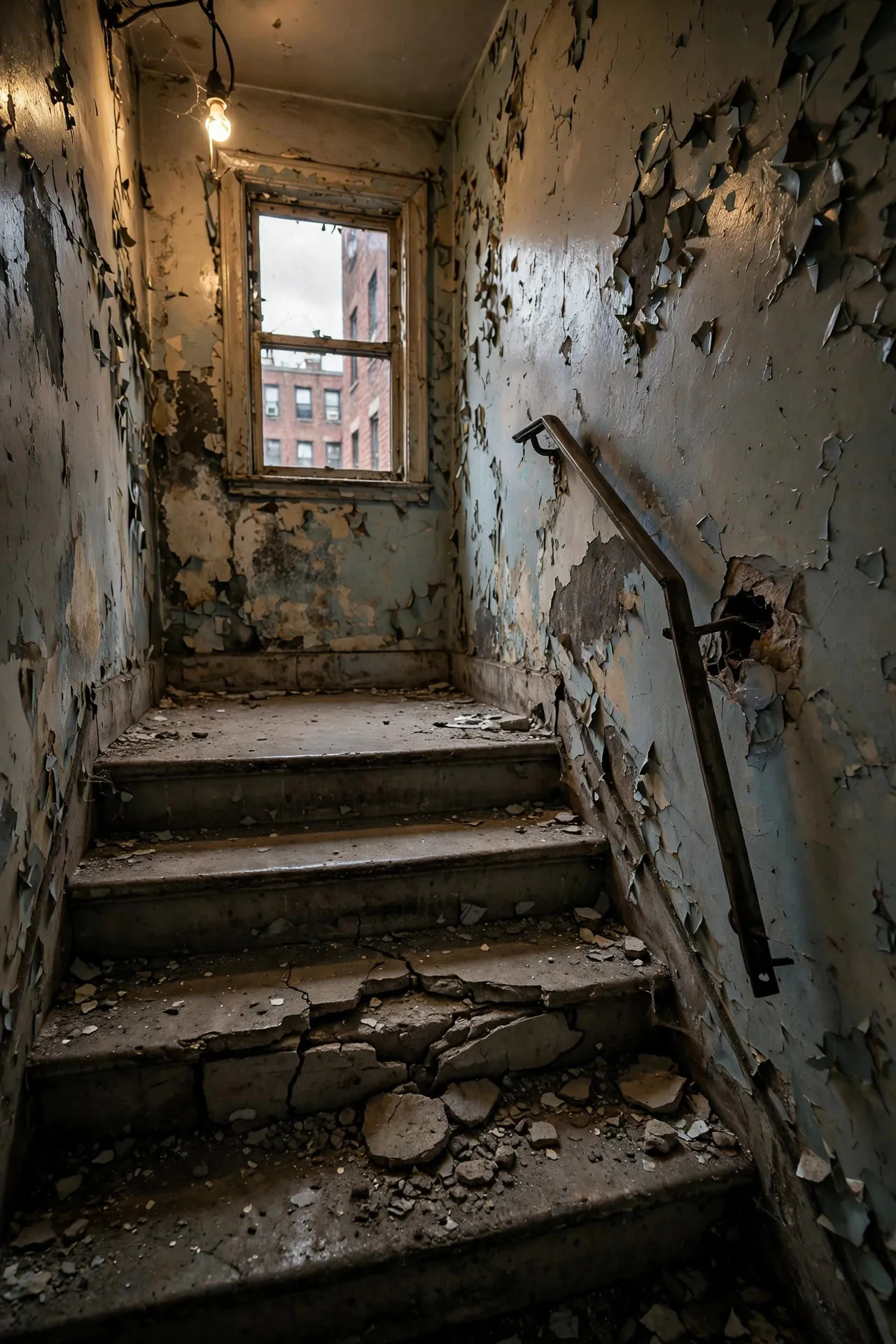
A broken stairway inside an apartment building is rarely a surprise to the building. The step was cracked at the landing, the handrail pulled away from the wall, the light over the flight had been out for weeks — and tenants had been saying so. When a Bronx tenant finally falls on that stairway, the landlord’s first response is often that nobody ever reported a problem. Whether that answer holds up usually decides the case.
That is what makes a building-stairway fall different from a fall on a stranger’s property. The evidence that matters most is not only the stairway itself, which can be repaired within days, but the record of what the owner knew and when: the complaints you and your neighbors made, the work orders the super opened or ignored, the 311 calls, and the inspection history of the building. Much of that record exists outside the building, in city files, and it can be pulled together if you start promptly.
This guide walks through what to document, in order: the stairway before anyone repairs it, the paper trail of the landlord’s knowledge, the reports to make in every direction, and the deadlines that apply — including the much shorter one that controls when the building is public housing. Our residential building accident page explains how these claims are evaluated; this guide is about building the record they are evaluated from.
Why a Broken-Stairway Fall Is Really a Case About Notice
New York landlords are not automatically responsible every time a tenant falls. A stairway claim generally turns on two things: a defective condition — a cracked or uneven step, a loose or missing handrail, a dark flight of stairs — and notice, meaning the owner knew about the defect, or it existed long enough and was obvious enough that the owner should have known. A landlord who was told about the broken step three times has a very different case from one facing a defect that appeared the same morning.
That is why the facts tenants treat as background — the complaint to the super in the spring, the neighbor who reported the same handrail last winter, the work order that was closed without a repair — are actually the center of the claim. Each one is a piece of notice, and each one has to be found and preserved before memories fade and records are discarded in the ordinary course of running the building.
The duty behind the claim is not informal. Under Multiple Dwelling Law § 78, the owner of a multiple dwelling must keep every part of it in good repair, and New York City’s Housing Maintenance Code, including Administrative Code § 27-2005, places the same maintenance obligation on owners. A stairway the building let deteriorate is measured against those duties — but only if the condition and the notice can be proved.
Photograph the Stairway Before Anyone Repairs It
A repaired stairway is the landlord’s best exhibit: by the time an insurer’s investigator visits, the step is patched, the handrail is tight, and the light works. Your photographs from the first days are usually the only neutral record of the condition that actually hurt you. If you are physically able — and if not, ask a family member or neighbor — document the flight thoroughly:
- The defect itself, close and wide. Photograph the cracked or uneven step, the loose handrail, or the dark landing up close, then from the top and bottom of the flight so its position on the stairway is unmistakable.
- Scale and condition. Lay a coin, a key, or a tape measure beside a crack or a raised edge so its size can be judged later, and photograph worn treads, missing nosing, and debris or liquid on the steps.
- The handrail along its whole run. Photograph where it pulls away from the wall, missing brackets, and any section where there is no rail at all — and note whether it moved when you grabbed it.
- The lighting as it actually was. Photograph the flight at the same time of day you fell, showing burned-out bulbs, covered fixtures, or a windowless landing, without using a flash that makes the scene look brighter than it was.
- Your injuries and what you were carrying. Photograph bruising and swelling as they develop over the first days, and keep the shoes you were wearing, unwashed and unrepaired.
- A short video descent. Walk the flight once on video, narrating the floor, the date, and what gave way — a wobbling rail is far more persuasive moving than still.
Then write your own account the same day: the time, which stairway and floor, what you were doing, what you felt give way, and who saw it or helped you. Send that account to yourself by email or text so it carries a date stamp. Details a jury hears about two years later are believed in proportion to how early they were written down.
BILLY COOPER LAW

Rebuild the Paper Trail of What the Landlord Knew
Notice is proved with records, and a Bronx apartment building generates more of them than most tenants realize. Work through each of these sources and keep a copy of everything you find:
- Your own complaints. Gather every text, email, letter, and rent-receipt note in which you reported the stairway, and note every verbal complaint with its date and who you spoke to. A complaint portal confirmation from the management company counts — screenshot it before it disappears.
- Your neighbors’ complaints. Ask the tenants above and below you, in writing if they are willing, whether they reported the same defect, and when. A neighbor’s earlier complaint about the same handrail is notice even if you never complained yourself.
- 311 complaints. Conditions reported through NYC 311 are logged by the City with dates and complaint numbers. A 311 complaint about the stairway from before your fall is a dated, city-held record the landlord cannot revise.
- HPD violations and inspection records. When the Department of Housing Preservation and Development inspects and finds a hazardous condition, it issues a violation that stays in the building’s public record. Earlier violations for the same stairway — or a pattern of stair and lighting violations — show both the defect and the owner’s knowledge of it.
- Work orders and the super’s log. Buildings track repair requests through work orders, superintendent logs, and management software. You will not be handed these, but noting the dates you were told a repair was ‘scheduled’ helps a lawyer demand the underlying records later, before routine retention periods run out.
One caution: keep your copies somewhere other than the apartment if you can — a phone backup, a family member’s email. Tenants in a dispute with a landlord should assume that anything left in a management portal or a building office can become hard to reach exactly when it is needed most.
Report the Fall in Every Direction — in Writing
Report the fall itself the same way you would want the earlier complaints to have been reported: in writing, dated, and kept. Tell the super and the management company by text, email, or letter that you fell on the stairway, identify the flight and the defect, and say that you were injured. Keep the sent copy. A verbal report to a porter in the hallway is the report the building will later say it never received.
Make the city record too. A post-fall complaint through NYC 311 about the stairway condition puts an inspector’s visit and a dated complaint in the file, and tenants can also pursue the building’s obligations through New York State Homes and Community Renewal, which oversees rent-regulated housing across the state. If the building is a New York City Housing Authority development, report through NYCHA’s own channels as well — and read the deadlines section below before anything else, because public-housing claims run on a far shorter clock.
Finally, get medical care promptly and tell every provider exactly where and how you fell. Stairway falls cause fractures, head injuries, and back injuries whose symptoms can build over days, and the first medical records — created before any lawyer is involved — are the records insurers and juries trust most about what the fall did to you.
BILLY COOPER LAW
The Law That Requires Landlords to Keep Stairways in Repair
Three overlapping rules frame a Bronx stairway claim. Multiple Dwelling Law § 78 requires the owner to keep every part of a multiple dwelling — stairways included — in good repair. The City’s Housing Maintenance Code adds its own maintenance duties and the violation system that enforces them. And the warranty of habitability in Real Property Law § 235-b guarantees tenants premises fit for residential use and not dangerous to health, life, or safety — a broken common stairway sits squarely inside that promise.
On top of those duties sits the notice rule described above: the owner must have known, or had reason to know, about the specific condition. Notice can be actual — your complaints, the super’s own reports — or constructive, where a defect was visible and existed long enough that a diligent owner would have found and fixed it. A handrail that has been loose for a year, in a stairway the super walks daily, is the classic constructive-notice case, which is why dating the defect matters as much as photographing it.
Expect the building to argue that you knew the stairway was broken and used it anyway. New York answers that argument with comparative negligence under CPLR § 1411: a tenant’s own carelessness reduces a recovery in proportion to fault instead of wiping it out — and tenants usually have no second stairway to choose. Our premises liability overview explains how fault is divided in cases like these.
Who Can Be Responsible Besides the Landlord of Record
The name on the deed is not always the only responsible party. Bronx buildings are commonly run by a managing agent that fields complaints and dispatches repairs, and stairway work is often done by outside contractors. If the managing agent received the complaints and sat on them, or a contractor’s earlier repair of the step or handrail failed, those parties can share responsibility with the owner. Identifying who actually controlled maintenance is one reason the complaint trail matters: it shows whose desk the warnings landed on.
Public housing is its own category. A fall in a NYCHA development is a claim against a public authority, with the notice-of-claim deadline described below and records held by the authority rather than a private landlord. Buildings owned by the City or another public entity raise the same issue. Establishing exactly who owns your building — deed records and the HPD registration identify the owner and managing agent — is one of the first steps after any building fall, because it determines which deadline governs the whole claim.
One boundary is worth knowing: your claim is against the building’s owner and managers, not against the super or porter personally in the ordinary case, and not against a neighbor who also complained. The duty to repair the common stairway belongs to the owner, and the claim follows that duty.
The Deadlines That Can Decide the Case
For a private landlord, the general deadline to file a personal injury lawsuit in New York is three years from the fall under CPLR § 214. Treat that as the outer limit rather than the plan: stairways get repaired, supers change jobs, management companies rotate, and complaint records age out of portals. A case begun in the first months can still reach evidence that a case begun in the third year cannot.
The exception swallows cases every year. If the building is owned by a public authority — NYCHA housing above all — a Notice of Claim under General Municipal Law § 50-e must generally be served within ninety days of the fall, before any lawsuit can be brought. Ninety days passes while a tenant is still in a cast. If there is any chance your building is publicly owned, that deadline — not the three-year one — is the first thing to confirm.
Evidence has deadlines of its own. Ask, in writing and early, that the building preserve the stairway in its post-fall condition until it can be documented, and that it keep the work orders, complaint logs, and any camera footage covering the stairway and entrances. Preservation requests sent in the first weeks are what turn ‘the landlord fixed it already’ from an ending into a fact the building has to explain.
BILLY COOPER LAW
About Billy Cooper Law
Notable Results
Published outcomes from the firm’s case results page:
- $9,000,000 settlement — catastrophic injury: a man severely injured when a tank exploded, suffering extensive burns that required multiple surgeries and the amputation of his dominant hand (Westchester County).
- $6,000,000 settlement — a 42-year-old bystander who was shot by police pursuing a suspect and severely injured (Bronx County).
- $2,400,000 mediated settlement — wrongful death of a bus driver killed when a tractor-trailer crossed the median and struck his bus head-on (New York County).
- $2,300,000 verdict — hospital negligence: an infant burned while in a hospital’s care, suffering third-degree burns (Westchester County).
- $2,005,000 settlement — a construction worker injured in a fall from a roof where adequate safety equipment was not provided (Rockland County).
- $970,000 settlement — an explosion inside a rental home caused by improper maintenance of the home, resulting in injuries and wrongful death (Westchester County).
Prior results do not guarantee a similar outcome. Each case is different and must be evaluated on its own facts.
What Clients Say on Google
“Billy Cooper has provided us clear professional information allowing us to make informed decisions. He never made us feel that we were asking too many questions or we were taking up too much of his time. He was able to achieve a positive outcome for us exceeding our expectations in a timely manner. He and his staff kept us updated and informed throughout the process. We highly recommend Billy Cooper Law.”
— R. S.
“I am extremely pleased with the level of professionalism and dedication that Billy Cooper and his entire team show. Billy is very supportive and represents clients with such commitment. If you are seeking out an attorney he and his team are it!! Thank you again for all of your support.”
— C. G.
“I am extremely grateful for the exceptional legal services provided by Mr. Cooper. His professionalism and intelligence were evident from our very first interaction. From the moment I contacted Mr. Cooper after my accident, he has been consistently available and supportive, addressing my concerns and health-related issues with genuine care.”
— Z. A.
Professional Recognition
- William H. Cooper — Super Lawyers designation, 2024–2026, following an evaluation process considering peer recognition and professional achievement.
Related Articles
- What to Do After a Slip and Fall in NY
- What Evidence Should You Gather Before a New York Slip and Fall Consultation?
- What Happens During a Lawyer’s Investigation of Slip and Fall in New York State?
- How Can NYC Sidewalk Notices Help Investigate a Bronx Trip-and-Fall Claim?
- How Can a Yonkers Shopper Document a Wet Entrance Before the Floor Is Cleaned?
- Comparative Negligence in NY Explained
Published Articles by Billy Cooper Law Attorneys
- The First 72 Hours After an Accident Can Shape the Case — William H. Cooper, New York Law Journal / Law.com, November 10, 2026.
- When the Video Disappears: Liability, Missing Footage, and the Modern New York Injury Case — William H. Cooper, New York Law Journal / Law.com, June 23, 2026.
- E-Bike Liability Shouldn’t Stop With Parents — William H. Cooper, New York Law Journal / Law.com, September 15, 2026.
- The ‘Serious Injury’ Threshold Is Quietly Deciding Who Gets Justice in New York — William H. Cooper, New York Law Journal / Law.com, May 26, 2026.
Videos and Social Posts
- Video: Premises Liability — from the firm’s Video Library.
Frequently Asked Questions About Falls on Broken Apartment-Building Stairways in the Bronx
The answers below cover the questions Bronx tenants ask most after falling on a broken stairway in their own building. They are general information about New York law, not legal advice about a specific case.
Does it matter legally that I told my landlord about the broken step before I fell?
Yes — it is often the single most important fact in the case. A landlord is generally responsible for a defective stairway condition it knew about, or should have known about, and a dated complaint from you is direct proof of that knowledge.
Keep every trace of the complaint: texts, emails, portal confirmations, and your own dated notes of verbal reports. A complaint the landlord acknowledges receiving is far harder to defend against than a defect the building can call sudden.
Sources: N.Y. Multiple Dwelling Law § 78 (Cornell Law Institute); N.Y.C. Administrative Code § 27-2005 (Cornell Law Institute)
What if I never reported the defect — can I still have a claim?
You may. Notice can also be constructive: if the defect was visible and existed long enough that a reasonably careful owner would have discovered and repaired it, the law can treat the owner as if it knew.
That is why evidence of how long the step or handrail was broken matters — neighbors’ accounts, earlier 311 complaints, and the building’s own inspection and violation history can all date the condition.
Sources: N.Y. Multiple Dwelling Law § 78 (Cornell Law Institute); N.Y.C. Administrative Code § 27-2005 (Cornell Law Institute)
What photographs should I take of the stairway after a fall?
Photograph the defect close up and from the top and bottom of the flight, with a coin or tape measure beside a crack or raised edge for scale. Photograph the handrail along its whole run, the lighting as it was at the time you fell, and your injuries as bruising develops.
Add one short video walking the flight while you describe what gave way. Photographs taken in the first days record the condition before the building repairs it, and they cannot be recreated afterward.
Sources: NYC 311; N.Y. Homes and Community Renewal
Should I report the fall to 311 or HPD even if I already told the super?
Yes. A report to the super stays inside the building; a 311 complaint creates a dated city record, can trigger an HPD inspection, and may produce a violation that documents the condition independently of anything the landlord says.
Make the building report in writing as well, and keep copies of both. The two records serve different purposes, and together they are much stronger than either one alone.
Sources: NYC 311; N.Y. Homes and Community Renewal
What records can show the landlord knew about the stairway defect?
Your own complaints, your neighbors’ complaints, 311 complaint histories, HPD violations and inspection records for the building, and the landlord’s work orders and superintendent logs.
Public records — 311 and HPD files — are especially valuable because the landlord cannot revise them. Private records like work orders are obtained later, which is one reason an early written preservation request matters.
Sources: N.Y.C. Administrative Code § 27-2005 (Cornell Law Institute); N.Y. Multiple Dwelling Law § 78 (Cornell Law Institute)
My building is NYCHA public housing — are the rules different?
Yes, mainly on deadlines. A claim against a public authority such as NYCHA generally requires a Notice of Claim under General Municipal Law § 50-e within ninety days of the fall, before a lawsuit can be filed.
The underlying maintenance duties are comparable, but the ninety-day clock is short enough to expire during treatment. A tenant in public housing should confirm the deadline before anything else.
Sources: N.Y. General Municipal Law § 50-e (Cornell Law Institute); N.Y. CPLR § 214 (Cornell Law Institute)
What if the landlord fixed the step the week after my fall — is my case gone?
No. A prompt repair is common, and it is one reason first-days documentation matters: your photographs, the 311 record, and any inspection file still show the condition that hurt you.
Send a written preservation request early asking the building to keep work orders, complaint logs, and camera footage. A repair explains the stairway’s present condition; it does not erase the record of its earlier one.
Sources: N.Y. Multiple Dwelling Law § 78 (Cornell Law Institute); NYC 311
Can the landlord blame me for using a stairway I knew was broken?
The building can raise your own conduct, but under New York’s comparative negligence rule it reduces a recovery in proportion to fault rather than eliminating it.
Tenants also rarely have a real choice: the building’s common stairway is usually the only route to their apartment. Knowing a step was broken is not the same as causing the fall, and the duty to repair it remained the owner’s.
Sources: N.Y. CPLR § 1411 (Cornell Law Institute); N.Y. Multiple Dwelling Law § 78 (Cornell Law Institute)
How long do I have to file a stairway-fall lawsuit in New York?
Against a private landlord, the general personal injury deadline is three years from the fall under CPLR § 214. Against a public owner or authority, a Notice of Claim is generally due within ninety days, and shorter suit deadlines can follow.
Whichever deadline applies, evidence does not wait for it: repairs, staff changes, and discarded logs all argue for starting while the record is still fresh.
Sources: N.Y. CPLR § 214 (Cornell Law Institute); N.Y. General Municipal Law § 50-e (Cornell Law Institute)
What does the warranty of habitability have to do with a stairway fall?
Real Property Law § 235-b guarantees tenants premises that are fit for residential use and not dangerous to health, life, or safety. A broken common stairway — the route every tenant must use — falls within the conditions that promise covers.
The warranty works alongside the Multiple Dwelling Law’s repair duty: both place the obligation to keep the building’s shared spaces safe on the owner, not on the tenants who reported the problem.
Sources: N.Y. Real Property Law § 235-b (Cornell Law Institute); N.Y. Multiple Dwelling Law § 78 (Cornell Law Institute)



Get the Answers You Need
At Billy Cooper Law, every day we renew our pledge to help injured people get the justice and compensation they deserve. We have a reputation throughout New York and nationally for standing up for our clients, and we take that responsibility seriously by approaching every case with preparation, persistence, and an unwavering commitment to results.