
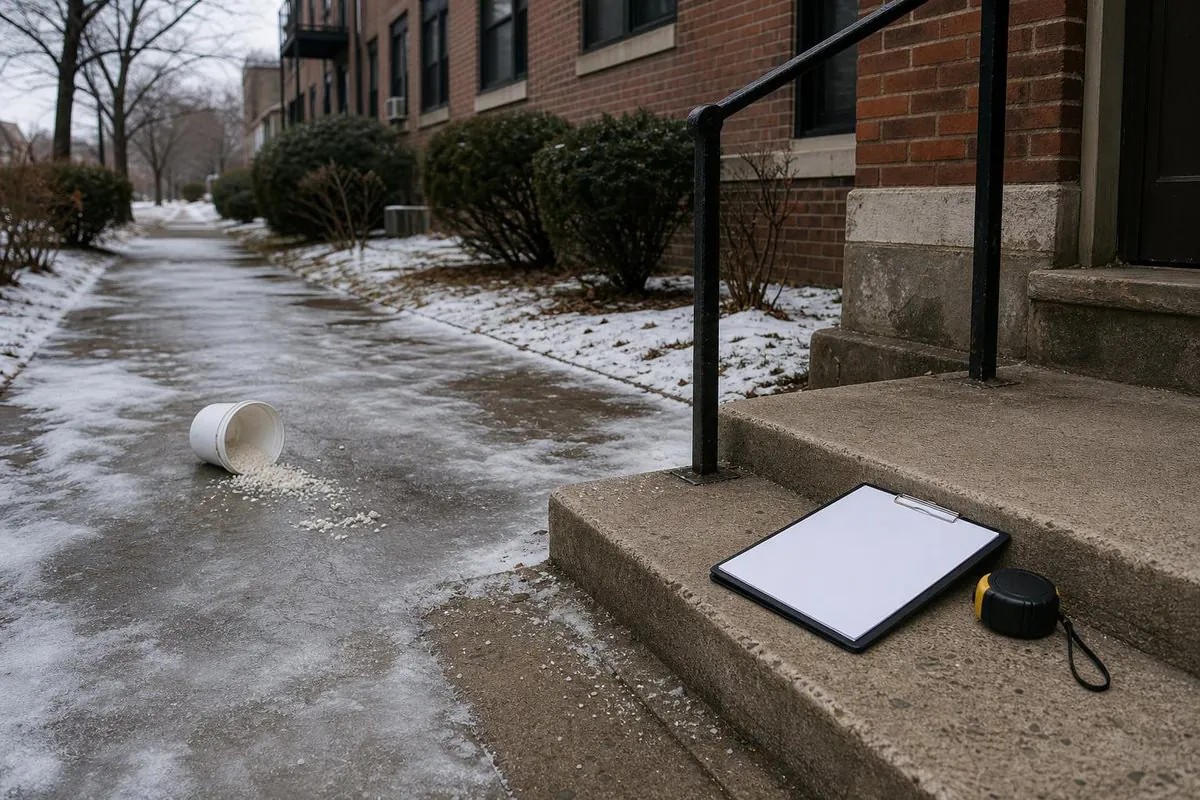
A lawyer investigating a slip and fall in New York State reconstructs what happened, preserves evidence, identifies who was responsible for the area, and evaluates whether the evidence supports a negligence claim. The lawyer also documents the injuries and financial consequences. Those tasks often happen together: a filing deadline cannot wait for every medical record, and a request to preserve video should not wait for settlement discussions.
Your lawyer brings these pieces together to explain the fall and its consequences. A photograph may show a puddle, while cleaning records or witness accounts help establish how it developed and what the property owner knew. Medical and wage records show how the injury affected you. Knowing what each piece adds can help you understand the questions your lawyer asks and the work still needed.
BILLY COOPER LAW

The first conversation builds a timeline
Expect questions about the exact location, date, approximate time, direction you were walking, and what you remember immediately before and after the fall. The lawyer may ask whether your foot slid, caught an edge, or landed on a different level; whether you noticed water, ice, debris, damaged flooring, or a loose mat; and whether anyone helped you. These details help define the investigation rather than forcing every fall into the same theory.
Bring the information you already have, even if it feels incomplete. A receipt may help establish when you were at a store. A text sent after the fall may help narrow the time. The name of an employee who took your report can provide a starting point. If you do not remember something, say so. Distinguishing an observation from an assumption is more useful than filling a gap with an answer that sounds certain.
An initial evidence folder can include the following:
- Original photographs and videos, with the files kept intact.
- The incident report or details about who received your report.
- Witness names and contact information.
- Letters, texts, emails, and insurance correspondence about the fall.
- Treatment-provider names, bills, work restrictions, and missed-work dates.
Evidence preservation starts before the case is fully evaluated
A lawyer may promptly send preservation requests to a store, building manager, property owner, or another entity believed to control relevant evidence. A useful request identifies the location and time window and specifies potentially relevant camera footage, incident records, cleaning logs, inspection records, photographs, and communications. It should be tailored to the actual accident, not merely request everything a business has ever recorded.
Preserving evidence and obtaining it are separate steps. A request to retain footage does not itself deliver a copy, guarantee that a camera recorded the fall, or give your lawyer unrestricted access to a business’s systems. Your lawyer may follow up about camera coverage, the recording period, and whether the original file remains available. Nearby cameras may show the approach to the scene even when no camera captured the precise moment of the fall.
If relevant evidence was destroyed, the circumstances matter. In Pegasus Aviation, the Court of Appeals explained that a request for spoliation sanctions requires a preservation obligation, culpable destruction, and relevance. Missing video does not automatically establish liability or entitle someone to a particular sanction. The lawyer should investigate what existed, who controlled it, when it disappeared, and what it could have shown. Pegasus Aviation I, Inc. v Varig Logistica S.A. (December 15, 2015).
The scene is examined in context
A scene review may compare close-up photographs with wider views showing the walking route, entrances, surrounding surfaces, and lighting. For a damaged step or uneven pavement, measurements can help. For a liquid spill, the location of a refrigerator, cleaning equipment, or warning cone may suggest questions worth pursuing. A later visit must be evaluated carefully because the scene may no longer look the way it did when you fell.
If the dispute involves a technical question, your lawyer may consult an engineer or another qualified expert. For example, an expert may help explain a stair’s design or the measurements of an uneven surface. The review must account for any repairs and use the photographs, measurements, and other evidence available from the time of the fall.
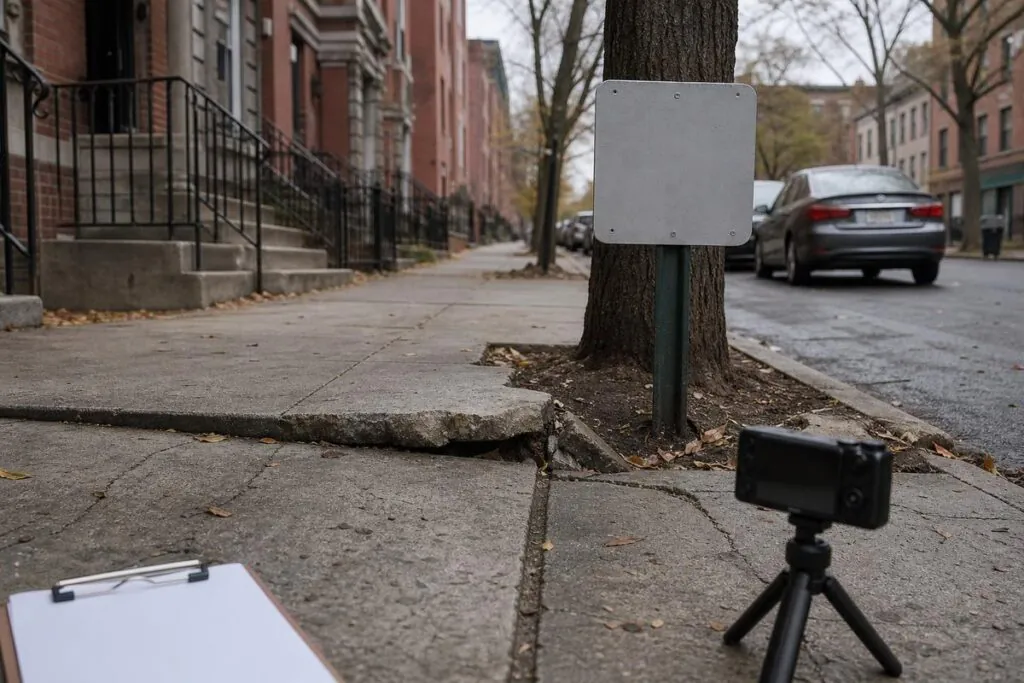
New York does not apply a universal minimum height or depth that makes a walking-surface defect actionable. Hutchinson requires consideration of the specific circumstances, not size alone. This makes the wider setting important: an isolated measurement may leave out the feature that made a condition difficult to negotiate. It also means a serious injury, by itself, does not prove that the defect was legally significant. Hutchinson v Sheridan Hill House Corp. (October 20, 2015).
Ownership, control, and maintenance responsibility are checked
The name on a storefront may not identify the property owner, the tenant, or the company maintaining the area. A lawyer may compare property information, business identities, leases, maintenance agreements, and testimony about actual responsibilities. The investigation asks who had authority over the specific place where the fall occurred and which duty is supported by the applicable law and evidence.
A maintenance contractor is not automatically liable to every visitor just because it had a contract. Foster discusses the general rule and exceptions derived from Espinal, including creating or worsening a dangerous condition, detrimental reliance, or entirely displacing another party’s maintenance duty. Reviewing both the contract and the work actually performed can help determine whether a claim against a contractor has a legal basis. Foster v Herbert Slepoy Corp. (June 22, 2010).
Your lawyer will also check whether a public entity is involved. Provide the precise location of a fall near a public building or on a sidewalk, along with any names or records you have. Responsibility can vary with the property and local rules, and public-entity claims may require prompt notice. Identifying the right party early helps protect those deadlines.
The investigation asks how the responsible party knew about the condition
One central issue is whether the defendant created the dangerous condition or had actual or constructive notice of it. Actual notice concerns knowledge of the condition. Constructive notice asks whether a visible and apparent defect existed long enough to allow discovery and correction. Gordon illustrates why general awareness that litter might be present does not establish notice of the particular item involved in a fall. Gordon v American Museum of Natural History (March 25, 1986).
That framework guides practical questions: Did someone report the same leak? Was there a repair request for that step? Does a log describe an inspection of the actual area? Did a witness see the condition before the accident? The lawyer compares timestamps and descriptions rather than treating every document titled “inspection” as proof that someone examined the relevant spot.
A recurring problem can also warrant closer investigation. Dorsa addressed maintenance records bearing on notice of a recurring dangerous condition. A lawyer looking into a repeated leak may seek earlier complaints and repair history, while keeping the focus on what connects those records to the condition involved in your fall. An unrelated complaint elsewhere in the building may have little value. Dorsa v National Amusements (April 26, 2004).
Injuries and losses are documented alongside responsibility
Your lawyer will need a clear account of treatment, symptoms reported to providers, work interruptions, and other claimed effects. Keep appointments and medical decisions with your healthcare professionals. For the legal investigation, accurate provider names and treatment dates make it easier to identify the records needed. Tell the lawyer about earlier injuries involving the same body area so the evidence can be assessed with the full history.
Practical documentation may include wage records, an employer’s confirmation of missed time, receipts, and notes about activities you could no longer perform. Record concrete examples rather than trying to assign your own settlement value. Being unable to climb the stairs to your bedroom or complete a particular work task gives the lawyer a factual issue to investigate; a broad statement that “everything changed” is harder to evaluate.
If an action is filed and a physical condition is in controversy, CPLR 3121 provides for medical examinations and specified hospital-record authorizations. Your lawyer can explain the requested scope and any dispute about it. An examination requested by the defense serves the litigation process; it should not be confused with selecting a provider for your treatment. CPLR 3121 — Physical or mental examination.
Formal discovery can fill gaps that voluntary requests leave open
The investigation can continue after filing. New York’s courts describe discovery as an exchange of information connected to the claims. It can involve records, sworn testimony, and requests directed to people with relevant information. It is not an unrestricted search through someone else’s affairs. Disputes about relevance, scope, privilege, or compliance may require court involvement. New York Courts — Preparing for Trial: Discovery.
CPLR 3120 authorizes properly described requests for documents, objects, and property inspections after an action begins. CPLR 3113 governs sworn deposition testimony. These tools can help test who inspected the area, what employees observed, or whether a record accurately describes the accident. A deposition also lets the defense ask you questions, so preparation should focus on understanding the process and answering truthfully from your own knowledge. CPLR 3120 — Discovery and production for inspection; CPLR 3113 — Conduct of the examination.
A business’s ordinary-course accident report may be subject to disclosure under CPLR 3101(g), while privileges and protections can affect other material. Insurance information is also addressed in that statute. Obtaining a report or policy does not resolve the claim: the lawyer still evaluates what the evidence proves, whether coverage applies, and what issues remain contested. CPLR 3101 — Scope of disclosure.
Deadlines and the next decision remain part of the investigation
An ordinary negligence action for personal injury generally has a three-year limitations period under CPLR 214(5), subject to exceptions. Many municipal tort claims require a notice of claim within 90 days under General Municipal Law 50-e; section 50-i generally provides a one-year-and-90-day action deadline for the entities it covers. Other public defendants may have different requirements. These dates require case-specific review, and investigation or insurance negotiations should not be treated as an extension. CPLR 214 — Actions to be commenced within three years; General Municipal Law 50-e — Notice of claim; General Municipal Law 50-i — Presentation of tort claims; commencement of actions.
Ask your lawyer what has been learned and what still needs attention. Which evidence is preserved? Has the responsible party been identified? Is an inspection or witness interview needed? A useful update should explain the next step and how deadlines are being protected. The pace will depend on the records available and any disputes about access or responsibility.
Once the evidence has been reviewed, your lawyer can explain whether to seek more records, present a claim, negotiate, or proceed with litigation. Discovery may continue after filing, and settlement conferences can provide an opportunity to discuss resolution. The decision should account for the evidence, remaining disputes, and your needs as the injured person.
Sources: New York Courts — Preparing for Trial: Discovery; New York Courts — Uniform Civil Rules, section 202.26.
How Billy Cooper Law investigates a slip-and-fall accident
After a fall, you may know what you encountered without knowing how to prove it. Billy Cooper Law investigates New York premises-liability claims by examining the condition, available photographs and footage, incident reports, witness accounts, and other evidence about what happened.
We work to understand both how the accident occurred and whether the evidence supports responsibility under the applicable law. A photograph can show a condition, but maintenance records, inspections, and witness information may be needed to explain how long it existed and what the property owner knew. Medical records help document the injuries and their effects.
William H. Cooper joined the predecessor firm and was admitted to practice in New York in 1991. He became lead trial counsel, is a member of the New York State Trial Lawyers Association, and received Super Lawyers recognition for 2024–2026. Attorney Anieska J. Garcia was admitted in New York in 2000 and is fluent in English and Spanish. Their legal experience and ability to communicate with clients help the firm develop a clear account of the fall and prepare the claim.
Billy Cooper Law offers a free consultation and contingency-based representation. Bring the records you have and ask about the written agreement, including expenses. We can explain how the investigation would proceed and the options available to you. Every case is different, and past results do not guarantee a similar outcome.
Related Billy Cooper Law resources
BILLY COOPER LAW
Professional Recognition

Recognition applies to the named attorneys and selection years. See the linked profiles for details.
NOTABLE RESULTS
Billy Cooper Law publishes the following results. This is a broader unsafe-property outcome involving maintenance of a rental home, rather than a slip-and-fall or sidewalk recovery.
$970,000 settlement
Read more about these results
- $970,000 settlement: Rental-home explosion attributed to improper maintenance caused injuries and wrongful death in Westchester County. Read the source account.
Read the firm’s published results
Prior results do not guarantee a similar outcome. Each case is different and must be evaluated on its own facts.
Published Writings by William Cooper
Related reading on preserving video evidence in injury cases:
- When the Video Disappears: Liability, Missing Footage, and the Modern New York Injury Case — Billy Cooper, New York Law Journal, June 23, 2026.
WHAT OUR CLIENTS SAY
General feedback about working with Billy Cooper Law:
“Wonderful experience. Very knowledgeable and responsive!”
— Lara C.
“He cares. He just cares.”
— Carmelo Curra
New York Slip-and-Fall Investigation FAQs
These questions provide general information about New York investigations and court procedures. Your circumstances, defendant identity, and accident date may change the analysis; this is not individual legal or medical advice.
Can a lawyer investigate if I do not have a photograph of the hazard?
Yes. A missing photograph does not prevent an investigation, although it can make proof more difficult. Your lawyer can ask about witnesses, available recordings, incident records, and the location itself. Start with what you personally remember and identify anyone who may have seen the condition or helped immediately afterward.
Do not recreate a scene and describe it as the original. If a later photograph is available, explain when it was taken and whether anything changed. The investigation must still establish the relevant condition and notice where required; collecting more material helps only when it addresses an actual gap. Ask which missing fact is most important to clarify.
Sources: Gordon v American Museum of Natural History (March 25, 1986); New York Courts — Preparing for Trial: Discovery.
Can my lawyer obtain the store’s incident report?
A business’s ordinary-course accident report may be obtainable in discovery. CPLR 3101(g) addresses these reports, but the circumstances and applicable protections still matter. Tell your lawyer who prepared the report, whether you signed anything, and whether you received a copy. Avoid assuming that the report contains everything an employee observed.
Your lawyer can compare the report’s time, location, and account of the accident with photographs and witness information. If the report is not provided voluntarily, document requests after filing may help obtain it. That comparison can clarify what was recorded at the time and identify details that need further investigation.
Sources: CPLR 3101 — Scope of disclosure; CPLR 3120 — Discovery and production for inspection.
What if surveillance footage has already been deleted?
Deleted footage requires investigation; it does not automatically mean you win or lose. The lawyer can ask whether footage existed, what it showed, who controlled it, and when and why it was lost. Preserve any correspondence about your report or earlier request for the recording so the sequence can be evaluated.
Pegasus Aviation requires attention to preservation duty, culpability, and relevance when sanctions are sought. Dorsa likewise illustrates the importance of missing maintenance evidence in a fall dispute. Your lawyer should explain whether there is a supported basis for asking the court for relief and what other evidence remains. Neither decision makes every missing recording conclusive proof of negligence.
Sources: Pegasus Aviation I, Inc. v Varig Logistica S.A. (December 15, 2015); Dorsa v National Amusements (April 26, 2004).
Do I have to know which company owns the property before contacting a lawyer?
No. You can begin by providing the precise accident location and the names you know. Ownership, occupancy, and maintenance responsibility may need further investigation. A storefront name, an employee’s uniform, or a building manager’s business card can be a lead without being a complete identification of the legally responsible party.
Relevant agreements and records may help clarify who controlled the area. Contractor liability requires its own legal analysis: a maintenance contract alone does not necessarily create a duty to an injured visitor. Give the lawyer photographs or documents that identify the property, and flag any indication of government involvement so the responsible entity and applicable requirements can be checked promptly.
Sources: Foster v Herbert Slepoy Corp. (June 22, 2010); CPLR 3120 — Discovery and production for inspection.
Will I have to answer questions under oath?
You may have to give a deposition if a lawsuit proceeds. A deposition is recorded questioning under oath, not the trial itself. Your lawyer can review the procedure with you and discuss the records and photographs you may be asked about. Preparation should help you give accurate answers rather than memorize a version of events.
If you do not recall a detail, make that clear instead of guessing. Distinguish the condition you saw from an explanation someone gave you later. CPLR 3113 governs the oath and recording of testimony, and the court’s discovery guide explains the role of depositions. Ask your lawyer how to handle a question you do not understand and what to expect during the examination.
Sources: CPLR 3113 — Conduct of the examination; New York Courts — Preparing for Trial: Discovery.
Will the defense be allowed to review my medical history?
Relevant medical information may be sought when your claimed injuries place your physical condition in controversy. That does not mean every record about your health is automatically relevant. Your lawyer should evaluate the requests and explain the records and authorizations involved, including any dispute about their scope.
Provide an accurate treatment history, including earlier conditions involving the same body area. Omitting prior treatment can leave your lawyer unprepared to assess an issue the defense raises. CPLR 3121 addresses examinations and specified hospital records; CPLR 3101 governs disclosure and protections. Keep treatment decisions with your healthcare professionals and ask counsel how the legal requests relate to the injuries you are claiming.
Sources: CPLR 3121 — Physical or mental examination; CPLR 3101 — Scope of disclosure.
Does an allegation that I was distracted end a slip-and-fall case?
No. In an ordinary New York premises-negligence claim, an allegation of distraction does not automatically bar recovery. CPLR 1411(a) provides for a proportional reduction based on culpable conduct attributable to the claimant. Whether distraction mattered must be evaluated against evidence of the accident, not assumed from an insurer’s accusation.
Tell your lawyer about your route, visibility, phone use, footwear, and any warning you noticed. Accurate information helps address the defense directly. The current statute also contains a separate subsection for personal-injury actions subject to Insurance Law article 51, so a motor-vehicle-related situation needs separate analysis. The investigation still must establish the defendant’s responsibility; comparative fault does not supply missing proof of negligence.
Sources: CPLR 1411 — Damages recoverable when contributory negligence is established; Gordon v American Museum of Natural History (March 25, 1986).
Is it too late to investigate if the property has been repaired?
A repair does not necessarily make investigation impossible, but it can limit what a later inspection proves. Identify photographs, witnesses, earlier complaints, and records describing the pre-repair condition. Tell your lawyer when you learned about the repair and whether anyone documented the work. Do not treat the present surface as identical to the original.
If the dispute involves an uneven step or pavement, context matters along with dimensions. Hutchinson rejects deciding triviality solely by size. CPLR 3120 permits appropriate property inspections after an action begins, but a measurement taken afterward must be evaluated for what it actually represents. The lawyer can assess whether historical evidence supports the condition claimed to have caused your fall.
Sources: Hutchinson v Sheridan Hill House Corp. (October 20, 2015); CPLR 3120 — Discovery and production for inspection.
Does an insurance investigation give me extra time to file?
Do not assume that an insurance investigation extends a filing deadline. An ordinary personal-injury negligence action generally falls within CPLR 214’s three-year period, with exceptions. Your lawyer should calculate the applicable time limits from the facts and defendant identity rather than rely on an adjuster’s ongoing requests for information.
Municipal claims can require much earlier action: General Municipal Law 50-e generally requires a notice within 90 days where that notice is required, and section 50-i generally sets a one-year-and-90-day action period for covered entities. Other public defendants can have different rules. Give counsel every relevant date promptly; these general descriptions are not a calculation of the deadline for your own claim.
Sources: CPLR 214 — Actions to be commenced within three years; General Municipal Law 50-e — Notice of claim; General Municipal Law 50-i — Presentation of tort claims; commencement of actions.
How will I know when the investigation is ready for the next step?
Ask your lawyer for an explanation of the evidence obtained, the unanswered questions, and the next decision. There is no single timetable that fits every fall. A straightforward record may be evaluated sooner than a case involving disputed responsibility, unavailable witnesses, or contested discovery. A status update should identify the actual obstacle.
The investigation can continue after filing, while the parties exchange information and prepare for later proceedings. The court’s discovery guide explains information-sharing before trial, and section 202.26 provides for settlement conferences. Ask whether further records, testimony, or an inspection could change the assessment, and how deadlines are being protected. Readiness for a claim presentation or negotiation is not a guarantee of settlement or a particular recovery.
Sources: New York Courts — Preparing for Trial: Discovery; New York Courts — Uniform Civil Rules, section 202.26.
BILLY COOPER LAW


Get the Answers You Need
At Billy Cooper Law, every day we renew our pledge to help injured people get the justice and compensation they deserve. We have a reputation throughout New York and nationally for standing up for our clients, and we take that responsibility seriously by approaching every case with preparation, persistence, and an unwavering commitment to results.

Related Billy Cooper Law Videos and Social Posts