

Manhattan NY E-Bike Accident Lawyer
An e-bike crash in Manhattan can leave you dealing with serious injuries, missed work, a damaged bike, and insurance questions that do not have obvious answers. The legal path may depend on whether you were hit by a car, forced from a bike lane, injured by a road defect, struck while making deliveries, or hurt because the e-bike itself failed.
Billy Cooper Law represents injured e-bike riders, pedestrians, delivery workers, and families after serious crashes. The firm can identify the responsible parties, preserve evidence, address short insurance deadlines, and explain what should happen next.
BILLY COOPER LAW

Types of Injury Cases We Handle in Manhattan NY
- Personal Injury
- E-Bike Accidents
- Car Accidents
- Slip and Fall
E-Bike Accident Lawyers Serving New York County
- New York County
- Manhattan
- Upper East Side
- Upper West Side
- Washington Heights
- East Harlem
- Harlem
- Inwood
- Midtown
- Chelsea
- Greenwich Village
- Lower East Side
- Financial District
What You Should Expect From Your Lawyer
An e-bike case rarely fits into one legal category. It may involve New York traffic law, no-fault insurance, commercial vehicle coverage, workplace benefits, product liability, or a claim against a government entity.
That is where experience becomes useful. Billy Cooper Law traces its history to a practice founded in 1960 and reports more than 75 years of combined experience. William H. Cooper has served as lead trial counsel in serious injury cases for more than 25 years and was selected to Super Lawyers from 2024 through 2026. You can learn more in Billy Cooper’s attorney profile.
The firm offers free consultations and handles personal injury cases on a contingency basis. There are no upfront legal fees, and the firm does not collect a legal fee unless compensation is recovered. Attorney Anieska J. Garcia is fluent in English and Spanish.
Billy Cooper Law also has a New York City location at 4746 Broadway in New York NY 10040, available by appointment.
Why Manhattan E-Bike Cases Require a Local Investigation
Manhattan’s bike lanes, one-way avenues, commercial loading activity, construction work, and constant pedestrian movement create recurring points of conflict.
A protected bike lane does not eliminate danger. At an intersection, a turning driver may still cross the rider’s path. Near the curb, an opening door or double-parked vehicle may force a rider into moving traffic. Construction barriers, steel plates, utility cuts, and temporary lane changes can create hazards that were not present a few days earlier.
There may also be more evidence than the injured person realizes. Buildings, storefronts, buses, taxis, delivery vehicles, and nearby intersections may have cameras. A rideshare or delivery app may hold location and timing information. A rental e-bike account may show the route, bicycle number, and trip duration.
That evidence can disappear quickly. Video is overwritten, vehicles are repaired, bikes are discarded, and app records become harder to obtain. A useful investigation begins by identifying every likely source before it is lost.
What the Manhattan Numbers Show
The NYC DOT 2025 Bicycle Crash Data Report recorded 270 injuries and five fatalities among e-bike users in Manhattan during 2025.
Motor-vehicle-involved crashes accounted for 197 of those injuries and four of the deaths. Crashes without a motor vehicle accounted for 73 injuries and one death.
That distinction matters legally. When a car, truck, taxi, or bus is involved, no-fault coverage and New York’s serious-injury rules may apply. A crash involving another e-bike, a road defect, or a failed component may follow a different insurance and liability path.
How E-Bike Injuries Happen in Manhattan
The location of a crash often points to the evidence and defendants that should be investigated.
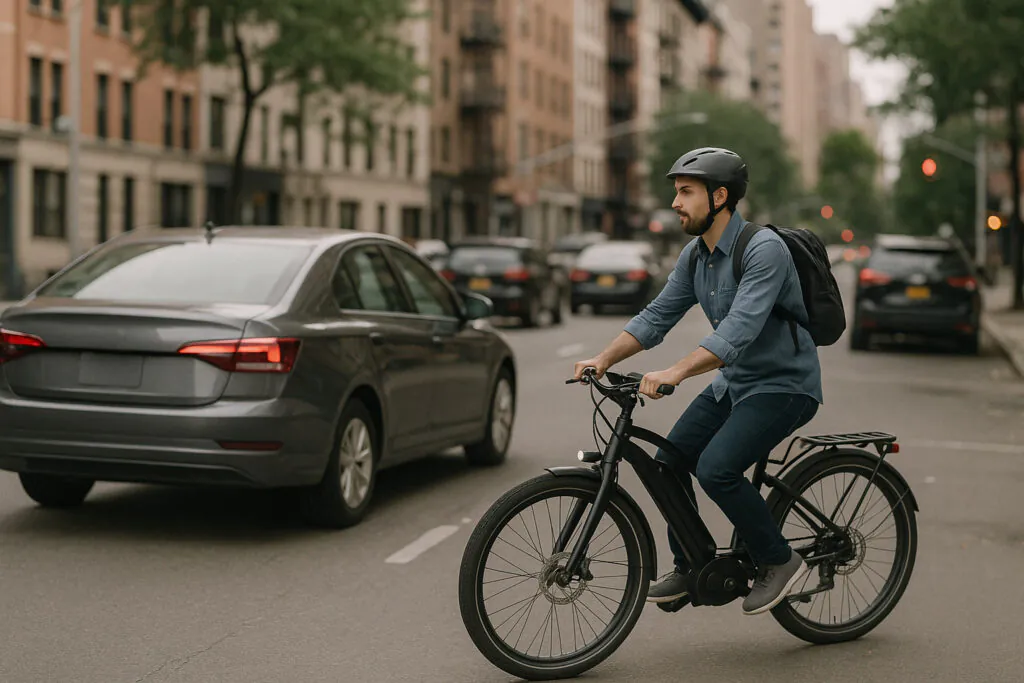
Turning vehicles crossing bike lanes
Drivers turning across a marked bike lane may fail to check for a rider approaching from behind. The signal sequence, pavement markings, driver sight lines, traffic speed, and location of any parked vehicles can all matter.
Dooring and curbside conflicts
A driver or passenger may open a door into a rider’s path. Delivery trucks, taxis, and rideshare vehicles may also stop in or beside a bike lane, leaving the rider to choose between stopping abruptly and entering a traffic lane.
Trucks and commercial vehicles
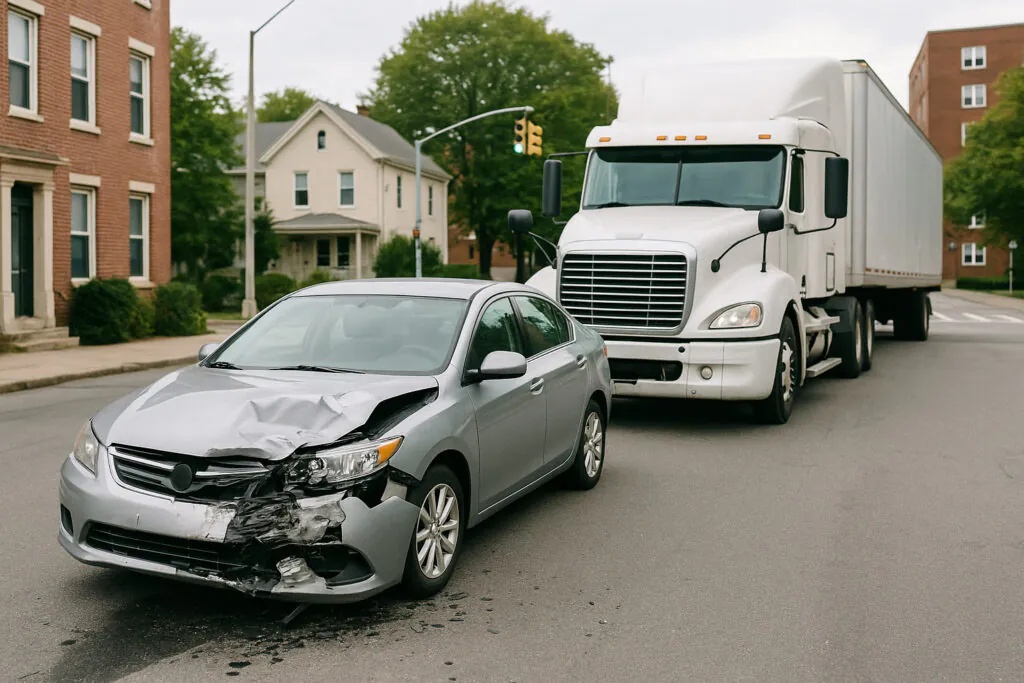
A truck driver may have difficulty seeing an e-bike in a blind spot, particularly while turning or pulling away from the curb. These cases may require prompt preservation of onboard video, GPS information, inspection records, and electronic vehicle data.
Roadway and construction hazards
Potholes, broken pavement, unsecured plates, debris, drainage problems, and poorly marked construction detours can cause a rider to lose control. The investigation may need to identify the City agency, utility company, contractor, or permit holder responsible for the location.
Collisions with pedestrians or other riders
Not every serious e-bike accident involves a car. Riders and pedestrians can be injured in bike lanes, crosswalks, greenways, and shared spaces. These claims may depend heavily on witness accounts, video, speed, right-of-way rules, and available insurance.
Defective bikes and batteries
Brake failures, frame defects, throttle problems, wheel failures, and battery fires may create claims against manufacturers, distributors, repair shops, rental operators, or other businesses in the supply chain. The e-bike and its components should be preserved before anyone repairs or disposes of them.
E-Bike Cases Billy Cooper Law Handles
The firm represents people injured in matters involving:
- E-bike accidents
- E-bike riders struck in car accidents
- Truck and commercial vehicle accidents
- Collisions involving Uber and Lyft vehicles
- Dooring incidents and other bicycle accidents
- Pedestrian accidents caused by e-bike collisions
- E-bike crashes arising from dangerous or defective products
- Delivery-related and other work accidents
- Catastrophic injuries, including traumatic brain injuries
- Fatal crashes resulting in a wrongful death claim
What to Do After an E-Bike Accident
Your health comes first. Call 911 after a serious crash and accept medical help if you struck your head, lost consciousness, feel confused, have significant pain, or cannot safely stand or walk.
If you can do so without putting yourself in further danger:
- Record the exact location. Note the street address, intersection, direction of travel, bike lane, traffic signal, and nearby businesses.
- Photograph the scene. Include the vehicle, license plate, e-bike, road surface, debris, skid marks, traffic signs, lane markings, construction barriers, and your injuries.
- Get driver and witness information. Record names, phone numbers, insurance details, vehicle ownership information, and commercial markings.
- Make sure the report is accurate. Confirm that the police report identifies you as an e-bike rider and correctly records the location and vehicles involved.
- Save app information. Preserve delivery assignments, rental receipts, route history, messages, screenshots, and trip timestamps.
- Do not repair the e-bike yet. Store the bike, battery, helmet, clothing, and damaged equipment in their post-crash condition.
- Be careful with insurance calls. Give required notice, but do not guess about speed, distance, fault, or the long-term effect of injuries you are still trying to understand.
Depending on the circumstances and severity of the injuries, a DMV crash report may also be required within 10 days. New York’s current MV-104 motor vehicle crash form specifically includes e-bike and e-scooter units. Crashes without a moving motor vehicle may instead involve the separate MV-104C bicycle crash report.
Evidence Worth Preserving
The strongest evidence is often the evidence no one thought to request during the first few days.
Important material may include:
- The e-bike, battery, brakes, tires, wheels, and electronic controls
- Your helmet, clothing, shoes, backpack, and delivery equipment
- Photographs and videos in their original digital format
- Driver, vehicle-owner, and insurance information
- Police and DMV crash reports
- Witness names and contact information
- Building, storefront, dashcam, bus, and intersection video
- Rideshare, delivery, navigation, and rental-app records
- Vehicle GPS, electronic data, and onboard camera footage
- NYC DOT street-work permits and construction records
- Medical records, imaging, prescriptions, and discharge instructions
- Pay records, tax records, delivery histories, and proof of missed work
- Notes describing pain, limitations, sleep problems, and daily activities you can no longer perform
If your e-bike may have malfunctioned, do not allow an insurer, repair shop, rental company, or manufacturer to take possession without first discussing how the bike will be inspected and preserved.
New York E-Bike Rules That May Affect the Case
Under New York Vehicle and Traffic Law § 102-c, the state recognizes three classes of bicycles with electric assist. Classes one and two provide assistance up to 20 mph. Class three, permitted in cities with at least one million residents, may provide assistance up to 25 mph.
Those classifications describe the bikes’ capabilities. They do not override local operating rules. NYC DOT’s current commercial cycling and e-bike guidance states that e-bikes are subject to a citywide 15 mph speed limit. Riders must follow traffic signals, travel with traffic, yield to pedestrians, and stay off sidewalks.
The City’s summary of bicycle and e-bike laws also states that a person must be at least 16 to operate an e-bike. Delivery cyclists have additional training, helmet, identification, lighting, and reflective-apparel requirements.
A traffic violation does not automatically decide a civil case. It can, however, become part of the fault analysis. The same is true of a driver’s unsafe turn, failure to yield, speeding, distraction, door opening, or bike-lane obstruction.
Insurance and Filing Deadlines
The general lawsuit deadline
Under CPLR § 214, many New York negligence actions must be started within three years. That is not the only deadline that may apply. Government claims, wrongful death cases, no-fault applications, and insurance claims can require much earlier action.
Waiting also creates an evidence problem. A case may still be within the statute of limitations even though the most useful video or electronic data is already gone.
No-fault coverage after a collision with a motor vehicle
An e-bike does not carry traditional automobile no-fault insurance. However, under Insurance Law § 5103, an e-bike rider injured through the use or operation of a motor vehicle may qualify for first-party benefits through the vehicle’s insurer.
Basic economic loss can include up to $50,000 in covered medical expenses, lost earnings, and certain necessary expenses under Insurance Law § 5102. No-fault does not pay to repair or replace the e-bike.
The New York Department of Financial Services no-fault guidance generally requires written notice within 30 days of the crash unless there is a clear and reasonable justification for delay. Medical bills generally must be submitted within 45 days of treatment, and lost-earnings claims generally must be submitted within 90 days after the loss is incurred.
If the driver fled or the vehicle was uninsured, coverage may be available through a household automobile policy or the Motor Vehicle Accident Indemnification Corporation. These claims should be addressed promptly because notice and cooperation requirements apply.
The serious-injury requirement
In many e-bike claims involving a motor vehicle, pain-and-suffering damages are available only if the injury meets the definition of a serious injury under Insurance Law §§ 5102 and 5104.
Recognized categories include fractures, significant disfigurement, permanent loss of use, permanent consequential limitations, and significant limitations of a body function or system.
A 2026 change to New York motor vehicle insurance law removed the former 90-out-of-180-day category for actions commenced on or after May 26 2026. Objective medical findings, imaging, specialist evaluations, and consistent treatment may therefore be especially important.
What If You Were Partly at Fault?
New York’s answer now depends on the type of claim.
For personal injury actions subject to Article 51 of the Insurance Law and commenced on or after May 26 2026, CPLR § 1411 bars recovery when the injured person’s fault is greater than the fault—or combined fault—of the defendants from whom recovery is sought. A person found exactly 50% responsible may still recover, but the award is reduced by 50%.
Claims outside the motor vehicle no-fault system generally continue to use pure comparative fault. Partial responsibility reduces the recovery but does not necessarily eliminate the claim.
This makes early evidence important. An insurer may argue that you were traveling too quickly, entered against a signal, rode outside the bike lane, or failed to avoid the collision. Video, app data, impact damage, signal timing, and witness testimony may tell a different story.
BILLY COOPER LAW
Who May Be Responsible?
Depending on how the accident happened, potentially responsible parties may include:
- The driver who struck or cut off the rider
- The owner of the vehicle
- A driver’s employer
- A trucking, delivery, taxi, or rideshare business
- Another cyclist or e-bike operator
- A business whose vehicle or loading activity blocked the bike lane
- A contractor responsible for unsafe street work
- A utility company responsible for a plate, cut, or excavation
- The City of New York or another public entity
- An e-bike rental or bike-share operator
- A repair shop
- The manufacturer or seller of a defective bike, battery, brake, tire, or other component
The company visible at the scene is not always the company legally responsible. Vehicle ownership records, employment information, permits, contracts, app data, and maintenance agreements may reveal additional defendants and insurance policies.
Compensation After a Serious E-Bike Injury
A claim should address what the accident has already cost and what the injury is reasonably expected to cost in the future.
Depending on the facts, compensation may include:
- Emergency treatment, hospitalization, surgery, and diagnostic testing
- Physical, occupational, and cognitive rehabilitation
- Future medical care
- Lost wages and delivery income
- Reduced earning capacity
- Home healthcare or personal assistance
- Replacement or repair of the e-bike and other damaged property
- Pain and suffering when legally recoverable
- Scarring, disfigurement, and permanent disability
- Loss of mobility, independence, or enjoyment of life
- Funeral costs and financial losses after a fatal crash
A quick settlement may not account for surgery that has not yet occurred, a concussion that is still affecting concentration, or an orthopedic injury that prevents a rider from returning to physical work. The medical picture should be understood before the claim is valued.
Claims Involving the City or Another Public Entity
If a pothole, broken bike lane, City vehicle, construction project, bridge approach, or other public property contributed to the crash, ordinary deadlines may not be the first deadlines that matter.
General Municipal Law § 50-e generally requires a notice of claim against the City within 90 days. Under General Municipal Law § 50-i, a lawsuit generally must be commenced within one year and 90 days of the event.
The NYC Comptroller’s personal injury claim guidance explains that filing a notice of claim is the first step in pursuing a personal injury claim against the City. A police report, 311 report, or complaint to an agency does not replace a legally sufficient notice of claim.
Road-defect cases present an additional issue. New York City Administrative Code § 7-201(c)(2) generally requires proof that the City received prior written notice of the specific roadway defect unless a recognized exception applies. New York courts continue to enforce that requirement, as discussed in Harelick v. Lora.
The investigation may therefore require NYC DOT permits, resurfacing records, complaints, inspection material, contractor agreements, and evidence showing who created or controlled the condition.
Local Courts, Hospitals, and Agencies
A substantial civil case arising from a Manhattan accident may be litigated in the New York County Supreme Court, Civil Term at 60 Centre Street in New York NY 10007. The correct court and venue depend on the parties and facts, not simply where the crash occurred.
People with severe trauma may receive care at NYC Health + Hospitals/Bellevue, an American College of Surgeons-verified Level I adult trauma center, or NYC Health + Hospitals/Harlem, a designated Level II trauma center.
After any head impact, take worsening symptoms seriously. The CDC’s concussion guidance advises seeking emergency care for warning signs such as repeated vomiting, worsening headache, seizures, slurred speech, unusual confusion, weakness, loss of coordination, or difficulty waking.
Agencies that may hold useful records include:
- NYPD, for collision reports, officer documentation, 911 records, and serious-crash investigation material
- NYC DOT, for street design, traffic controls, permits, resurfacing, bike-lane, and construction records
- NYC Comptroller’s Office, for claims filed against the City
- NYC Taxi and Limousine Commission, when a taxi or licensed for-hire vehicle was involved
- New York State DMV, for required crash filings and copies of collision reports
The NYPD collision report page explains that reports may generally be requested from the precinct during the first 30 days after filing and through DMV afterward.
How Billy Cooper Law Investigates an E-Bike Case
The investigation starts with your account. The legal team then works outward to identify the people, companies, insurers, and public entities involved.
That work may include:
- Inspecting and documenting the crash location
- Obtaining police and DMV reports
- Sending preservation demands for video and electronic data
- Interviewing witnesses
- Identifying the driver, vehicle owner, employer, and insurers
- Preserving and inspecting the e-bike and its components
- Requesting delivery, rideshare, rental, GPS, or trip records
- Reviewing street-work permits and government records
- Documenting medical treatment, future care, and lost income
- Consulting qualified medical, engineering, reconstruction, or product experts when necessary
The purpose is not simply to prove that you were injured. It is to explain how the crash happened, who had the ability to prevent it, and what the injury has changed in your life.
Frequently Asked Questions
Does no-fault insurance cover an e-bike rider?
It may. If a car, truck, taxi, bus, or other covered motor vehicle was involved, the rider may qualify for no-fault benefits through the vehicle’s insurer. A crash involving only an e-bike, pedestrian, or another bicycle generally does not create the same no-fault coverage.
What if the driver left the scene?
Call 911, record every detail you remember, and look for witnesses or cameras. If the vehicle cannot be identified or was uninsured, a household auto policy or MVAIC may provide benefits. These claims have strict notice requirements.
Can I bring a claim if I was not in a bike lane?
Possibly. The absence of a bike lane does not give drivers permission to strike or crowd a rider. Your road position may be disputed, but the entire sequence—including speed, visibility, passing distance, signals, and evasive options—must be examined.
What if I was making deliveries?
Save your app history, completed orders, messages, work identification, earnings records, and any report made to the business or platform. You may have a claim against the responsible driver as well as possible workplace or occupational benefits. The available benefits depend on your work arrangement.
What if I was a pedestrian hit by an e-bike?
You may have a negligence claim against the rider and potentially another responsible business or party. Because no conventional motor vehicle may be involved, identifying liability insurance can be more difficult and should begin early.
Should I keep my damaged e-bike?
Yes. Do not repair, sell, return, or discard it before the parties have had an opportunity to inspect it. If the battery appears damaged, follow emergency or fire-safety instructions and do not attempt to charge it.
How much does it cost to speak with Billy Cooper Law?
The firm offers free consultations and handles personal injury cases on a contingency basis. There are no upfront legal fees, and no legal fee is collected unless compensation is recovered.
Related Manhattan Injury Information
For information about other accident claims, government deadlines, local courts, and injury investigations, visit the firm’s Manhattan NY personal injury lawyer page.
Tell Us What Happened
You do not need to know which insurance company should pay, who controlled the bike lane, or whether your injuries satisfy a legal threshold before asking for help.
Billy Cooper Law can review what happened, identify the deadlines that may apply, and explain your options. Call (718) 866-3311 or (914) 730-5789 for a free consultation, or contact Billy Cooper Law online.
The firm’s New York City location at 4746 Broadway in New York NY 10040 is available by appointment. Spanish-language assistance is available.
Sources
Billy Cooper Law
- Manhattan NY Personal Injury Lawyer
- New York E-Bike Accident Lawyer
- Billy Cooper Attorney Profile
- Anieska Garcia Attorney Profile
- Billy Cooper Law Contact Information
- Car Accident Practice
- Truck and Commercial Vehicle Accident Practice
- Uber and Lyft Accident Practice
- Bicycle Accident Practice
- Pedestrian Accident Practice
- Products Liability Practice
- Work Accident Practice
- Catastrophic Injury Practice
- Traumatic Brain Injury Practice
- Wrongful Death Practice
Manhattan E-Bike and Crash Information
- NYC DOT 2025 Bicycle Crash Data Report
- NYC DOT Bike Network and Ridership
- NYC DOT Delivery by Bike or E-Bike
- NYC Bicycle and E-Bike Laws, Rules, and Regulations
- New York DMV MV-104 Motor Vehicle Crash Report
- New York DMV MV-104C Bicycle Crash Report
- NYPD Motor Vehicle Accident Reports
New York Laws and Insurance Rules
- Vehicle and Traffic Law § 102-c: Bicycles With Electric Assist
- CPLR § 214: Personal Injury Limitations Period
- CPLR § 1411: Comparative Fault
- Insurance Law § 5102: No-Fault Definitions and Serious Injury
- Insurance Law § 5103: Entitlement to First-Party Benefits
- Insurance Law § 5104: Personal Injury Causes of Action
- New York Department of Financial Services No-Fault FAQs
- New York Department of Financial Services 2026 Motor Vehicle Insurance Reforms
- General Municipal Law § 50-e: Notice of Claim
- General Municipal Law § 50-i: Commencement of Actions
- NYC Comptroller Personal Injury Claim FAQs
- Harelick v. Lora: Prior Written Notice of Roadway Defects
Courts and Medical Resources
- New York County Supreme Court, Civil Term
- NYC Health + Hospitals/Bellevue Trauma Surgery
- NYC Health + Hospitals/Harlem
- CDC Traumatic Brain Injury and Concussion Symptoms
BILLY COOPER LAW
Get the Answers You Need
At Billy Cooper Law, every day we renew our pledge to help injured people get the justice and compensation they deserve. We have a reputation throughout New York and nationally for standing up for our clients, and we take that responsibility seriously by approaching every case with preparation, persistence, and an unwavering commitment to results.