

Upper West Side NY E-Bike Accident Lawyer
An e-bike crash can leave you trying to manage medical care, missed work, a damaged bike, and insurance calls before you know who was responsible. On the Upper West Side, the answer may depend on more than the moment of impact. Lane design, turning traffic, curbside loading, delivery records, video, and the legal classification of the bike can all affect the claim.
Billy Cooper Law represents injured e-bike riders, pedestrians, and families throughout Manhattan. If you were hurt in another type of accident, visit the firm’s Upper West Side NY personal injury page for broader guidance.
BILLY COOPER LAW

Types of Injury Cases We Handle in Upper West Side NY
- Personal Injury
- Slip and Fall
- E-Bike Accidents
- Car Accidents
E-Bike Accident Lawyers Serving New York County
- New York County
- Manhattan
- Upper East Side
- Upper West Side
- Washington Heights
- East Harlem
- Harlem
- Inwood
- Midtown
- Chelsea
- Greenwich Village
- Lower East Side
- Financial District
Legal Help That Starts With the Right Questions
If you suffered a fracture, head injury, spinal injury, or long absence from work, you need a lawyer who will look beyond the bills that have already arrived. A serious e-bike case may require proof of future treatment, reduced earning capacity, permanent limitations, and the ways the injury has changed your daily life.
Billy Cooper Law brings more than 75 years of combined experience to personal injury matters. William H. “Billy” Cooper has practiced in New York since 1991 and received a Super Lawyers designation from 2024 through 2026. Attorney Anieska J. Garcia works with clients in English and Spanish. Consultations are free, and personal injury cases are handled on a contingency basis, so there is no upfront attorney’s fee and no attorney’s fee unless the firm recovers compensation for you. (billycooperlaw.com)
Why Upper West Side E-Bike Crashes Require a Local Investigation
Manhattan Community Board 7 serves the Upper West Side from West 59th Street to West 110th Street, between Central Park and the Hudson River. Within that area, e-bike riders encounter protected bicycle lanes, unprotected crosstown routes, park entrances, bus stops, commercial loading activity, garages, curb cuts, and heavily traveled intersections. (nyc.gov)
The north-south bicycle network does not eliminate crosstown conflicts. In April 2026, NYC DOT proposed a two-way protected bike lane along West 72nd Street, describing it as a missing connection between the Hudson River Greenway, Central Park, and the East Side. That proposal illustrates why the exact street configuration on the date of a crash matters. Lane markings, barriers, bus stops, construction, signal phases, and loading rules may change while a case is pending. (nyc.gov)
A useful investigation therefore begins at the exact location—not simply “on Broadway” or “near the park.” The direction of travel, nearest intersection, position of parked vehicles, location of the bicycle lane, and point of impact may determine which records and cameras should be requested.
A Local E-Bike Accident Snapshot
In its fiscal year 2024 transportation statement, Community Board 7 reported 405 traffic injuries in the district between September 2020 and September 2021. The injured included 91 cyclists and 97 pedestrians, and six people were killed.
More recent borough data shows the growing importance of distinguishing e-bikes from traditional bicycles and mopeds. The NYC DOT 2024 Bicycle Crash Data Report counted 148 e-bike rider injuries and five e-bike fatalities in Manhattan during 2024. (nyc.gov)
Those numbers do not explain any individual collision. They do show why the evidence must identify the device, the vehicles involved, and the conditions at the scene.
Where E-Bike Injuries Happen on the Upper West Side
Turning and merging conflicts
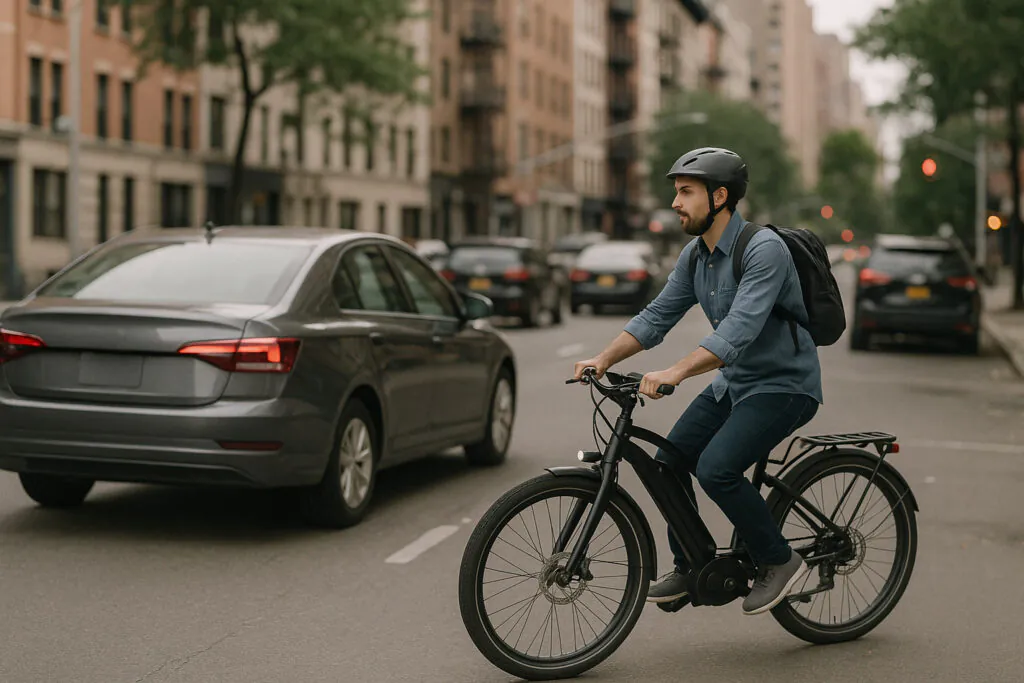
A driver turning across a bicycle lane may look for pedestrians and oncoming vehicles without recognizing how quickly an e-bike is approaching. Other crashes occur when a driver merges into the lane, pulls from the curb, enters a garage, or crosses a bicycle route to reach a parking space or loading area.
Signal timing, vehicle speed, sight lines, turn restrictions, and the rider’s direction of travel may all matter.
Parked cars and curbside activity
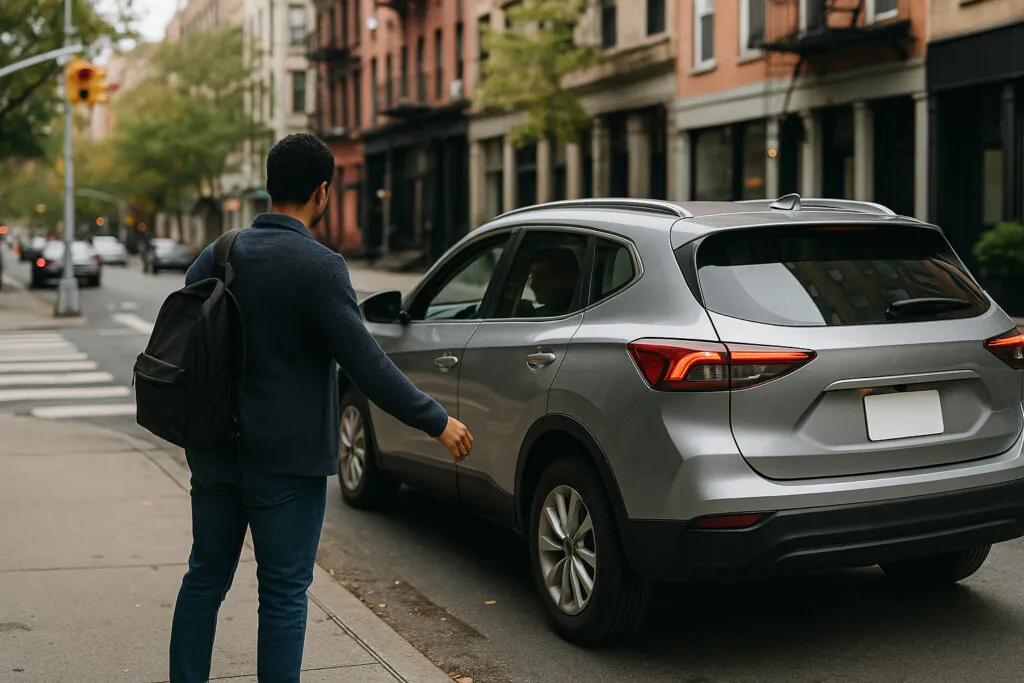
Dooring crashes happen when a driver or passenger opens a door into a rider’s path. Delivery trucks, taxis, rideshare vehicles, buses, garbage collection, construction, and double parking can also force riders out of a bicycle lane and into moving traffic.
Photographs should show the entire curbside area—not only the damaged bike. The position of parked vehicles and loading activity may explain why the rider changed lanes or had no safe route forward.
Crosstown streets and park connections
Riders traveling between Riverside Park, Central Park, subway stations, homes, schools, and businesses may encounter abrupt changes in bicycle infrastructure. A protected segment can lead into an ordinary traffic lane or an intersection where drivers turn across the rider’s path.
A crash near a park drive or greenway may also raise questions about which agency or entity controlled the surface, lighting, barrier, path, or construction zone.
Sidewalks, crosswalks, and building entrances
E-bikes are not permitted to be ridden on New York City sidewalks. Even so, pedestrian collisions may occur near restaurant entrances, apartment buildings, curb ramps, crosswalks, and places where riders enter or leave the street.
When a pedestrian is injured, the investigation should consider the rider’s conduct, visibility, nearby delivery activity, possible employer involvement, and whether any insurance policy covers the loss.
E-Bike Cases Billy Cooper Law Handles
The firm represents injured people in matters involving:
- E-bike riders struck by negligent drivers
- Car and taxi collisions
- Uber and Lyft collisions
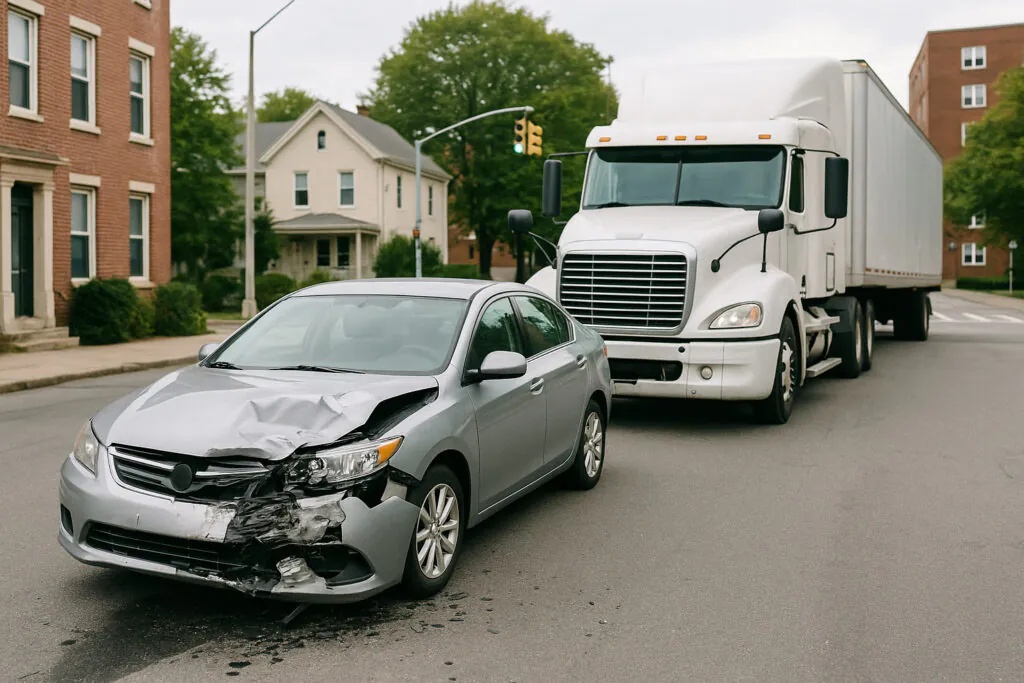
- Truck and commercial vehicle crashes
- Bicycle and e-bike collisions
- Pedestrians struck by e-bikes
- Delivery riders injured while working
- Defective e-bikes, brakes, throttles, chargers, and batteries
- Catastrophic injuries and fatal e-bike accidents
One crash may create several claims. A delivery rider hit by a truck, for example, may have access to work-related benefits and a separate claim against the driver, vehicle owner, or another responsible company.
What to Do After an E-Bike Accident
Your health comes first. Call 911 if you may have suffered a head injury, fracture, spinal injury, internal injury, severe bleeding, or significant road rash. Adrenaline can hide symptoms, and a damaged helmet does not tell you whether a concussion or brain injury occurred.
When you can do so safely:
- Report the crash. Ask the police to document every vehicle and person involved. Make sure the report describes your vehicle as an e-bike rather than incorrectly calling it a moped or motorcycle.
- Photograph the full scene. Include lane markings, signals, signs, parked vehicles, road defects, construction, nearby buildings, vehicle plates, and the resting positions of the bike and other vehicles.
- Get witness information. Do not assume the police report will contain every witness’s name and number.
- Photograph the e-bike label. Capture the make, model, serial number, motor wattage, class, battery, controller, and manufacturer’s speed label.
- Preserve the bike and helmet. Do not repair, discard, recharge, or alter damaged equipment before it can be inspected.
- Save digital information. Keep delivery-app records, GPS history, trip data, photographs, text messages, and communications with an employer or platform.
- Be careful with insurance calls. Do not guess about speed, distance, injuries, or fault. You are not required to give the other party’s insurer an immediate recorded statement.
The New York DMV MV-104 instructions require a crash report within 10 days when a crash causes death, personal injury, or more than $1,000 in property damage. The form specifically addresses injury-producing e-bike and e-scooter crashes. (dmv.ny.gov)
Evidence That May Decide the Case
Some of the most important evidence may disappear within days. Potential sources include:
- Apartment-building, garage, storefront, school, and doorbell video
- Bus, taxi, rideshare, or commercial vehicle cameras
- Police reports, body-camera footage, and 911 recordings
- Vehicle event-data and telematics
- Driver cellphone records
- Delivery-app order, dispatch, route, and GPS data
- Witness statements
- Traffic-signal timing and lane-design records
- NYC DOT permits, resurfacing records, and work orders
- Prior complaints concerning a road or bicycle-lane defect
- The e-bike’s manufacturer label, battery, controller, brakes, and throttle
- Purchase receipts and maintenance records
- Medical records, imaging, work restrictions, and wage documentation
The bike itself can be crucial. A mechanical failure may support a product or repair claim. Modifications may affect whether the device legally qualified as an e-bike. Damage patterns can also help explain the angle and force of the impact.
New York E-Bike Rules That May Affect Your Claim
Under New York Vehicle and Traffic Law § 102-c, a legal e-bike must have operable pedals, be no more than 36 inches wide, and use an electric motor of less than 750 watts. State law recognizes three classes based on whether the motor uses pedal assistance or a throttle and the speed at which motor assistance stops. Qualifying e-bikes are excluded from the state definition of a motor vehicle under Vehicle and Traffic Law § 125. (nysenate.gov)
The distinction between an e-bike and a moped matters. A legal e-bike does not require a driver’s license, registration, or license plate. A moped does, and mopeds cannot lawfully use bicycle lanes.
Current NYC DOT e-bike rules include the following:
- An e-bike operator must be at least 16.
- E-bikes may be used in bicycle lanes and on qualifying streets.
- E-bikes may not be ridden on sidewalks.
- Riders must yield to pedestrians.
- The operating speed limit for e-bikes in New York City is 15 mph.
- Helmets are required for Class 3 e-bike riders and delivery workers; they are recommended for everyone.
- A manufacturer’s classification and wattage label must be affixed to the bike.
Cyclists have roadway rights and are generally subject to the duties that apply to vehicle drivers under Vehicle and Traffic Law § 1231. Additional statewide e-bike rules appear in Vehicle and Traffic Law § 1242. (nyc.gov)
A traffic violation may be relevant evidence, but it does not answer every liability question. A speeding rider can still be hit by a driver who made an unsafe turn. A rider’s mistake does not excuse a motorist from using reasonable care.
How Insurance Works After an E-Bike Crash
When a qualifying e-bike rider is struck by a car, the rider will generally seek no-fault benefits through the insurer covering the striking vehicle. No-fault can pay qualifying medical expenses, part of lost earnings, and certain necessary expenses without waiting for the liability claim to end.
New York’s no-fault notice rule generally requires written notice within 30 days unless there is a clear and reasonable justification for delay. Basic no-fault coverage is ordinarily limited to $50,000 per person. (dfs.ny.gov)
If no motor vehicle was involved, automobile no-fault coverage may not apply. Medical bills may initially go through health insurance or workers’ compensation, while the liability claim proceeds against the responsible rider, business, property owner, manufacturer, or public entity.
A pedestrian hit by an e-bike may face a different insurance problem because legal e-bikes are not insured like cars. Depending on the facts, possible coverage may include a rider’s homeowners, renters, umbrella, business, restaurant, or delivery-company policy. Those policies often contain exclusions, so each one must be reviewed rather than assumed.
Hit-and-run and uninsured-driver cases require immediate attention. Possible sources of coverage include a household automobile policy or the Motor Vehicle Accident Indemnification Corporation, but reporting and application deadlines can be short.
What If You Are Accused of Sharing Fault?
New York changed its comparative-fault rules for certain motor vehicle cases in 2026.
For actions commenced on or after May 26, 2026, CPLR § 1411(b) provides that a claimant in a personal injury action subject to New York’s no-fault law is barred from recovery if the claimant’s fault is greater than the fault of the person—or combined parties—from whom recovery is sought. A claimant found 50% responsible may still recover a reduced amount. A claimant found 51% responsible may recover nothing in a covered motor vehicle action. (nysenate.gov)
Claims not governed by the no-fault law generally remain subject to New York’s traditional comparative-negligence rule. In those cases, partial fault reduces compensation in proportion to the claimant’s responsibility rather than automatically barring the claim.
The same 2026 legislation changed New York’s “serious injury” definition for motor vehicle cases. The former 90/180-day category was removed for actions commenced on or after May 26, 2026. Fractures, significant disfigurement, permanent loss of use, permanent consequential limitations, and significant limitations of a body function or system remain among the categories recognized by Insurance Law § 5102. Objective medical documentation is now even more important. (dfs.ny.gov)
Filing Deadlines Can Arrive Quickly
Many New York personal injury lawsuits must be commenced within three years under CPLR § 214. That is not a safe deadline to assume in every e-bike case.
Other deadlines may include:
- 10 days: Filing an MV-104 crash report when required
- 30 days: Giving notice for no-fault benefits, subject to limited exceptions
- 90 days: Serving a notice of claim when a municipal defendant is involved
- One year and 90 days: Commencing many negligence actions against New York City
- Two years after death: Commencing many wrongful death actions
Insurance policies, uninsured-motorist claims, delivery-company procedures, and claims against public authorities may impose additional requirements. The correct deadline depends on who caused the crash, who owned the vehicle or location, and what type of device was involved.
When New York City May Be Responsible
A government claim may arise if an e-bike crash involved a City vehicle, dangerous street condition, defective barrier, missing or obscured sign, park path, construction project, or another location controlled by a public entity.
Under General Municipal Law § 50-e, a notice of claim is generally required within 90 days. General Municipal Law § 50-i generally requires a negligence action against the City to be commenced within one year and 90 days. (nysenate.gov)
Street-defect claims face another obstacle. NYC Administrative Code § 7-201 generally requires prior written notice of a dangerous street, bicycle-lane, or roadway condition before the City can be held liable, subject to narrow exceptions. (codelibrary.amlegal.com)
That makes the precise location essential. An attorney may need to search prior complaints, written acknowledgments, repair records, permits, resurfacing documents, contractor records, and earlier accident reports. A general description such as “a pothole near West 86th Street” may not be specific enough months later.
Compensation in an E-Bike Injury Case
Depending on the facts and available insurance, compensation may include:
- Ambulance and emergency treatment
- Hospital care, surgery, and medication
- Rehabilitation and physical therapy
- Future medical treatment
- Lost wages
- Reduced future earning capacity
- Household and transportation expenses
- E-bike, helmet, clothing, and other property damage
- Physical pain and suffering
- Emotional distress
- Scarring and disfigurement
- Loss of enjoyment of life
- Permanent disability
- Wrongful death damages when an injury is fatal
An early settlement offer may account for the emergency-room bill while ignoring future surgery, chronic pain, cognitive symptoms, time away from work, or the need for ongoing assistance. The full medical picture should be understood before a claim is resolved.
Local Medical Care, Courts, and Records
Call 911 after a serious crash rather than trying to choose a hospital based on a potential legal claim. EMS will determine the appropriate destination based on your condition and available care.
Near the northern end of the Upper West Side, the Mount Sinai Morningside Emergency Department provides emergency care at its West 113th Street entrance. The New York State Department of Health lists Mount Sinai Morningside as a Level II adult trauma center. (mountsinai.org)
When an Upper West Side case is filed in state court, a substantial personal injury action may proceed in New York County Supreme Court, Civil Term. Its main facility is the New York County Courthouse at 60 Centre Street, although the court conducts work in several buildings and most new cases are electronically filed. (nycourts.gov)
The location of a courthouse does not make a case local by itself. What matters is knowing which agencies, businesses, building owners, vehicle operators, and technology platforms may possess the evidence.
BILLY COOPER LAW
How Billy Cooper Law Investigates an E-Bike Case
A focused investigation may include:
- Inspecting and photographing the crash location
- Confirming the lane design and traffic controls in place on the accident date
- Obtaining police, 911, EMS, and available body-camera records
- Sending prompt requests to preserve video
- Identifying vehicle owners, employers, and applicable insurers
- Securing delivery-app, dispatch, and GPS records
- Inspecting the e-bike for defects, damage, labels, and modifications
- Reviewing roadway complaints, permits, and repair records
- Consulting reconstruction or mechanical experts when needed
- Documenting the connection between the crash and each injury
- Calculating past and future medical, wage, and household losses
- Handling no-fault applications and insurance communications
- Filing claims against the correct private or public parties
The goal is to answer the questions the insurance company will eventually raise before evidence is lost: How fast was each party moving? Who had the right of way? Could the driver see the rider? Was the bike legally classified? Did a product fail? Was the rider working? Who controlled the location? What will the injury mean six months or five years from now?
Related Billy Cooper Law Resources
- New York e-bike accident claims
- New York bicycle accident claims
- Traumatic brain injury claims
- Wrongful death claims
Tell Us What Happened
If you were injured in an Upper West Side e-bike crash, try to get answers before the bike is repaired, video is overwritten, or an insurance deadline passes.
Billy Cooper Law offers free consultations and handles personal injury cases on a contingency basis. Call (718) 866-3311 or contact Billy Cooper Law to explain what happened and ask your questions. (billycooperlaw.com)
Upper West Side NY E-Bike Accident FAQs: Medical Care, Insurance, and Claims
These answers provide general New York information, not advice for a particular case; the crash facts, the law in effect on the crash date, local rules, available insurance, and supporting evidence can change the analysis.
What should I do immediately after an e-bike accident in Upper West Side NY?
Call 911 if anyone may be injured, traffic creates an immediate danger, or emergency help is needed. Do not move a person with a possible head or neck injury unless leaving them in place creates a greater danger. If you can do so safely, exchange names, contact details, vehicle and insurance information, identify witnesses, and photograph the vehicles, e-bike, road conditions, traffic controls, and visible injuries.
Preserve the e-bike, helmet, damaged clothing, purchase and repair records, electronic ride data, photographs, and messages without altering or discarding them. Report the crash promptly to the appropriate insurer. New York’s current MV-104 instructions require a police report and a DMV report when an e-bike or e-scooter crash causes injury; the form also says reportable crashes must be filed with DMV within 10 days. Which form and duties apply can depend on who and what were involved.
Sources: New York DMV Report of Motor Vehicle Crash instructions; MedlinePlus head-injury first aid guidance.
Should I get medical care if I felt fine right after the e-bike crash?
Yes—seek prompt medical guidance after a significant impact, especially if your head, neck, back, chest, or abdomen was struck. Call 911 or go to an emergency department for danger signs such as a worsening headache, repeated vomiting, seizure, weakness or numbness, slurred speech, unequal pupils, increasing confusion, loss of consciousness, or difficulty waking. This information cannot determine whether you have an injury.
Feeling normal at the scene does not rule out a concussion or another injury. The CDC explains that some mild traumatic-brain-injury symptoms appear immediately while others emerge hours or days later, and MedlinePlus likewise notes that symptoms can develop slowly. Tell the clinician how the crash happened and report all symptoms accurately. Follow the clinician’s instructions, attend recommended follow-up, and keep discharge papers, test results, prescriptions, bills, and a dated record of symptoms and activity limits.
Sources: CDC symptoms of mild TBI and concussion; MedlinePlus traumatic brain injury overview.
Does my bicycle qualify as an e-bike under New York law?
It qualifies only if it meets New York’s statutory definition. Vehicle and Traffic Law § 102-c currently requires, among other things, operable pedals, a motor of less than 750 watts, a width of no more than 36 inches, federal bicycle-equipment compliance, and one of three assistance profiles: Class 1 pedal assist to 20 mph, Class 2 motor assistance to 20 mph, or Class 3 motor assistance to 25 mph solely in a city of at least one million people.
Do not rely only on a seller’s description. Check the permanent manufacturer label for class, maximum motor-assisted speed, and wattage, and preserve photographs of that label after a crash. Modifications to speed, power, pedals, or control systems may change how the device is classified and which traffic or insurance rules apply. New York also permits local governments to regulate where and how compliant e-bikes may operate, so the statewide definition is only the starting point for a Upper West Side NY analysis.
Sources: New York Vehicle and Traffic Law § 102-c; New York Vehicle and Traffic Law § 1242.
Where may I legally ride an e-bike in Upper West Side NY?
New York generally allows a compliant e-bike on highways with a posted speed limit of 30 mph or less and in designated bicycle lanes, subject to local restrictions. State law generally prohibits operating an e-bike on a sidewalk unless a local law authorizes it, requires riders to yield to pedestrians and ride single file on a roadway, and prohibits Class 3 e-bikes outside a city with a population of one million or more.
The exact rule in Upper West Side NY may be narrower because cities, towns, villages, counties, parks, and state agencies can regulate or prohibit e-bike use in certain places. Look for posted restrictions and confirm the current local code for the specific street, path, park, greenway, or public property involved. A traffic violation can matter as evidence, but it does not by itself answer every question about civil fault; the conduct of the motorist, rider, and any other responsible actor must be evaluated separately.
Sources: New York Vehicle and Traffic Law § 1242; New York State DOT bicycle and e-bike FAQs.
Who may be responsible when a motor vehicle hits an e-bike rider?
Responsibility depends on whose conduct caused the collision. New York Vehicle and Traffic Law § 1146 requires drivers to exercise due care to avoid colliding with bicyclists. A driver may be responsible for conduct such as failing to yield, turning or opening a door without adequate observation, following too closely, speeding, distraction, or another proven breach of a traffic or ordinary-care duty. A police citation can be relevant, but it is not the entire civil-liability analysis.
The e-bike rider’s conduct is also examined because riders generally receive the roadway rights and duties that apply to vehicle drivers, subject to bicycle-specific rules. The motor vehicle’s owner may also be responsible for a permissive driver’s negligent operation under Vehicle and Traffic Law § 388. Employment relationships, roadway control, or a defective product can raise additional fact-specific questions, but those theories require evidence; they should not be assumed from the crash alone.
Sources: New York Vehicle and Traffic Law § 1146; New York Vehicle and Traffic Law § 1231; New York Vehicle and Traffic Law § 388.
Can no-fault insurance pay an e-bike rider’s medical bills and lost earnings?
Often, yes, when the rider’s injury arises from the use or operation of a covered motor vehicle in New York. The Appellate Division has explained that New York’s no-fault system applies to a cyclist struck by or in contact with a motor vehicle. Statutory basic economic loss can include necessary medical care, a portion of lost earnings, and specified reasonable expenses, subject to limits, exclusions, offsets, proof requirements, and the facts connecting the injury to the vehicle.
Act quickly even though the coverage is called “no-fault.” The Department of Financial Services says written notice generally must reach the proper no-fault insurer within 30 days unless the injured person provides clear and reasonable justification for delay; medical bills generally have a 45-day submission period and wage claims a 90-day period. No-fault benefits do not determine fault or automatically pay pain and suffering, and a separate liability claim may be subject to New York’s serious-injury requirement.
Sources: New York DFS no-fault consumer FAQs; New York Insurance Law § 5102; Rojas v. Romanoff, New York Official Reports.
What can I do if the driver who hit my e-bike fled or had no insurance?
Report a hit-and-run to police immediately and pursue available insurance without delay. New York DFS instructs an injured person to look first to an applicable automobile policy in the household when the striking vehicle is unidentified or uninsured. If no such coverage is available, the Motor Vehicle Accident Indemnification Corporation may provide no-fault benefits or a path to a bodily-injury claim for a person who satisfies Article 52’s residency, insurance, reporting, cooperation, and eligibility requirements.
The deadlines can be much shorter than the ordinary lawsuit deadline. Insurance Law § 5208 generally requires a hit-and-run involving an unascertainable driver to be reported to police or another specified official within 24 hours and a notice of claim to MVAIC within 90 days, while an identified uninsured-motorist claim generally has a 180-day filing period. The statute contains limited exceptions, but relying on one is risky. Preserve witness details, video locations, debris, delivery or ride-app data, and every insurance or police communication.
Sources: New York Insurance Law § 5208; New York DFS auto-insurance consumer guide; MVAIC official eligibility requirements.
Can I still recover if I may have been partly at fault for the e-bike accident?
Possibly. Current CPLR § 1411 uses different consequences depending on the kind of claim. In a personal-injury action subject to New York’s no-fault law, recovery is barred if the claimant’s culpable conduct is greater than the fault of the person sued or greater than the combined fault of all people sued. When that bar does not apply, fault attributed to the rider can still reduce recoverable damages. Claims outside that subsection generally remain subject to proportional reduction rather than an automatic bar.
That makes the crash date, the applicability of Insurance Law Article 51, and a careful allocation of fault important. Evidence may include sight lines, signal timing, vehicle and e-bike data, surveillance video, witness accounts, lighting, road design, and compliance with traffic rules. A rider should not accept an insurer’s fault percentage as a final legal determination. The current statute should be checked against the law governing the particular accident before any conclusion is reached.
Sources: New York CPLR § 1411; New York Insurance Law § 5104.
How long do I have to bring an e-bike accident claim in New York?
For many New York negligence claims seeking damages for personal injury, CPLR § 214 sets a three-year limitations period, but that is not a safe universal deadline. A claim against a city, county, public authority, school district, or another public entity may require a notice of claim, often within 90 days under General Municipal Law § 50-e. Wrongful-death, workers’ compensation, hit-and-run, contractual, and out-of-state claims can follow different rules.
Insurance deadlines arrive sooner and are separate from the time to sue. New York DFS states that no-fault written notice generally must be submitted within 30 days, with different deadlines for medical bills and wage-loss proof. The proper defendant and public owner may not be obvious from the scene, and video or electronic records can disappear quickly. Identify every potentially responsible party and applicable coverage promptly rather than calculating from the general three-year period alone.
Sources: New York CPLR § 214; New York General Municipal Law § 50-e; New York DFS no-fault filing deadlines.
Can I seek workers’ compensation if I crashed while making deliveries by e-bike?
You may be eligible if the crash arose out of and occurred in the course of covered employment. New York workers’ compensation can provide medical care and wage-related benefits without requiring proof that the employer caused the crash. Whether an app-based courier is an employee is fact-specific; a 1099 label alone does not settle the issue, and the Workers’ Compensation Board considers supervision, direction, control, and other features of the working relationship.
Notify the employer in writing as soon as possible and generally within 30 days, and file Form C-3 with the Board promptly; the Board states that the claim generally must be filed within two years of the accident. If a motorist or another third party caused the crash, a separate claim may coexist with workers’ compensation, but Workers’ Compensation Law § 29 can create reimbursement, lien, consent, and timing issues. Preserve delivery-app logs, assignment details, pay records, communications, and the route in progress.
Sources: New York Workers’ Compensation Board claim instructions; New York Workers’ Compensation Board coverage criteria; New York Workers’ Compensation Law § 29.
Sources
Billy Cooper Law
- Billy Cooper Law
- New York E-Bike Accident Lawyer
- Upper West Side NY Personal Injury Lawyer
- William H. “Billy” Cooper
- Anieska J. Garcia
- Billy Cooper Law Contact Information
- New York Car Accident Lawyer
- New York Uber and Lyft Accident Lawyer
- New York Truck and Commercial Vehicle Accident Lawyer
- New York Bicycle Accident Lawyer
- New York Pedestrian Accident Lawyer
- New York Work Injury Lawyer
- New York Products Liability Lawyer
- New York Catastrophic Injury Lawyer
- New York Traumatic Brain Injury Lawyer
- New York Wrongful Death Lawyer
Upper West Side and Traffic Data
- Manhattan Community Board 7
- Manhattan Community Board 7 Fiscal Year 2024 Transportation Statement
- NYC DOT 2024 Bicycle Crash Data Report
- NYC DOT West 72nd Street Protected Bike Lane Proposal
- NYC DOT Electric Bicycles and Micromobility Rules
New York Law and Insurance
- Vehicle and Traffic Law § 102-c: Bicycle With Electric Assist
- Vehicle and Traffic Law § 125: Motor Vehicles
- Vehicle and Traffic Law § 1231: Rights and Duties of Bicycle Riders
- Vehicle and Traffic Law § 1242: Additional E-Bike Provisions
- New York DMV MV-104 Crash Report and Instructions
- New York Department of Financial Services No-Fault FAQs
- New York Department of Financial Services Auto Insurance Information
- New York Department of Financial Services 2026 Motor Vehicle Insurance Reforms
- CPLR § 1411: Comparative Fault
- CPLR § 214: Personal Injury Limitation Period
- Insurance Law § 5102: No-Fault and Serious Injury Definitions
- General Municipal Law § 50-e: Notice of Claim
- General Municipal Law § 50-i: Actions Against Municipalities
- NYC Administrative Code § 7-201: Actions Against the City
Medical and Court Resources
- Mount Sinai Morningside Emergency Department
- New York State Trauma Center Directory
- New York County Supreme Court, Civil Term
- About New York County Supreme Court, Civil Term
BILLY COOPER LAW
Get the Answers You Need
At Billy Cooper Law, every day we renew our pledge to help injured people get the justice and compensation they deserve. We have a reputation throughout New York and nationally for standing up for our clients, and we take that responsibility seriously by approaching every case with preparation, persistence, and an unwavering commitment to results.