
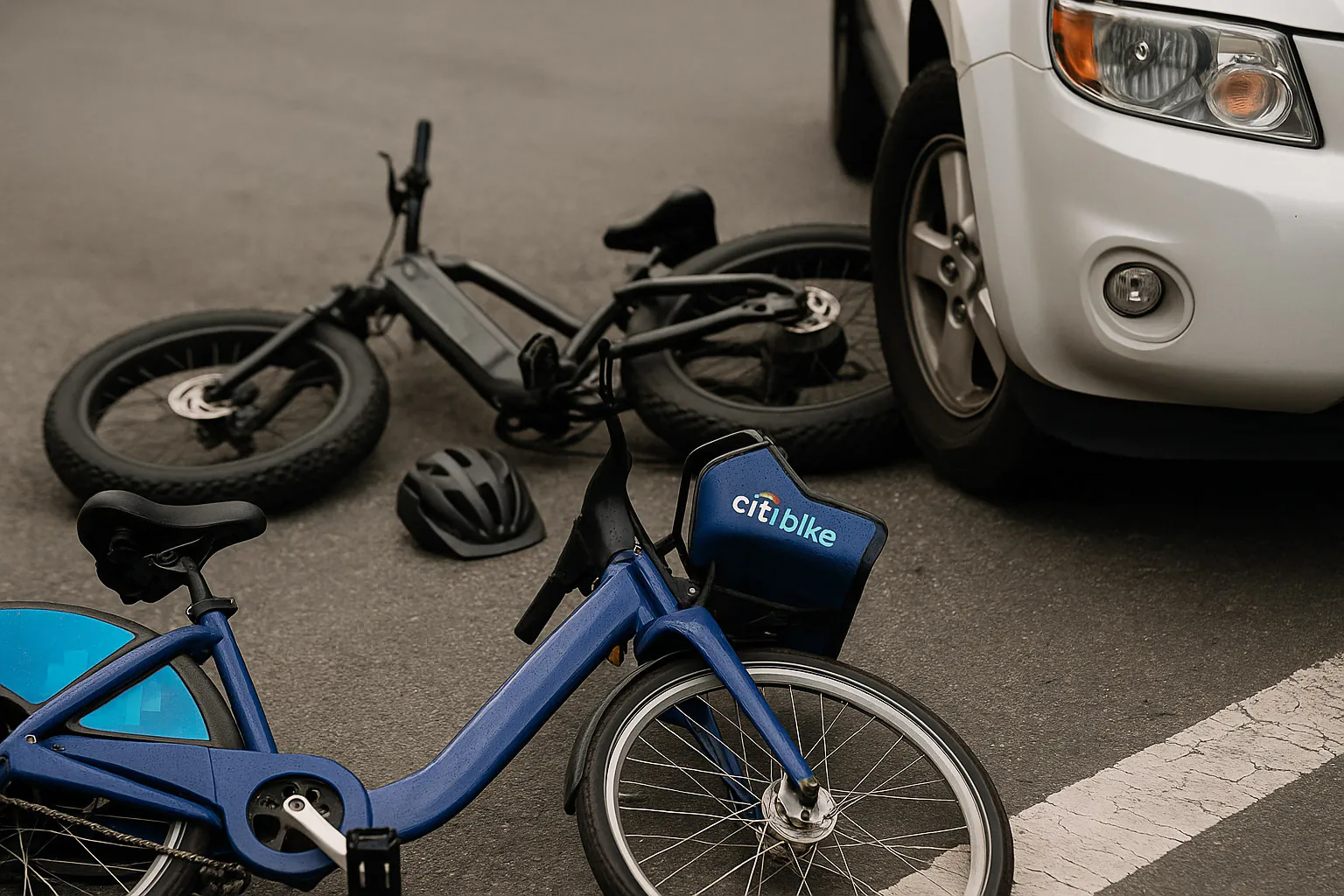
Collisions with moving or parked motor vehicles are the leading cause of death in e-bike accidents. In its April 2026 micromobility report, the U.S. Consumer Product Safety Commission identified 310 reported e-bike fatalities from 2017 through 2024. Of those deaths, 170 involved motor vehicles—far more than control problems, battery fires, or other identified hazards.
New York City data points in the same direction. In the NYC Department of Transportation’s 2024 crash report, motor vehicles were involved in 14 of the city’s 17 e-bike rider fatalities.
These figures cover e-bikes generally, not Citi Bike alone. NYC’s public crash report does not identify the bike’s brand or operator. Still, the data gives Citi Bike riders and their families a clear answer: the greatest fatal danger is a collision with a car, SUV, truck, bus, or other motor vehicle.
BILLY COOPER LAW

Motor Vehicles—not Batteries—Lead Fatal E-Bike Crashes
News coverage of lithium-ion battery fires can make fires seem like the primary fatal e-bike risk. Those fires are serious, but they are not the leading cause of e-bike deaths.
The CPSC’s 2017–2024 analysis attributed 170 reported deaths to collisions with moving or parked motor vehicles. Control issues, such as striking a curb or fixed object, accounted for 61 deaths. Battery-related fires accounted for 19.
The report describes the cause by the event that led to death, rather than by a medical diagnosis. It therefore does not establish that one particular injury—such as a brain injury—is the leading medical cause. What it does show is that motor-vehicle contact is the most common fatal crash scenario.
The reason is straightforward. An e-bike rider has no vehicle frame, seat belt, or airbag. A collision can throw the rider into the roadway or beneath a vehicle, producing more than one severe impact.
What Citi Bike Riders Should Take From the Data
Citi Bike e-bikes use pedal-assist technology: the rider pedals, and the motor adds power. They are not throttle-powered mopeds or motorcycles.
New York City currently limits e-bikes to 15 mph. Citi Bike’s electric fleet is also programmed so that motor assistance stops at that speed. NYC DOT adopted the lower cap after concerns about fatal crashes involving faster Citi Bike models, but a lower e-bike speed cannot control the speed or conduct of the motor vehicles around a rider.
The most dangerous interactions can arise when a driver:
- Turns across a rider’s path without yielding;
- Opens a vehicle door into a bike lane;
- Enters or blocks a bike lane;
- Passes without leaving enough space; or
- Fails to see a rider at an intersection.
A parked vehicle can also be part of a fatal crash. The CPSC category includes collisions with parked cars, which may involve an opening door or a rider being forced into a stationary vehicle.
Why a Fatal Citi Bike Crash Requires a Careful Investigation
The initial police report may not tell the whole story. A driver might claim that the rider appeared suddenly, ignored a signal, or lost control. Witnesses and camera footage may tell a different story.
A thorough investigation may examine:
- NYPD collision reports and witness statements;
- Traffic, building, bus, dashboard, or doorbell video;
- The motor vehicle’s damage and electronic data;
- The driver’s phone, work, or delivery records;
- The Citi Bike number, trip history, and docking information;
- The e-bike’s brakes, tires, steering, battery, and motor assistance; and
- Medical examiner findings and the rider’s medical records.
Citi Bike data can be particularly important when there is a question about speed, a mechanical problem, or which bicycle was involved. A family should save available app screenshots, ride receipts, emails, and photographs rather than relying on continued access to the account.
If a defect is suspected, the specific bicycle should be identified before it is repaired or returned to service. A prompt preservation request can also tell relevant businesses, property owners, and vehicle operators not to erase video or electronic records.
Who May Be Responsible for an E-Bike Rider’s Death?
Responsibility depends on what caused the crash. The most useful categories to examine are:
The driver and vehicle owner
A driver may be liable for speeding, failing to yield, making an unsafe turn, opening a door into traffic, or otherwise driving carelessly. Under New York Vehicle and Traffic Law § 388, a vehicle owner can also be responsible for negligence by someone operating the vehicle with permission.
The driver’s employer
An employer may be responsible when an employee causes a crash while acting within the scope of the job. This can matter when the vehicle belonged to a delivery company, contractor, rideshare operation, or other business.
A bike operator or product company
If faulty brakes, a loose wheel, unexpected motor assistance, or negligent maintenance contributed to the crash, the investigation may include the bike operator, manufacturer, seller, or component company. A defect claim requires evidence connecting the product problem to the collision; a crash involving a rental bike does not automatically make the operator liable.
A government or roadway entity
A public entity may be involved when a government vehicle or an actionable roadway condition contributed to the death. These claims can involve special defenses and much shorter notice requirements.
Three Time Limits Families Should Know
These are general New York rules, not advice about a particular case.
30-day no-fault notice when a motor vehicle is involved
A qualifying e-bike rider struck by a motor vehicle may be covered as a pedestrian under New York no-fault insurance. The Department of Financial Services states that written notice generally must reach the proper insurer within 30 days, unless there is a clear and reasonable justification for delay.
Two years for a New York wrongful death action
Under EPTL § 5-4.1, the estate’s personal representative generally has two years from the date of death to begin a wrongful death lawsuit. Waiting can still damage a case long before that date because video, physical evidence, and witnesses may become unavailable.
90-day notice for many government claims
When a city or another public corporation may be responsible, General Municipal Law § 50-e often requires a notice of claim within 90 days. In a wrongful death matter, that period generally runs from the appointment of the estate’s representative.
BILLY COOPER LAW
Why Contact Billy Cooper Law After a Fatal E-Bike Crash?
A fatal Citi Bike or e-bike collision can leave a family trying to understand a crash while also dealing with grief, insurance questions, and estate responsibilities. Billy Cooper Law represents e-bike riders and their families in New York. The firm’s stated services include reviewing police and medical records, gathering witness statements and crash footage, investigating fault, working with appropriate experts, handling insurer communications, and filing a lawsuit when necessary.
The firm offers free consultations and handles personal injury matters on a contingency fee basis, meaning legal fees are owed only if compensation is recovered. If your family needs clear answers about a fatal e-bike accident, evidence preservation, insurance coverage, or a possible wrongful death claim, contact Billy Cooper Law to discuss what happened and what legal options may be available.
Published Writings by Billy Cooper
- Who Should Be Liable When a Child Is Hurt on an E-Bike? — Billy Cooper, New York Law Journal, September 15, 2026. Billy examines who may bear responsibility when a child is injured on an e-bike, including riders, parents, manufacturers, and retailers.
- Op-ed: NY doesn’t have an e-bike problem. It has a speed problem. — Billy Cooper, Crain’s New York Business, September 1, 2026. Billy’s commentary considers speed as a central concern in New York’s e-bike safety debate.
NOTABLE RESULTS
Selected results in Billy Cooper Law’s broader personal injury practice:
$2,400,000 settlement · $1,725,000 verdict
Read more about these results
- $2,400,000 settlement — Fatal tractor-trailer collision
A mediated wrongful-death settlement followed a tractor-trailer crossing the median and striking a bus head-on in New York County.
- $1,725,000 verdict — Wrongful death involving a drunk driver
A Putnam County verdict followed the death of a thirteen-year-old boy struck by a drunk driver; the case involved the bar’s improper service of alcohol.
These are reported gross results, before fees, expenses, and applicable liens. They are not estimates of another claim’s value. Read the firm’s published case results.
Prior results do not guarantee a similar outcome. Each case is different and must be evaluated on its own facts.
WHAT OUR CLIENTS SAY
General feedback about working with Billy Cooper Law:
“I am an attorney in Massachusetts and specialize in personal injury matters. I have known Billy Cooper for many years and refer clients to him who have been injured in New York. I know many personal injury lawyers who practice in New York and there is no one else I would refer my clients to. He is smart, hard working and trustworthy. Thank you for your help over the years.”
— R. M., Google review
“I had the pleasure of working with Billy Cooper a number of years back, and I can’t thank him enough for his incredible help and ongoing support. From the beginning, he made the legal process feel less daunting with his approachable and friendly manner. His expertise in personal injury law was evident, and he fought hard for my case, resulting in a substantial settlement.Billy didn’t just stop once the case was over. He has always been there to offer advice and guidance whenever I’ve needed it. His down-to-earth explanations of legal jargon made everything so much easier to understand, empowering me to make informed decisions.I can’t recommend Billy Cooper enough. He’s not just a fantastic lawyer; he’s a genuine human being who goes above and beyond for his clients.”
— H. K., Google review
Professional Recognition

Recognition applies to the named attorneys and selection years. See the linked profiles for details.
Related Billy Cooper Law Videos and Social Posts
- Bicycle and E-Bike Safety — Facebook.
- Billy Cooper Law official LinkedIn profile — LinkedIn.
- Billy Cooper Law official YouTube channel — official profile.
- Billy Cooper Law official Instagram profile — official profile.
- What to Do After an E-Bike or E-Scooter Accident — Facebook.
- Sharing the Road With E-Bikes and E-Scooters — Facebook.
Frequently Asked Questions
Is a Citi Bike e-bike legally considered a motor vehicle in New York?
No. Citi Bike’s electric bicycles provide pedal assistance, and New York Vehicle and Traffic Law § 125 excludes qualifying bicycles with electric assist from the definition of a motor vehicle. That classification can affect traffic rules and insurance coverage after a collision.
Can a family pursue a claim if the rider was not wearing a helmet?
Not wearing a helmet does not automatically defeat a New York wrongful death claim. Under CPLR § 1411, conduct attributed to the deceased can reduce wrongful death damages in proportion to fault, but it does not by itself bar recovery. NYC recommends helmets for all e-bike riders and requires them in certain situations, including for riders under 18 and delivery workers.
What if the driver who struck the e-bike rider fled?
A hit-and-run may still allow access to no-fault or uninsured-motorist benefits. If no applicable household auto policy exists, the claim may involve New York’s Motor Vehicle Accident Indemnification Corporation, but police and insurance reporting requirements can be short.
Does a Citi Bike crash need to be reported separately to Citi Bike?
Yes. In addition to calling 911 and making a police report, Citi Bike instructs riders to notify customer service within 24 hours. That instruction is separate from New York’s insurance notices and lawsuit deadlines.
Sources
- Billy Cooper Law: New York E-Bike Accident Lawyer
- U.S. Consumer Product Safety Commission: Micromobility Deaths, Injuries, and Hazard Patterns, 2017–2024
- NYC Department of Transportation: Bicycle Crash Data 2024
- NYC DOT: Electric Bicycles and Other Motorized Devices
- Citi Bike: Electric Pedal-Assist Bikes
- Citi Bike: Reporting Safety Incidents
- New York Department of Financial Services: No-Fault Insurance FAQs
- New York Estates, Powers and Trusts Law § 5-4.1
- New York General Municipal Law § 50-e
- New York Vehicle and Traffic Law § 125
- New York Vehicle and Traffic Law § 388
- New York Civil Practice Law and Rules § 1411
Related Practice Resources
Related Reading and Practice Resources
- Wrongful Death
- Personal Injury
- Rideshare App Status and Coverage
- Bicycle Crash Claims
- Pedestrian Crash Claims
- World Cup Travel and Rideshare Safety
- Who Pays After a Rideshare Crash
- Filing a Wrongful-Death Claim
- Recoverable Injury Damages
- Comparative Negligence
- Driverless Cars and Responsibility
- Claims After a Lyft Accident
- When an E-Bike Hits Your Car
BILLY COOPER LAW

Get the Answers You Need
At Billy Cooper Law, every day we renew our pledge to help injured people get the justice and compensation they deserve. We have a reputation throughout New York and nationally for standing up for our clients, and we take that responsibility seriously by approaching every case with preparation, persistence, and an unwavering commitment to results.