
Haverstraw NY Slip and Fall Lawyer
A serious fall can leave you facing surgery, missed work, and questions the property owner’s insurance company may not answer honestly. You may know what caused you to fall—a patch of ice, broken pavement, a wet floor, poor lighting—but proving who was responsible often requires a prompt investigation.
Billy Cooper Law represents people injured on unsafe property throughout Rockland County. From its White Plains NY office, the firm investigates how the condition developed, who controlled the area, and what evidence exists before repairs, cleanup, or overwritten surveillance footage make the truth harder to establish. Tell Billy Cooper Law what happened or call (914) 730-5789 for a free consultation. (billycooperlaw.com)
Slip and Fall Lawyers Serving Rockland County
- Rockland County
- Ramapo
- Clarkstown
- Haverstraw
- New City
- Spring Valley
BILLY COOPER LAW

A Legal Team That Takes the Time to Explain Your Case
Slip and fall claims are often dismissed too quickly. A store manager may say nobody reported the spill. A landlord may blame a tenant or maintenance contractor. A municipality may rely on a prior-written-notice rule. An insurer may suggest you should have seen the condition and avoided it.
Those are defense arguments—not necessarily the final answer.
Billy Cooper Law reports more than 75 years of combined experience. William H. “Billy” Cooper has practiced with the firm since 1991 and received a Super Lawyers designation from 2024 through 2026. Attorney Anieska J. Garcia handles premises liability matters and is fluent in English and Spanish. The firm also states that people who contact the office speak directly with an attorney rather than being routed only through intake staff. (billycooperlaw.com)
The consultation is free, and personal injury cases are handled on a contingency basis. You can ask questions and learn whether the facts support a claim without paying an upfront attorney’s fee. (billycooperlaw.com)
Why Haverstraw NY Slip and Fall Cases Require a Local Investigation
“Haverstraw” can refer to the Town of Haverstraw or the incorporated Village of Haverstraw. That distinction matters after a fall.
A dangerous walkway may be controlled by:
- A private property owner
- A commercial tenant
- A landlord or management company
- A condominium or homeowners association
- A snow-removal or maintenance contractor
- The Village of Haverstraw
- The Town of Haverstraw
- Rockland County
- New York State
The Village Department of Public Works maintains village-owned streets, parks, and other public property. Separately, the Town operates its own departments and maintains property within its jurisdiction. A fall only a short distance away may therefore involve a different owner, records custodian, maintenance department, insurer, and legal deadline. Village public-works information and Town government information can help identify the relevant public authority, but deeds, tax maps, contracts, and maintenance records may still be needed. (villageofhaverstraw.gov)
The location becomes especially important on public sidewalks, crosswalks, streets, parks, and the Village RiverWalk or trailway. In July 2025, the Village adopted a local law requiring qualifying prior written notice of defects affecting those areas. The law says the notice must be delivered as a physical hard copy to the Village Clerk; an email, website submission, social media comment, or other electronic report does not satisfy the local procedure. Chapter 168 of the Village Code explains that rule. (ecode360.com)
This does not mean a person injured on public property should assume there is no case. It means the investigation must begin quickly enough to determine exactly where the fall occurred, which entity controlled the location, whether qualifying notice existed, and whether another party may also be responsible.
A Local Look at Fall Injuries
The U.S. Census Bureau’s current Haverstraw data estimates that the Town had 40,462 residents in 2025. The 2020–2024 data identifies 12,366 households, with an owner-occupied housing rate of 64.8%. That mix produces potential claims involving private homes, rental properties, apartment common areas, businesses, sidewalks, and community facilities. (census.gov)
The same source reports that 16.6% of residents are age 65 or older. Falls can be especially serious for older adults, who may face fractures, hospitalization, rehabilitation, and loss of independence after an accident. New York State Department of Health data recorded 281 fall-related hospitalizations among Haverstraw residents age 65 and older during 2016–2018, a rate of 166.1 per 10,000 residents in that age group. The Department of Health’s Haverstraw report provides the underlying figures. (health.ny.gov)
The Census Bureau also reports that 50.6% of Haverstraw residents age five and older speak a language other than English at home. If communicating in Spanish is more comfortable, the firm’s bilingual attorney can discuss the claim directly with you rather than requiring a relative to interpret sensitive medical or legal information. (census.gov)
Where Falls Happen in Haverstraw NY
A useful local investigation does more than name streets or landmarks. It identifies who controlled the exact surface and where evidence may be found.
In Haverstraw, serious falls may occur on:
- Sidewalks adjoining homes, apartment buildings, stores, and vacant lots
- Village streets, crosswalks, parks, or the RiverWalk
- Parking areas serving shopping centers, offices, and residential developments
- Apartment stairs, entrances, hallways, laundry rooms, and common walkways
- Grocery-store aisles and checkout areas
- Restaurants and other commercial properties
- Private homes
- Construction and renovation sites
- Bus stops and other public-transportation areas
The Village Code requires owners or occupants of adjoining property to keep sidewalks free from snow and ice and states that removal should occur within 24 hours after snow stops falling. It also requires sidewalks to be kept in safe repair. That ordinance can help identify who was expected to maintain the walkway, but it does not automatically resolve civil liability. Ownership, control, lease terms, repair obligations, and New York negligence law must still be examined. Village Code § 200-3 contains the local sidewalk rule. (ecode360.com)
Slip and Fall Cases Billy Cooper Law Handles
Billy Cooper Law represents people injured in a range of unsafe-property situations, including:
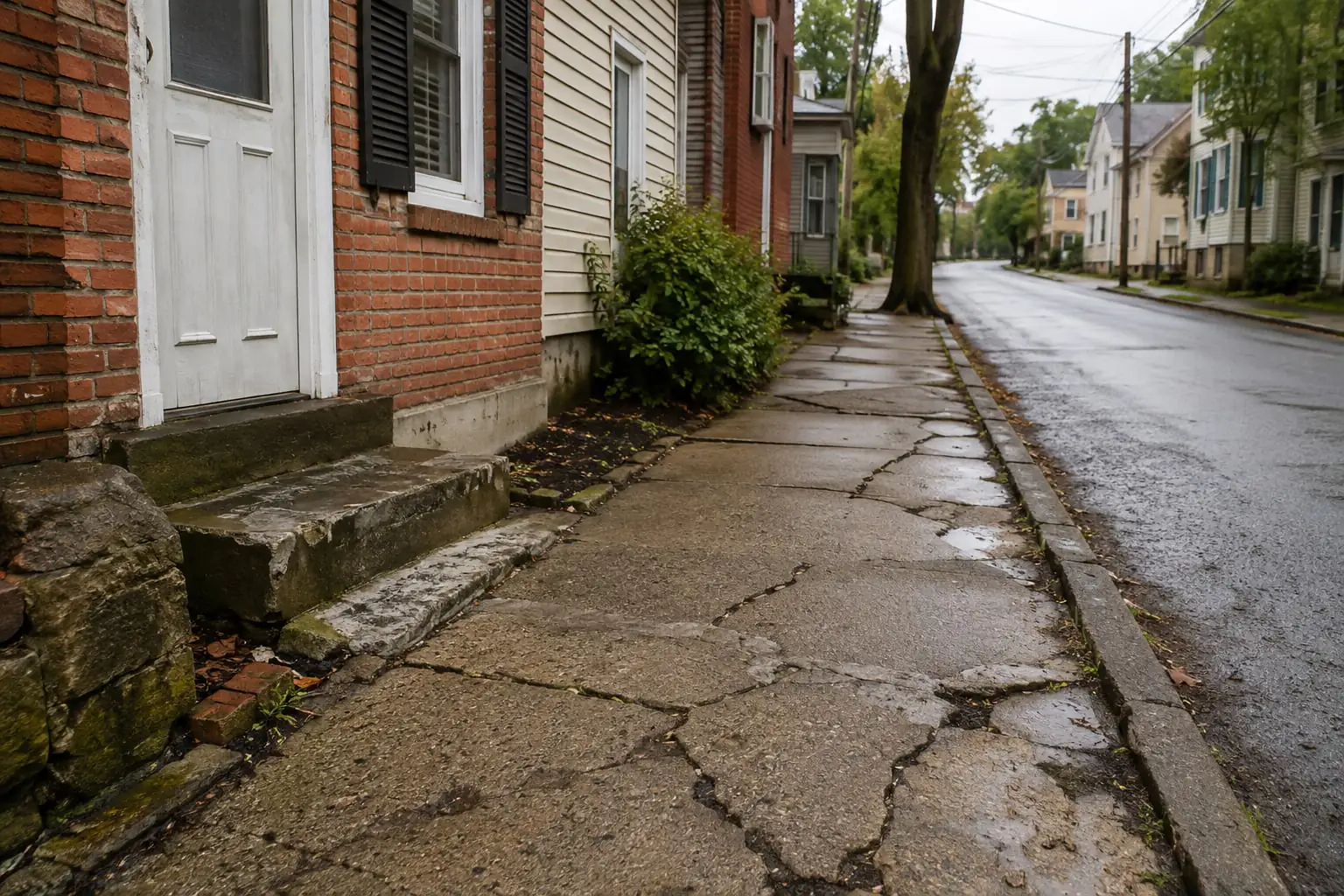
- Sidewalk falls caused by broken slabs, height differences, holes, debris, snow, or ice
- Parking lot falls involving potholes, poor lighting, drainage problems, or untreated winter conditions
- Supermarket falls involving spills, leaking refrigeration equipment, clutter, loose mats, or damaged flooring
- Residential building accidents involving stairs, railings, hallways, entrances, and common areas
- Falls inside private homes caused by unsafe stairs, loose flooring, poor lighting, or other hazards
- Commercial property accidents at stores, restaurants, offices, and other businesses
- Construction fall accidents involving unsafe work areas or missing safety equipment
- Public-property falls involving sidewalks, streets, parks, crosswalks, and government buildings
Some accidents involve more than one type of claim. A worker who falls at a commercial property, for example, may have workers’ compensation benefits and a separate claim against a property owner, contractor, or another third party.
What to Do After a Fall
Your health comes first. If you struck your head, cannot put weight on a limb, feel numbness, or have severe pain, call 911 or seek emergency care.
When possible, take these additional steps:
- Report the accident. Tell the manager, landlord, property owner, security officer, or public agency what happened. Ask for a copy of any incident report.
- Photograph the condition. Capture the hazard, the surrounding area, lighting, warning signs, weather conditions, and anything that identifies the exact location.
- Get witness information. A witness may later confirm how long the condition existed or what employees did before and after the fall.
- Preserve what you were wearing. Keep your shoes and clothing in their post-accident condition.
- Seek medical care promptly. Tell the provider how you fell and report every symptom, including headaches, dizziness, weakness, numbness, and increasing pain.
- Save documents. Keep receipts, appointment records, work notes, insurance letters, photographs, and communications with the property owner.
- Be careful with recorded statements. The property insurer may ask questions designed to support defenses before you know the full extent of your injuries.
A property owner can repair a broken step in an afternoon. Snow and ice can melt. A spill may be cleaned within minutes. Prompt documentation often determines whether the dangerous condition can later be proved.
Evidence That Can Make the Difference
A successful claim requires more than proof that you fell. The evidence should show what caused the accident and why the responsible party should have corrected or warned about the condition.
Important evidence may include:
- Photographs and video
- Surveillance footage
- Incident reports
- Inspection and cleaning logs
- Prior complaints
- Work orders and repair records
- Building-code or property-maintenance violations
- Snow-removal and salting records
- Weather and temperature data
- Leases and property-management agreements
- Maintenance and snow-removal contracts
- Witness statements
- 911, police, fire, or ambulance records
- Medical records documenting the connection between the fall and your injuries
For a Village or Town property claim, prior written complaints can be critical. Those records may show that another resident reported the same broken sidewalk, ice accumulation, drainage problem, or obstruction before your accident.
What New York Law Requires You to Prove
A property owner is not automatically liable whenever someone falls. Generally, the evidence must show that a dangerous condition existed, that the defendant created it or had actual or constructive notice of it, and that the condition caused the injury.
Actual notice means the responsible party knew about the hazard. An employee may have seen a spill, a tenant may have complained about a broken stair, or a manager may have received an earlier incident report.
Constructive notice generally means the condition was visible and apparent and existed long enough that a reasonable inspection should have discovered it. The New York Court of Appeals explained this standard in Gordon v American Museum of Natural History. General awareness that spills or icy patches sometimes occur is not necessarily enough; the evidence should address the condition that caused the particular accident. (nycourts.gov)
Defendants also sometimes argue that a pavement defect was too small to be dangerous. New York does not apply a fixed inch-based rule. Courts consider the defect’s dimensions together with its shape, appearance, location, lighting, surrounding conditions, and potential to act as a trap. New York decisions applying Trincere v County of Suffolk emphasize that the analysis cannot be based only on a measurement. (nycourts.gov)
BILLY COOPER LAW
Snow, Ice, and Haverstraw Winters
Winter cases often turn on timing.
Under New York’s storm-in-progress doctrine, an owner’s duty to clear naturally accumulating snow or ice is generally suspended while a storm is continuing and for a reasonable period afterward. The rule does not give an owner unlimited time, and it does not answer whether earlier snow piles, drainage defects, or negligent snow-removal work created the condition. Solazzo v New York City Transit Authority states the controlling general rule. (nycourts.gov)
A winter investigation may require hourly weather records, surface temperatures, plowing logs, salting records, photographs, contractor invoices, and testimony about when precipitation stopped. It should also distinguish fresh precipitation from older ice caused by runoff or repeated thaw-and-refreeze cycles.
How Long Do You Have to File a Claim?
Most New York personal injury actions must be filed within three years under CPLR § 214. Waiting until that deadline approaches is risky because video, witnesses, maintenance records, and physical conditions may disappear much sooner. (nysenate.gov)
Government claims have shorter requirements. If the Town, Village, County, a school district, or another public corporation may be responsible, General Municipal Law § 50-e generally requires a Notice of Claim within 90 days. General Municipal Law § 50-i generally requires the lawsuit to begin within one year and 90 days after the event. (nysenate.gov)
Those deadlines are separate from prior-written-notice rules. A Notice of Claim tells the municipality that you intend to pursue a claim after the accident. Prior written notice concerns whether the municipality received qualifying notice of the specific dangerous condition before the accident.
What If You Were Partly at Fault?
You may still have a claim.
The current version of CPLR § 1411 generally reduces compensation according to the injured person’s percentage of responsibility rather than barring recovery. A 2026 amendment added a different rule for personal injury actions subject to Article 51 of the Insurance Law, which governs motor-vehicle no-fault cases. Ordinary premises liability and slip and fall claims are not Article 51 motor-vehicle cases, so the traditional comparative-fault rule continues to apply to them. (nysenate.gov)
The property insurer may argue that you were distracted, chose the wrong route, ignored a warning, or wore unsuitable footwear. Those arguments should be evaluated against photographs, lighting, visibility, warnings, witness accounts, and the conduct of the property owner. Do not assume you were legally responsible simply because you looked away for a moment or did not notice the hazard before falling.
Who May Be Responsible?
The deed owner is only the starting point. Depending on the property, responsibility may rest with:
- A landlord
- A residential or commercial tenant
- A property-management company
- A store or restaurant operator
- A condominium association
- A maintenance company
- A cleaning contractor
- A snow-removal contractor
- A construction contractor
- A government entity
- A company that created the dangerous condition
For apartment properties, New York law requires covered multiple dwellings to be kept in good repair. Multiple Dwelling Law § 78 may be relevant when broken stairs, railings, flooring, or common-area conditions cause an injury, although its application depends on the type and location of the building. (nysenate.gov)
Contracts and leases often divide maintenance duties. A shopping-center owner may be responsible for the parking lot while a tenant controls conditions inside the store. A landlord may retain control of common stairs while a management company handles inspections and an outside contractor performs repairs.
Compensation After a Serious Fall
Compensation depends on the injuries, available insurance, and how the accident affects your life. A claim may include:
- Emergency treatment and hospital bills
- Surgery, medication, and rehabilitation
- Future medical care
- Lost wages
- Reduced future earning capacity
- Pain and suffering
- Loss of mobility or independence
- Household assistance
- Transportation and other accident-related expenses
- Permanent disability, scarring, or disfigurement
The value of the case should not be estimated from the first emergency-room bill alone. Fractures, head injuries, torn ligaments, spinal injuries, and nerve damage may require months of treatment before the long-term effects are clear.
Claims Against the Town or Village
The Town of Haverstraw has a local prior-notice law covering qualifying defects and snow or ice on Town highways, sidewalks, bridges, and culverts. The law generally requires written notice to the Town Clerk or Town Superintendent of Highways before the accident. Town Code Chapter 147 describes the requirement. New York’s Town Law § 65-a also addresses written notice for certain Town property claims. (ecode360.com)
The Village has its own rules. Village Law § 6-628 addresses village liability for specified streets, sidewalks, crosswalks, bridges, and other public ways, while the Village’s 2025 local law adds detailed requirements for the form and delivery of notice. (nysenate.gov)
If a government agency may be involved, do not wait to learn which rule applies. Determining whether the accident occurred on Town, Village, County, state, or private property can take time, and the 90-day Notice of Claim period begins running immediately.
Local Courts, Medical Facilities, and Records
Many Rockland County personal injury lawsuits are handled in Rockland County Supreme Court, located at 1 South Main Street in New City NY. The place where a lawsuit is filed will depend on the parties, amount in dispute, and applicable venue rules. (nycourts.gov)
People with serious fall injuries may receive emergency treatment at Montefiore Nyack Hospital’s emergency center, which treats fractures, head injuries, spinal injuries, and other trauma. Helen Hayes Hospital in West Haverstraw NY provides inpatient and outpatient physical rehabilitation services. Where you choose to receive care is a medical decision; the important legal point is to follow through with recommended treatment and keep complete records. (montefiorenyack.org)
Municipal records may come from the Village Clerk, Village Department of Public Works, Town Clerk, Town Highway Department, building departments, or Rockland County agencies. Private-property evidence may be held by landlords, businesses, management companies, and contractors.
How Billy Cooper Law Investigates a Fall
The investigation begins with the precise location and condition that caused the accident. The firm may then:
- Inspect and photograph the scene
- Identify the property owner and all parties controlling the area
- Send requests demanding preservation of surveillance footage
- Obtain incident reports and witness statements
- Review leases and maintenance contracts
- Seek inspection, cleaning, repair, and snow-removal records
- Request prior complaints and municipal written-notice records
- Review applicable building and property-maintenance codes
- Analyze weather data in snow and ice cases
- Work with medical providers and appropriate experts to document the injuries
- Calculate lost income, future care, and other long-term losses
That work allows the claim to be built around evidence rather than assumptions.
Types of Injury Cases We Handle in Haverstraw NY
- Personal Injury
- Slip and Fall
- E-Bike Accidents
- Car Accidents
Additional Legal Resources
- New York premises liability claims
- Rockland County personal injury representation
- What to do after a slip and fall in New York
- Billy Cooper Law case results
Tell Us What Happened
If you were injured on a sidewalk, in a store, at an apartment building, in a parking lot, or on public property in Haverstraw NY, start by getting answers.
Billy Cooper Law serves Rockland County from its White Plains NY office. Call (914) 730-5789 or contact the firm online for a free consultation. An attorney can listen to what happened, identify the evidence that should be preserved, and explain your options. (billycooperlaw.com)
BILLY COOPER LAW
Haverstraw NY Slip and Fall FAQs
These answers provide general information about New York injury claims and related concerns. The rules depend on the facts; this is not individual legal or medical advice.
Does falling on someone else’s property automatically create a claim?
No. A fall alone does not establish negligence. A premises claim generally requires evidence of a dangerous condition, a basis for holding the defendant responsible and a connection between that condition and the injury. In a typical slip-and-fall case, whether the defendant created the hazard or had notice of it is central.
Record the precise spot, what caused the loss of footing and who controlled the area. Photographs, witness accounts and inspection records can help distinguish an actionable condition from an unexplained fall. Avoid guessing how long a spill existed if you did not see it beforehand. The investigation should connect specific facts to responsibility rather than assuming that property ownership or an injury by itself proves the case.
Sources: Dorsa v National Amusements: Unsafe Conditions and Evidence; Branham v Loews Orpheum Cinemas: Constructive Notice.
What if I have no photographs from the time of my fall?
The absence of immediate photographs does not automatically end the inquiry. Witness accounts, incident reports, surveillance video, maintenance records and other evidence may help establish the condition and its timing. Later photographs can be useful, but they should be identified honestly as later images rather than presented as a record of the accident moment.
Write down what you remember while it is fresh, including the location, lighting, surface and people nearby. Identify possible cameras and tell counsel promptly because recordings can be overwritten. New York disclosure rules provide mechanisms for seeking relevant records, but the availability and significance of any particular item must be assessed. Preserve originals and avoid altering the scene merely to recreate how you believe it looked.
Sources: CPLR § 3101: Disclosure of Evidence; CPLR § 3126: Disclosure Sanctions.
Can I still recover if I was distracted or partly responsible?
Possibly. For an ordinary premises-injury claim outside the motor-vehicle no-fault framework, New York generally reduces damages in proportion to the injured person’s fault rather than treating every contribution as a complete bar. The defendant may nevertheless dispute both responsibility for the condition and the share of fault attributed to each person.
Keep evidence of visibility, lighting, handrails, footwear and the route you were using. Explain the circumstances accurately, including anything you were carrying or doing at the time. An insurer’s assertion that you should have seen the hazard is not a final court determination. Counsel can assess comparative fault alongside the separate questions of whether the defendant created or knew about the dangerous condition and whether it caused the injury.
Sources: CPLR § 1411: Comparative Fault; Dorsa v National Amusements: Unsafe Conditions and Evidence.
How long do I have to bring a fall-injury claim in Haverstraw NY?
Many New York negligence actions have a three-year limitation period, but government-related claims can require much earlier action. A notice of claim against a public corporation is often required within 90 days. The correct deadline depends on the defendant, legal theory and applicable exceptions, so the general three-year period should not be used as a reason to wait.
Identify the accident date, exact address and any owner, tenant or public agency connected with the site. An incident report to a building employee does not necessarily satisfy a statutory notice requirement. Save the report and correspondence, but have the legal deadlines checked separately. Early investigation also gives a better opportunity to locate records and witnesses while the relevant information is still available.
Sources: CPLR § 214: Limitation Periods; General Municipal Law § 50-e: Notice of Claim.
Does a store have to know about a spill before it can be responsible?
Responsibility may depend on whether the store created the spill or had actual or constructive notice of it. Constructive notice generally concerns a condition that was apparent and present long enough to allow discovery and correction. A spill’s existence when someone falls does not, by itself, establish every part of that analysis.
Record what the substance looked like, where it was located and whether anyone described an earlier complaint or cleanup. Preserve those statements accurately without inferring a duration you did not observe. Video, inspection schedules and maintenance records may help evaluate the sequence of events. The legal significance depends on the evidence and the applicable duty; a general belief that a store should always be safe cannot replace proof about the specific condition.
Sources: Branham v Loews Orpheum Cinemas: Constructive Notice; Dorsa v National Amusements: Unsafe Conditions and Evidence.
What should I preserve after a fall in an apartment building?
Preserve the exact location and the records showing the condition, including prior complaints, repair requests, photographs and communications with management. A lobby, stairwell, courtyard or inside apartment can raise different questions about control and responsibility. Do not assume that the name on the building sign identifies every potentially responsible party.
Keep copies of what you reported and when you reported it, and identify witnesses who actually saw the condition or the fall. Relevant leases, inspection records and management agreements may be requested through appropriate legal procedures. Avoid changing or discarding damaged personal items while the claim is being evaluated. The investigation should establish the responsible party’s connection to the hazard and notice rather than treating every building-related injury as automatically compensable.
Sources: CPLR § 3101: Disclosure of Evidence; Dorsa v National Amusements: Unsafe Conditions and Evidence.
What if I fell on public property or at a public housing development?
Special procedures may apply, so identify the public entity promptly. The correct defendant is not always obvious from the address or the appearance of the property. Government notice requirements are separate from ordinary reporting to staff, and claims against New York State follow procedures distinct from claims against many local public corporations.
Record the building, entrance, stairway or sidewalk segment precisely, and retain any incident number and employee correspondence. Have counsel determine ownership, operation and the applicable notice and filing rules. Do not assume that a maintenance request, police report or verbal complaint preserves a lawsuit. Because statutory requirements can depend on the entity and the type of claim, individualized deadline review is important before deciding that there is time to wait.
Sources: General Municipal Law § 50-e: Notice of Claim; Court of Claims Act § 10: Claims Against New York State.
What if headache or dizziness starts after I have gone home?
Seek medical advice promptly after new symptoms following a head impact. CDC guidance explains that concussion symptoms can appear hours or days later. Worsening headache, repeated vomiting, seizures, slurred speech, marked confusion or difficulty waking are emergency warning signs; call 911 or obtain emergency care immediately if these occur.
Tell the clinician when the fall happened, whether your head or body took a blow and when each symptom began. Ask for written guidance about returning to work, driving and other activities, and report symptoms that worsen or fail to improve. Medical assessment addresses your health; a symptom diary or this webpage cannot diagnose a concussion or establish the legal cause of an injury.
Sources: CDC: Symptoms of Mild TBI and Concussion; CDC: What to Do After a Mild TBI or Concussion.
What if I fell while working at someone else’s property?
A work-related fall may involve workers’ compensation and a separate claim against a responsible third party. Coverage depends on employment and the circumstances of the injury. Workers’ compensation does not generally require proof that the employer was negligent, while a third-party premises claim requires its own factual and legal basis.
Preserve work assignments, incident reports, photographs and information about the property owner and contractors. Tell counsel about any benefits claim before settling with another party. New York’s third-party provisions address the relationship between compensation and other recoveries, including reimbursement and settlement issues. Do not assume that receiving benefits eliminates every possible claim, or that a separate recovery can be accepted without affecting existing rights and obligations.
Sources: Workers’ Compensation Law § 10: Work-Related Injuries; Workers’ Compensation Law § 29: Third-Party Claims.
Does a fall injury have to meet the car-accident serious-injury threshold?
An ordinary premises-injury claim is generally not governed by the special no-fault serious-injury threshold used in covered motor-vehicle actions. That does not mean every fall produces a compensable case. The claimant still needs to establish responsibility, causation and actual injury, and the precise circumstances must be checked if a vehicle was involved.
Keep treatment records, bills, work-loss documentation and information about how the injury affects daily activities. Those records help evaluate the nature and extent of the claimed harm without relying on a diagnosis alone. A general case-value estimate cannot substitute for evidence about the individual injury and the defendant’s conduct. Counsel can determine which legal framework applies and what proof is needed for the particular claim.
Sources: Insurance Law § 5104: Personal Injury Actions; Dorsa v National Amusements: Unsafe Conditions and Evidence.
Sources
- Billy Cooper Law official website (billycooperlaw.com)
- Billy Cooper Law premises liability practice (billycooperlaw.com)
- Billy Cooper Law Rockland County personal injury page (billycooperlaw.com)
- Billy Cooper Law attorney William H. Cooper (billycooperlaw.com)
- Billy Cooper Law attorney Anieska J. Garcia (billycooperlaw.com)
- Billy Cooper Law contact and office information (billycooperlaw.com)
- U.S. Census Bureau QuickFacts for the Town of Haverstraw (census.gov)
- New York State Department of Health Town of Haverstraw report (health.ny.gov)
- Town of Haverstraw official website (townofhaverstraw.gov)
- Village of Haverstraw Department of Public Works (villageofhaverstraw.gov)
- Town of Haverstraw Code Chapter 147 (ecode360.com)
- Village of Haverstraw Code Chapter 168 (ecode360.com)
- Village of Haverstraw sidewalk-maintenance ordinance (ecode360.com)
- New York CPLR § 214 (nysenate.gov)
- New York CPLR § 1411 (nysenate.gov)
- New York General Municipal Law § 50-e (nysenate.gov)
- New York General Municipal Law § 50-i (nysenate.gov)
- New York Town Law § 65-a (nysenate.gov)
- New York Village Law § 6-628 (nysenate.gov)
- New York Multiple Dwelling Law § 78 (nysenate.gov)
- Gordon v American Museum of Natural History (nycourts.gov)
- Solazzo v New York City Transit Authority (nycourts.gov)
- Rockland County Supreme and County Court (nycourts.gov)
- Montefiore Nyack Hospital emergency care (montefiorenyack.org)
- Helen Hayes Hospital (helenhayeshospital.org)



Get the Answers You Need
At Billy Cooper Law, every day we renew our pledge to help injured people get the justice and compensation they deserve. We have a reputation throughout New York and nationally for standing up for our clients, and we take that responsibility seriously by approaching every case with preparation, persistence, and an unwavering commitment to results.