Downtown Brooklyn NY Personal Injury Lawyer
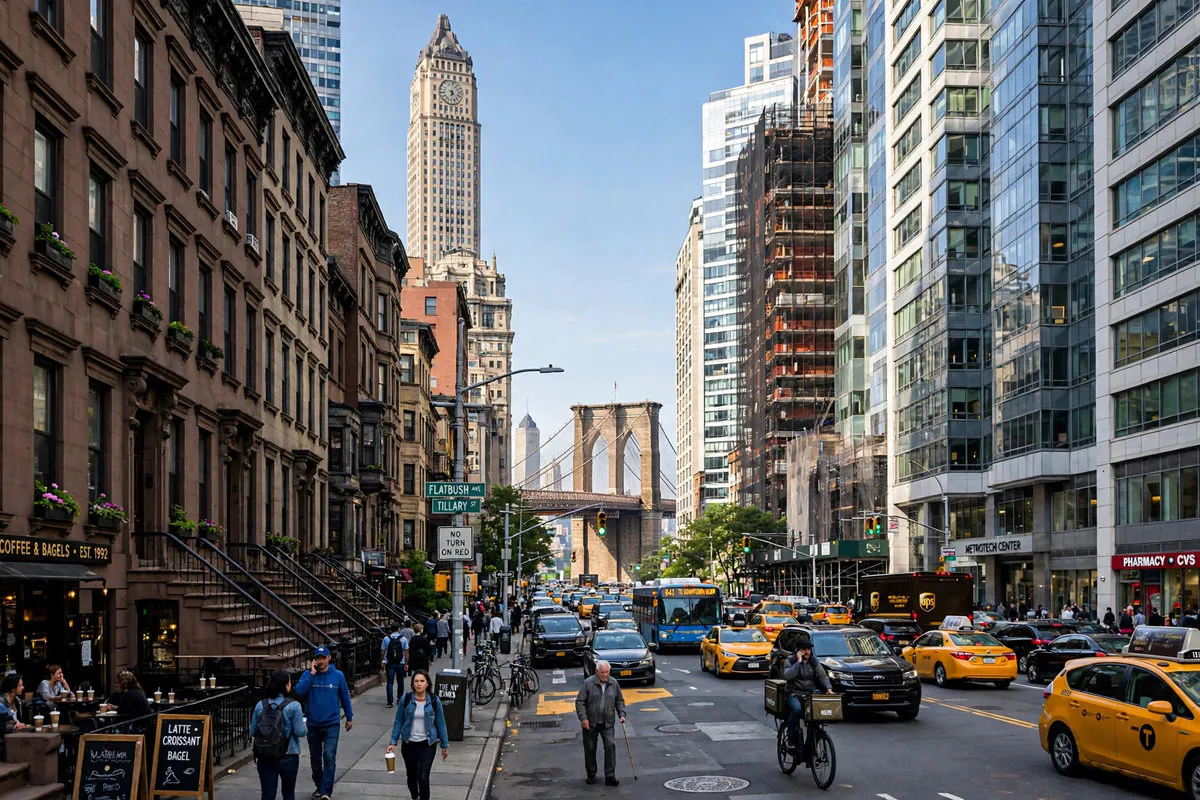
Downtown Brooklyn is the civic center of Kings County — courthouses, municipal buildings, MetroTech offices, university campuses and two bridge approaches packed into a few dozen blocks. That density produces a distinctive injury docket: pedestrians struck on Flatbush Avenue and Adams Street, falls in towers, garages and subway stations, delivery and rideshare collisions, and construction injuries as the skyline keeps rising.
Billy Cooper Law represents people injured in Downtown Brooklyn and across Kings County. This page explains how these claims work — the deadlines, the insurance layers, and the evidence that decides them — and how the firm builds them. The county-wide view is on our Brooklyn personal injury page.
A Kings County Firm for a Serious Downtown Brooklyn Injury
Serious Downtown Brooklyn cases are litigated at 360 Adams Street, where Kings County Supreme Court sits — a short walk from where many of these accidents happen. Billy Cooper Law practices in those courtrooms and builds its Brooklyn cases around how claims are actually evaluated there: documented treatment, identified defendants, and evidence gathered before it disappears.
Downtown’s injury cases reward speed. The corner where a pedestrian was struck is covered by building, bus and traffic cameras whose footage rotates on short cycles. A construction site that produced a fall is reconfigured within weeks. A firm that moves in the first days works from a fundamentally better record than one that starts with the police report alone.
The firm handles the consultation, the investigation and the litigation under one roof — no hand-offs to a call center, and no fee unless there is a recovery.
Why Downtown Brooklyn Cases Get Complicated
A Downtown Brooklyn injury usually has more than one responsible party hiding in it. A pedestrian struck near the bridge approach may have a claim against the driver, a delivery company whose van blocked the sightline, and — if a signal, sign or roadway defect contributed — the City of New York, on a ninety-day notice clock. A fall in a tower can involve the owner, the managing agent, an elevator or cleaning contractor, and the tenant whose space it was.
The transit layer complicates things further. Subway stations, MTA buses and Access-A-Ride vehicles run through downtown constantly; claims against the MTA or the City follow the public-entity rules, not the ordinary ones, and their evidence — onboard video, operator reports, station footage — is held by the agencies themselves.
Untangling that web is the first task, and it has to be done while the footage still exists and the ninety-day clock is still open.
BILLY COOPER LAW

Types of Injury Cases We Handle in Downtown Brooklyn NY
Downtown Brooklyn already has a dedicated page for one fast-growing practice area, and the firm’s main practice pages cover the rest:
- E-Bike Accidents in Downtown Brooklyn
- Car Accidents
- Personal Injury
- Uber and Lyft Accidents
- E-Bike Accidents — New York
A Useful Local Snapshot
Downtown Brooklyn holds the borough’s courthouse complex (Supreme Court and Civil Court around Adams and Joralemon Streets), the MetroTech office campus, Long Island University Brooklyn, and the Manhattan and Brooklyn Bridge approaches at its edges. The Jay Street–MetroTech and Borough Hall stations funnel subway riders onto the same sidewalks as buses, delivery vans, e-bikes and construction traffic.
The Brooklyn Hospital Center on DeKalb Avenue is the neighborhood’s major hospital. Flatbush Avenue, Atlantic Avenue, Adams Street and the BQE (I-278) carry the through-traffic; the result is a neighborhood where a large share of injuries involve someone who was walking, riding or working — not driving.
Where Serious Injuries Happen in Downtown Brooklyn
The locations that produce Downtown Brooklyn claims share a pattern: heavy pedestrian volume meeting fast or obstructed traffic, and vertical buildings with vertical risks.
- Flatbush Avenue and the bridge approaches — merging traffic, turning vehicles and cyclists and pedestrians crossing long, complex intersections.
- Adams Street and Atlantic Avenue — bus and delivery traffic, double-parking and rideshare stops around the courts and retail.
- Subway station stairs, escalators and platforms — falls at Jay Street–MetroTech, Borough Hall and Atlantic Avenue–Barclays Center, where maintenance and crowd conditions matter.
- Construction sites across the downtown core — falling objects, scaffold and ladder falls, and equipment injuries covered by the Labor Law.
- Office towers, garages and retail — elevator and escalator incidents, wet-floor and stair falls, and garage pedestrian strikes.
- The BQE corridor and its ramps — higher-speed collisions feeding into downtown streets.
Real Injury Cases Often Begin in Ordinary Places
The firm handles Downtown Brooklyn claims across the negligence spectrum: pedestrians and cyclists struck by cars, buses and delivery vehicles; e-bike and scooter collisions; car and rideshare crashes; slip, trip and fall injuries in buildings, stations, stores and on sidewalks; construction accidents, including Labor Law §§ 200, 240 and 241 claims; elevator and escalator injuries; and wrongful death cases.
Downtown’s signature cases are the pedestrian strike and the premises fall. Both turn on the same kind of proof — who controlled the place or the vehicle, what the footage shows, and how quickly the medical record ties the injury to the event. Both also decay fast, which is why the first week of a downtown case looks different from the first week of a suburban one.
What To Do After an Injury in Downtown Brooklyn
After an injury in Downtown Brooklyn, the steps that protect both your health and your claim:
- Get medical care. Call 911 for emergencies; the Brooklyn Hospital Center on DeKalb Avenue is the local first stop for serious injuries. Tell providers the visit follows an accident.
- Report it. NYPD for a crash (the 84th Precinct covers Downtown Brooklyn); the building, station or store management for a fall — and get the incident report number before you leave.
- Photograph the scene. The vehicle, the condition, the intersection or staircase, and your injuries — before anything is moved, cleaned or repaired.
- Collect names. Drivers, witnesses, the responding officer, the property representative. In a downtown crowd, witnesses vanish in minutes.
- Preserve your own record. Keep discharge papers, bills, and anything an insurer sends you; do not throw away the shoes or clothing involved in a fall.
- Hold off on recorded statements and quick settlements until you know your injuries, your deadlines, and whether a public entity is involved.
How Evidence Proves a Downtown Brooklyn Injury Claim
Downtown Brooklyn is one of the most heavily recorded places in the country — and almost none of that recording is kept for long. Building and retail systems, bus cameras and traffic cameras overwrite on cycles of days or weeks. The single most valuable act in a downtown case is often the preservation letter that goes out in the first days, demanding that identified holders keep their footage.
The rest of the record is assembled in parallel: NYPD collision reports and any MV-104, agency files where transit is involved, maintenance and inspection records for premises cases, and the medical file that connects treatment to the event. Construction cases add a further layer — site logs, safety records and contractor documents that exist only while the job is running.
BILLY COOPER LAW
Deadlines That Control a Downtown Brooklyn Personal Injury Claim
New York’s general negligence deadline is three years from the injury to start suit (CPLR 214). Downtown cases, however, very often run into the shorter public-entity clocks: where the City of New York, the MTA or another public body may be responsible, a notice of claim is generally due within ninety days, and suit must follow within one year and ninety days.
Vehicle cases add the no-fault layer: first-party benefits are available regardless of fault, but the written application is generally due within thirty days, and pain-and-suffering claims against a motorist must satisfy the serious-injury threshold in Insurance Law § 5102(d). Fault is apportioned under CPLR 1411’s pure comparative rule — with the § 1411(b) exception for motor-vehicle actions commenced on or after May 26, 2026, where a claimant more at fault than the defendants combined is barred.
Every one of those clocks runs from the date of the accident. The deadline map is drawn at intake, before anything else, because the shortest applicable clock — not the three-year one — sets the real schedule.
How Fault Is Divided Under New York Law
Responsibility downtown can rest with a driver, a delivery or rideshare company, a building owner or manager, a contractor, or a public agency responsible for a roadway, signal or station. Serious cases frequently involve several at once, each with its own insurer and its own version of events.
Sharing some fault does not end your case. Under pure comparative fault, your recovery is reduced by your percentage rather than eliminated — subject to the § 1411(b) bar for post-May 2026 vehicle actions where the claimant’s fault exceeds the defendants’. Insurers know this and argue percentages aggressively while the proof is thin; the answer is an early, documented fault record — footage, measurements and witnesses assembled before positions harden.
What Compensation Covers After a Serious Injury
A Downtown Brooklyn claim seeks the full measure of what the injury cost: medical care past and future, lost earnings and diminished earning capacity, and pain, suffering and loss of enjoyment of life. For the neighborhood’s many working claimants — court staff, office workers, delivery riders, construction trades — the wage and future-capacity side of the case is often as significant as the medical side.
There is no honest number at the start. Value is built from the treatment record, the prognosis, the earnings documentation and the coverage actually available, and it is usually clearest once the medical picture stabilizes. The firm’s job early on is to make sure none of that value is lost to a missed deadline or a vanished video.
When a Government Agency Is Involved
Downtown Brooklyn is thick with public entities: the City (streets, signals, sidewalks, the courthouse buildings themselves), the MTA and New York City Transit (stations and buses), and various authorities around the bridge approaches. An injury touching any of them — a bus collision, a defective sidewalk or roadway, a station fall — takes the notice-of-claim path with its ninety-day deadline.
The entity question is precise work: the city is not the MTA, and a notice served on one does not satisfy a claim against the other. If any public vehicle, property or roadway appears in your account of the accident, raise it at the first conversation, not after the ordinary deadlines have lulled you.
Which Courts Hear Downtown Brooklyn Personal Injury Cases?
Kings County Supreme Court at 360 Adams Street is the trial court for serious Brooklyn civil claims; the courthouse is part of the same downtown complex where many of these accidents occur. Kings County Civil Court handles smaller matters, and the federal Eastern District courthouse sits on Cadman Plaza.
Treatment records usually begin at the Brooklyn Hospital Center on DeKalb Avenue. Police records come from the NYPD’s 84th Precinct for downtown streets; transit incidents generate MTA and NYPD Transit files. Knowing which agency holds which record — and asking for it correctly — is a basic but decisive part of building the case.
How Billy Cooper Law Builds a Downtown Brooklyn Injury Case
A Downtown Brooklyn case at Billy Cooper Law starts with the deadline map and the evidence run: preservation demands to footage holders, the agency and police files requested, the medical record assembled, and the insurance layers identified — no-fault, liability, and any commercial or excess coverage behind a delivery or rideshare defendant.
With that file built, most cases are positioned to negotiate from documentation rather than assertion. If the offers do not match the record, the case is filed in Kings County Supreme Court and prepared for trial. The client is kept informed in plain language throughout — what has been done, what it means, and what happens next.
Downtown Brooklyn in Practice: How a Case Moves Here
A Downtown Brooklyn case moves on two tracks that clients experience as one. The treatment track runs from the first hospital or urgent-care visit through specialist care, imaging and, where needed, surgery — scheduled around the claimant’s life in consultation with treating providers, and documented as it goes. The legal track runs in parallel: the investigation and preservation demands in the first weeks; the claims filed and noticed inside their windows; the demand presented when the medical picture matures; and, if the carrier will not pay the documented value, suit in Kings County Supreme Court — where conferences, discovery and motion practice proceed on the court’s calendar, typically across many months.
Understanding that rhythm matters. Insurers exploit the gap between tracks — offering quick money while treatment is incomplete, or slow-walking a documented claim in the hope that financial pressure will discount it. The firm’s role is to keep the file’s value independent of the calendar’s pressure: the client always knows what stage the case is in, what the next date is, and what any offer on the table leaves uncounted.
Downtown Brooklyn NY Personal Injury FAQs: City Claims, Deadlines, and Evidence
Below are answers to common questions about personal injury claims in Downtown Brooklyn, New York. This information is general and not legal advice — contact our office for guidance about your specific situation.
How long do I have to sue after an injury in Downtown Brooklyn?
Against a private party, generally three years from the date of injury under CPLR 214.
If the City of New York, the MTA or another public body may be responsible, the timeline compresses sharply: a notice of claim is generally due within ninety days, and the lawsuit within one year and ninety days. Which track your case is on is determined at intake.
Sources: CPLR 214 (N.Y. Senate) · General Municipal Law § 50-e (N.Y. Senate)
What does it cost to hire Billy Cooper Law?
The consultation is free, and personal injury cases are handled on a contingency fee — no legal fee unless the firm recovers money for you.
The fee arrangement and how expenses are handled will be explained in writing before you commit, so there are no surprises later.
Sources: CPLR 214 (N.Y. Senate) · Insurance Law § 5102 (N.Y. Senate)
A city bus hit me downtown. What is different about my claim?
MTA and city bus claims are public-entity claims. They begin with a notice of claim, generally within ninety days, served on the correct agency — and the lawsuit window is one year and ninety days, not three years.
Buses also generate their own evidence: onboard and exterior cameras, operator reports and event data. Those materials are requested through the agency and are far easier to obtain when the notice goes in early and identifies the bus and run precisely.
Sources: General Municipal Law § 50-e (N.Y. Senate) · General Municipal Law § 50-i (N.Y. Senate)
Who pays my medical bills after a crash in Downtown Brooklyn?
No-fault insurance pays first in vehicle cases. A person struck by a car — including a pedestrian or cyclist — is covered for first-party benefits by the striking vehicle’s policy, for necessary treatment and a share of lost earnings, regardless of fault.
The written application is generally due within thirty days. Health insurance and the at-fault party’s liability coverage sit behind no-fault; part of the firm’s early work is routing bills to the right payer so treatment is not interrupted.
Sources: Insurance Law § 5103 (N.Y. Senate) · Insurance Law § 5102 (N.Y. Senate)
I was partly at fault. Can I still recover?
Usually, yes. New York follows pure comparative fault under CPLR 1411: your compensation is reduced by your share of fault, not barred — a pedestrian found 30 percent responsible still recovers 70 percent.
The exception: for motor-vehicle actions commenced on or after May 26, 2026, CPLR 1411(b) bars recovery if your fault is greater than the defendants’ combined fault. Fault percentages come from the evidence, which is why it is gathered immediately.
Sources: CPLR 1411 (N.Y. Senate) · CPLR 214 (N.Y. Senate)
What counts as a serious injury in a New York car case?
Insurance Law § 5102(d) sets the categories: death, dismemberment, significant disfigurement, a fracture, loss of a fetus, permanent loss or limitation of use of a body organ, member, function or system, a significant limitation of use, or an injury that prevents substantially all usual activities for 90 of the first 180 days.
If none applies, a claim against a motorist is limited to economic losses. Qualification is proved in the medical record — imaging, measured limitations, documented restrictions — not in a lawyer’s letter.
Sources: Insurance Law § 5102 (N.Y. Senate) · Insurance Law § 5104 (N.Y. Senate)
I fell on a subway station staircase. Who is responsible?
Station premises claims run against the transit authority responsible for the station, as a public-entity claim — notice of claim within ninety days, and the maintenance and inspection history of the staircase becomes central evidence.
Report the fall to station personnel if you can, photograph the condition, and note the station, entrance and time precisely. Station camera footage exists but rotates; a preservation demand should go out immediately.
Sources: General Municipal Law § 50-e (N.Y. Senate) · General Municipal Law § 50-i (N.Y. Senate)
Where are Downtown Brooklyn injury cases heard?
Serious civil claims are heard in Kings County Supreme Court at 360 Adams Street in Downtown Brooklyn itself. Smaller claims may go to Kings County Civil Court; some cases belong in the federal Eastern District court on Cadman Plaza.
Venue is rarely the client’s main concern — the deadlines and the evidence are — but local filing rules and practice shape how the case is prepared from the start.
Sources: CPLR 503 (N.Y. Senate) · CPLR 214 (N.Y. Senate)
The insurance company wants a recorded statement. Should I give one?
You are generally not required to give a recorded statement to the other side’s insurer, and doing so early rarely helps you. Adjusters are trained to lock in incomplete accounts — before treatment reveals the full injury picture.
Your own insurer is different: cooperation duties exist under your policy, and no-fault has its own forms and examinations. A short consultation before any statement keeps both obligations straight.
Sources: CPLR 214 (N.Y. Senate) · Insurance Law § 5102 (N.Y. Senate)
What should I bring to the first meeting about my case?
Bring what you have: the date, time and exact location; any police or incident report number; insurance details; photographs or video; witness names; and your medical paperwork and any proof of missed work.
An incomplete file is normal — downtown accidents happen fast. What matters is starting while footage can still be saved and the ninety-day public-entity clock, if it applies, is still open.
Sources: CPLR 214 (N.Y. Senate) · CPLR 1411 (N.Y. Senate) · General Municipal Law § 50-e (N.Y. Senate)
Tell Us What Happened
If you were injured in Downtown Brooklyn, tell us where it happened, what treatment you have received, and what any insurer has said. We will map your deadlines, tell you plainly whether we can help, and explain the next steps. Request a free consultation online or call (914) 730-5789.
Communities We Serve
- Kings County — Brooklyn
- Downtown Brooklyn
- Bay Ridge
- Bedford-Stuyvesant
- Bensonhurst
- Borough Park
- Bushwick
- Crown Heights
- East New York
- Flatbush
- Midwood
- Sunset Park
- Williamsburg
Sources
Firm Information
- Billy Cooper Law: Meet the Team
- Billy Cooper Law: Billy Cooper, Esq.
- Billy Cooper Law: Case Results
- Billy Cooper Law: Office Locations
- Billy Cooper Law: Personal Injury
- Billy Cooper Law: Contact
Downtown Brooklyn Sources
- U.S. Census Bureau QuickFacts: Brooklyn (Kings County), New York
- NY Courts — Second Judicial District (Kings County)
- City of New York
NOTABLE RESULTS
Selected results in Billy Cooper Law’s broader personal injury practice:
$9,000,000 settlement · $2,005,000 settlement
Read more about these results
- $9,000,000 settlement — Tank explosion
A man suffered extensive burns and loss of his dominant hand in a tank explosion in Westchester County.
- $2,005,000 settlement — Construction-site roof fall
A worker fell from a roof after inadequate safety equipment was provided on a Rockland County job site.
These are reported gross results, before fees, expenses, and applicable liens. They are not estimates of another claim’s value. Read the firm’s published case results.
Prior results do not guarantee a similar outcome. Each case is different and must be evaluated on its own facts.
WHAT OUR CLIENTS SAY
General feedback about working with Billy Cooper Law:
“Billy handled a personal legal matter for me and his professionalism and legal knowledge was undoubtedly top notch and outstanding. However that which truly sets William apart is his experience, understanding of the situation and attentiveness which allowed this matter to be brought to a successful resolution quickly. I give Billy my highest recommendation. Thank you Billy.”
— J. R., Google review
“Over the years, I have frequently worked with Billy Cooper and his team and give the Law Office of Marvin Cooper the highest review as they are consummate professionals who understand all aspects of representing clients in personal injury cases. Billy is thoughtful and compassionate along with being one of the premier trial lawyers in the state. He also has long standing relationships with the various insurance carriers which allows him to effectively settle cases before they get to trial. As a result of my many dealings with this firm over the past 30 years, Billy will always be my go-to lawyer when I refer clients to a personal injury firm in NY State.”
— a. g., Google review
Professional Recognition

Recognition applies to the named attorneys and selection years. See the linked profiles for details.
Related Billy Cooper Law Videos and Social Posts
- Billy Cooper Law official YouTube channel — Youtube — official account.
- Billy Cooper Law official Instagram profile — Instagram — official account.
- Billy Cooper Law official Linkedin profile — Linkedin — official account.
- Protecting an Injury Claim on Social Media — Facebook.
- Types of Personal Injury Cases the Firm Handles — Facebook.
Published Articles by Billy Cooper
- When the Video Disappears: Liability, Missing Footage, and the Modern New York Injury Case — New York Law Journal · June 23, 2026.
Billy Cooper discusses video evidence that is missing, incomplete, or overwritten in New York injury litigation.
Related Locations and Practice Resources
BILLY COOPER LAW
Related Resources

Get the Answers You Need
At Billy Cooper Law, every day we renew our pledge to help injured people get the justice and compensation they deserve. We have a reputation throughout New York and nationally for standing up for our clients, and we take that responsibility seriously by approaching every case with preparation, persistence, and an unwavering commitment to results.