
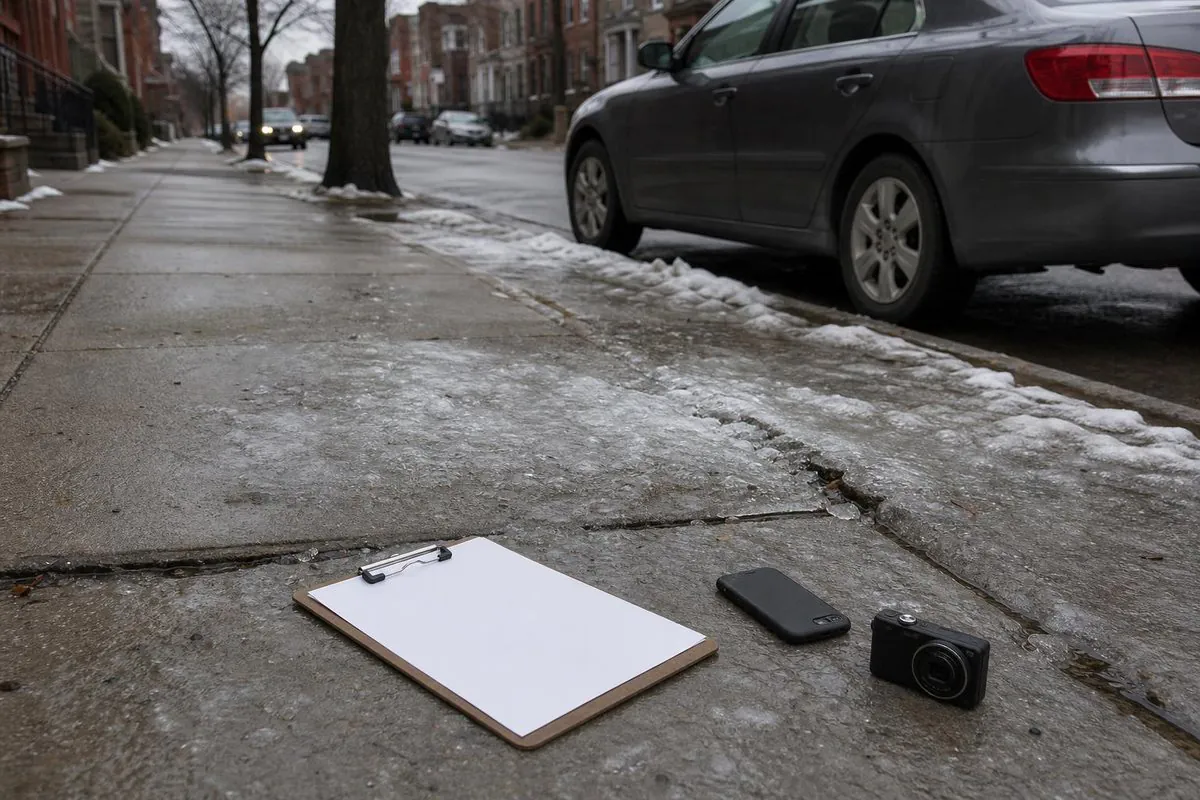
Before speaking with a lawyer about a slip and fall in New York State, gather any photographs of the hazard, the exact location and approximate time, witness contact information, incident-report details, medical paperwork, and records of expenses or missed work. Preserve the shoes you wore and the original digital files. Tell the lawyer promptly about nearby cameras and any possible government involvement.
You do not need every item before asking for help. Some of the most useful evidence belongs to the store, landlord, management company, or another person. A first conversation can identify what needs to be preserved and which deadlines need attention. If you are still receiving care, a short account of the fall and the documents already on your phone are a practical starting point.
BILLY COOPER LAW

Start with safety, then make a short evidence folder
Medical care comes first. If taking photographs or speaking with witnesses would put you at risk, ask someone you trust to help when it is safe to do so. Start the evidence folder with the information already available and add to it as you recover.
- Date, approximate time, address, and precise spot where you fell.
- Original scene photographs and video, with the photographer’s name and capture date.
- Names and contact details for witnesses, employees, and the person who received your report.
- Incident-report copy or reference number, plus emails and other messages about the fall.
- Treating providers, discharge instructions, appointment dates, bills, and work restrictions.
- Receipts, missed-work information, insurer correspondence, and the shoes or clothing involved.
Keep these items in one folder, with a separate list of evidence you know exists but do not possess. “Lobby camera above the south entrance” is more useful than “there might be video.” If a friend took photographs, ask for the actual files rather than only a screenshot of a message. Mark uncertain details as uncertain; you can update the folder as information becomes available.
Photograph the cause and the surrounding scene
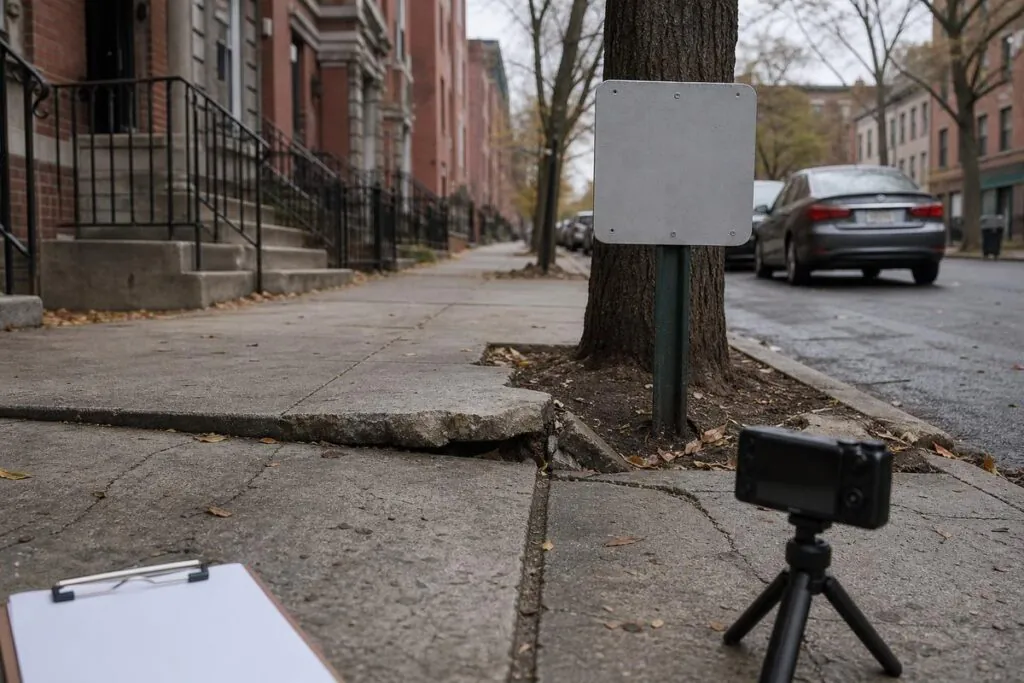
If it is safe and lawful to do so, document the exact condition you believe caused your foot to slip or catch. Take a close view of the spill, raised slab, damaged stair edge, loose mat, or other condition, then wider views showing the approach and surrounding area. Photograph the entrance, nearby address, aisle number, or another reference point that lets someone locate the same spot later.
Record lighting, visible warnings, obstructions, and the walking route. A close-up can make a defect look different from how it appeared to someone approaching it. Avoid filters, annotations on originals, or staging the scene. Do not move a mat, pour liquid, recreate the fall, or ask someone to pose in a dangerous position. Keep an untouched original and label any separate copy used to point out the location.
Measurements can be helpful when safely obtained, but an estimate should be identified as an estimate. New York’s Court of Appeals explains that defect size alone does not decide whether a condition is actionable; the surrounding circumstances matter. A photograph should therefore show context, not merely a ruler beside a crack. Hutchinson v Sheridan Hill House Corp. (October 20, 2015)
Write down when each photograph was taken. A picture from the next day may still provide information, but explain any differences you noticed. If the surface was already cleaned or repaired, record that fact rather than describing the later image as the accident scene. The lawyer needs to know what the image actually shows.
Write a factual timeline while the details are available
Describe why you were at the property, where you entered, the direction you walked, and what happened immediately before your fall. Explain whether your foot lost traction, caught an edge, or encountered something you could not identify. Include what you personally saw afterward, where you landed, and who helped. Do not choose a cause simply because someone later suggested one.
Use receipts, appointment confirmations, parking tickets, transit records, or messages to narrow the time. Keep the original record and explain what it establishes: a checkout receipt may place you in a store around a particular time, but may not identify the minute of the fall. If your memory and a timestamp differ, tell the lawyer about both.
Separate observation from inference. “I saw water next to the refrigerator after I fell” is an observation. “The refrigerator had been leaking all morning” needs an actual basis. Record who made a statement, what they said as accurately as you can remember, and whether you heard it yourself. Include details that may seem unfavorable, such as footwear, phone use, bags you carried, or a warning you noticed. Honest detail helps the lawyer evaluate the incident.
Collect witness information without coaching anyone
Ask willing witnesses for their names, telephone numbers, and email addresses. Note whether each person saw the fall, saw the condition earlier, helped afterward, or heard a conversation with staff. Those roles are different. A shopper who saw a puddle before you entered may have useful information even if that person did not see you fall.
Do not suggest what a witness should say or ask them to agree with your version. Preserve any spontaneous written message in full, including its date and sender. If someone declines to provide contact information, describe the person’s role and location as accurately as possible. Your lawyer can decide whether there is a legitimate way to identify or contact them.
For employees, write down the name or job title, the business, and any shift information you know. If you have only a first name or remember the person’s role, include that. Your lawyer can use those details to follow up with someone who may know about the condition or how the fall was reported.
Report the fall and preserve the paper trail
When you can, report the incident to the property’s manager or other appropriate contact. Give the location, time, and what you know happened. Ask whether an incident report was made and whether you can have a copy or reference number. Retain the name of the person who took the report and the date you requested it.
If you receive a written account, read it carefully and retain a copy. Tell the lawyer about inaccuracies, omissions, or documents you signed. Do not assume a store’s incident report is a formal government notice of claim. If no copy is supplied, keep your request and any response. Under New York disclosure law, ordinary-course accident reports and a party’s own statement have specific disclosure provisions, subject to applicable legal limits. CPLR 3101: Scope of disclosure
Save correspondence from the property, its insurer, or a claims administrator, including envelopes when dates matter. Keep claim numbers and the contact details of anyone who calls. Bring requests for recorded statements, authorizations, or releases to the consultation so the lawyer can explain their significance before you decide how to respond.
Identify evidence about how long the hazard existed
A fall and an injury do not, by themselves, establish property negligence. In a typical New York slip-and-fall claim, evidence must address whether the responsible defendant created the condition or had actual or constructive notice of it. Prior complaints, observations, and maintenance records may help answer that question. Dorsa v National Amusements (April 26, 2004)
Preserve earlier emails to a landlord, maintenance requests, photographs from prior visits, or messages about the same condition if you already have them. Keep the entire conversation, including replies. A dated complaint about the precise stair or leak may tell a different story from a general complaint about building upkeep. Do not relabel a complaint about another location as evidence about your fall.
For an outdoor fall, describe the weather and surface you actually observed: precipitation, ice, standing water, drainage, or areas that appeared treated. Do not infer the condition’s age from its appearance alone. Record whether you saw cleaning or repair activity and when. These details can give counsel a direction for investigating records without pretending you already know the full history.
Tell the lawyer about cameras and records you cannot access
List cameras you noticed on the property or nearby businesses, and describe where they point. Give the approximate time window and your route. You may not know whether a camera was operating or whether it captured the relevant area. State that uncertainty. Promptly flag possible footage so counsel can consider a focused preservation request.
Your lawyer may first ask the business to retain the footage, then seek a copy through an appropriate request or discovery. Camera systems have different retention periods, so raise the issue promptly. If a recording has been lost, the lawyer can examine the preservation duty, the circumstances of the loss, and its relevance under New York’s lost-evidence rules.
Sources: Pegasus Aviation I, Inc. v Varig Logistica S.A. (December 15, 2015).
Cleaning logs, inspection records, repair invoices, contracts, and property-control documents may also be useful. You do not need to obtain private records before a consultation or enter restricted areas to investigate. New York procedure provides mechanisms for document production and property inspection after an action begins, with requirements and limits. Counsel can assess which route fits the situation. CPLR 3120: Discovery and production
Keep medical records and concrete proof of the injury’s effects
Bring the discharge summary and instructions you already have, a list of treating providers, appointment dates, and any written work restrictions. Ask providers how to request records and imaging. Federal privacy rules generally give individuals access to medical and billing records held by covered providers, with exceptions and qualifications. HHS: Your Medical Records
Tell clinicians accurately how the fall happened and describe symptoms without exaggeration. Let medical professionals make diagnoses. If a record seems wrong, keep the original and ask the provider about its correction process; do not edit the record yourself. Tell the lawyer about relevant earlier injuries or treatment so the medical history can be evaluated honestly.
Save receipts for medication, equipment, transportation, or paid assistance, and retain medical bills alongside insurance explanations of benefits. For missed work, collect pay records, schedules, employer correspondence, and documentation of the dates you could not work. Self-employed people can bring existing invoices, cancellations, and business records rather than an unsupported estimate of lost income.
A brief dated log can help explain how the injury affects daily life. Record a task you needed help with, an appointment you missed, or an activity your clinician restricted. Bring the supporting medical and financial records too. Your lawyer can use them to assess the claimed losses and address the requirements for using business records in court.
Sources: CPLR 4518: Business records.
Protect originals and flag deadlines before the folder is complete
Preserve footwear and clothing without unnecessary cleaning, repair, or disposal, and ask counsel how to store anything wet or otherwise difficult to preserve. Back up original photographs, messages, and files securely. Retain existing relevant social-media material and discuss it with counsel before deleting or changing it. Avoid posting new speculation about fault or your medical condition.
For an ordinary private-party negligence claim, New York generally allows three years from the accident to start the lawsuit, subject to exceptions. That filing period does not mean the evidence will remain available for three years. CPLR 214: Actions to be commenced within three years New York Courts: Statute of Limitations Timetable
Government involvement deserves prompt attention. Where General Municipal Law 50-e applies, a notice of claim is generally due within 90 days. Section 50-i generally requires covered municipal negligence actions within one year and 90 days. State and other public-entity claims can involve different rules. Tell counsel about any public building, school, sidewalk, or transit location immediately; do not wait to identify the correct defendant yourself. General Municipal Law 50-e: Notice of claim General Municipal Law 50-i: Presentation of tort claims
How Billy Cooper Law can help you prepare a slip-and-fall claim
If you were hurt in a fall, you may be unsure which photographs, records, or witness details matter. Billy Cooper Law handles New York slip-and-fall and premises-liability claims and can help you understand the evidence your case needs. Bring what you have; you do not need a complete investigation before asking for help.
We review the location and condition, available video and photographs, incident reports, and witness information. For sidewalk and supermarket falls, inspection history and evidence about how the hazard developed can be important. Your medical records and account of the injury’s effects help document a different part of the claim: the harm you suffered.
William H. “Billy” Cooper joined the predecessor firm in 1991 and became its lead trial counsel. He was selected to Super Lawyers for 2024–2026. His trial experience helps the firm assess what the evidence shows, identify gaps, and prepare a claim for negotiations or litigation. Every case depends on its own facts, and past results do not guarantee a similar outcome.
Billy Cooper Law offers a free consultation. We can review what you have, explain which records or recordings need attention, and discuss the next steps for your claim. You can ask for help while treatment and evidence collection are still underway.
Related resources
- Billy Cooper Law: Billy Cooper, Esq.
- Slip and Fall and Premises Liability
- Sidewalk Falls
- Supermarket Falls
BILLY COOPER LAW
Professional Recognition

Recognition applies to the named attorneys and selection years. See the linked profiles for details.
NOTABLE RESULTS
Billy Cooper Law publishes the following results. This is a broader unsafe-property outcome involving maintenance of a rental home, rather than a slip-and-fall or sidewalk recovery.
$970,000 settlement
Read more about these results
- $970,000 settlement: Rental-home explosion attributed to improper maintenance caused injuries and wrongful death in Westchester County. Read the source account.
Read the firm’s published results
Prior results do not guarantee a similar outcome. Each case is different and must be evaluated on its own facts.
Published Writings by William Cooper
Related reading on preserving video evidence in injury cases:
- When the Video Disappears: Liability, Missing Footage, and the Modern New York Injury Case — Billy Cooper, New York Law Journal, June 23, 2026.
WHAT OUR CLIENTS SAY
General feedback about working with Billy Cooper Law:
“Mr. Cooper came to my home to discuss my personal injury case. Without any commitment to his services on my part, he took the time to explain a great deal about my particular situation, did so with great clarity, and was presented a measured and understandable answers to all my questions. I really appreciate his time and would very much recommend his services.”
— B. H., Google review
“Over the years, I have frequently worked with Billy Cooper and his team and give the Law Office of Marvin Cooper the highest review as they are consummate professionals who understand all aspects of representing clients in personal injury cases. Billy is thoughtful and compassionate along with being one of the premier trial lawyers in the state. He also has long standing relationships with the various insurance carriers which allows him to effectively settle cases before they get to trial. As a result of my many dealings with this firm over the past 30 years, Billy will always be my go-to lawyer when I refer clients to a personal injury firm in NY State.”
— a. g., Google review
New York State Slip and Fall Evidence FAQs
These answers provide general information about gathering evidence for a New York slip-and-fall consultation. The applicable duties, deadlines, and procedures depend on the property, parties, and circumstances.
Can I speak with a lawyer if I have no photographs?
Yes, you can seek legal advice without photographs. Start with the location, approximate time, your account of the fall, and any documents you already possess. Explain why there are no pictures and identify anyone who may have taken them. A receipt, message, or provider visit may help organize the timeline, even though each proves something different.
Tell your lawyer about witnesses, nearby cameras, and anyone who took photographs before or after the fall. Relevant footage or property records may also be requested during litigation. If you have a later photograph, explain when it was taken and whether the condition had changed. Those details help the lawyer assess what each source can show.
Sources: CPLR 3101: Scope of disclosure CPLR 3120: Discovery and production
Is a photograph of a small sidewalk crack enough to prove liability?
No, a photograph of a crack does not by itself establish liability. It may help document the surface, but counsel must assess the surrounding circumstances and the evidence connecting that condition to your fall. Include wider views and explain when the image was taken, whether the condition had changed, and how you encountered it.
New York does not use a fixed minimum height or depth to decide every defect case. The Court of Appeals requires attention to context, while creation or notice can be a separate liability issue. Avoid assuming that a measurement automatically proves a claim or automatically defeats one. Let the lawyer review the original photograph and your factual description together.
Sources: Hutchinson v Sheridan Hill House Corp. (October 20, 2015) Dorsa v National Amusements (April 26, 2004)
Should I delay calling until I know who owns the property?
No, you should not delay a consultation simply because ownership or control is unclear. Provide the address, business name, building entrance, and exact part of the property involved. Include any documents identifying a landlord, manager, tenant, or maintenance contact, but label assumptions clearly. The name displayed on a storefront may not resolve every responsibility question.
Counsel can evaluate what additional records are needed and which procedures may obtain them. If public property or a public entity may be involved, say so promptly because municipal notice and filing rules can be shorter than the ordinary private-party deadline. An incomplete ownership search is a reason to raise the issue early, not to wait for certainty.
Sources: CPLR 3120: Discovery and production General Municipal Law 50-e: Notice of claim
What if the store refuses to give me its incident report?
Keep your request, any response, and the report number if available, and tell your lawyer that the store did not provide a copy. Note when you reported the fall and who took the report. Bring your own written statement and any document you signed so the lawyer can compare your account with the records available.
CPLR 3101 addresses a party’s own statement and accident reports prepared in the regular course of business, subject to applicable protections. After a lawsuit begins, your lawyer may use formal document requests to seek a report that was not provided voluntarily. The circumstances in which it was prepared help determine whether it can be obtained and used in the case.
Sources: CPLR 3101: Scope of disclosure CPLR 3120: Discovery and production
Can a lawyer require a business to preserve security video?
A lawyer can evaluate and send an appropriate preservation request, but that request does not guarantee immediate access to a recording. Tell counsel the precise location, approximate time window, route you took, and cameras you noticed. State whether you actually saw footage or merely saw a camera; those are different facts.
New York’s lost-evidence rules examine preservation duties, culpability, and relevance, and courts have discretion over appropriate remedies. Do not assume that overwritten video automatically proves negligence or guarantees sanctions. Production procedures also have requirements. Promptly identifying possible footage gives counsel an opportunity to address preservation while assessing how access might properly be obtained.
Sources: Pegasus Aviation I, Inc. v Varig Logistica S.A. (December 15, 2015) CPLR 3120: Discovery and production
Do I need a witness who saw the actual fall?
An eyewitness to the fall is not the only possible source of evidence. Someone who observed the condition beforehand, helped immediately afterward, or received your report may provide different useful information. Ask willing people for contact details and explain what each person actually observed without assigning them knowledge they do not have.
The value of those observations depends on the issues being investigated, including the condition’s existence, timing, and notice. Preserve complete messages and identify their authors, rather than compiling a coached statement. New York permits disclosure of material and necessary information under its procedural rules, but a witness’s account must still be evaluated for relevance and reliability.
Sources: Dorsa v National Amusements (April 26, 2004) CPLR 3101: Scope of disclosure
Which medical documents should I bring to the first consultation?
Bring the discharge paperwork, provider names, appointment dates, bills, and written restrictions you already have. Include information about related earlier treatment and tell counsel if imaging or other records must still be requested. You do not need to make your own diagnosis or obtain every medical document before speaking with a lawyer.
HHS explains that individuals generally may access their medical and billing records from covered providers, with exceptions and qualifications. Ask the provider about its records process, and retain originals if you request a correction. Medical documents require proper evaluation and, when used in court, applicable evidentiary foundations; their existence does not alone establish who caused the injury.
Sources: HHS: Your Medical Records CPLR 4518: Business records
How should I document missed work and expenses without estimating a settlement?
Collect actual records of the time missed and costs incurred, rather than assigning your case a settlement figure. Useful starting items include pay statements, work schedules, employer messages, medical restrictions, invoices, and receipts. Identify which expenses were paid, remain unpaid, or were addressed by insurance, and keep supporting documents with the corresponding entry.
If you are self-employed, keep records of canceled jobs, invoices, and changes in revenue, along with a short explanation of what happened. A dated summary can help your lawyer find the supporting documents. The lawyer can then assess which losses relate to the injury and how to document them under New York’s disclosure and business-record rules.
Sources: CPLR 3120: Discovery and production CPLR 4518: Business records
Can my shoes or phone use affect a New York slip-and-fall claim?
Yes, footwear and what you were doing may be relevant to the circumstances of the fall. Preserve the shoes and describe phone use, carried items, warnings, and your route accurately. Do not hide those facts because they seem unfavorable; counsel needs to consider both the property condition and potential arguments about your conduct.
For an ordinary premises-liability claim governed by CPLR 1411(a), claimant fault generally reduces damages proportionally rather than automatically barring recovery. The party asserting that defense bears the pleading and proof burden under CPLR 1412. The result depends on the evidence and applicable law; a shoe type or brief phone use alone does not establish a particular percentage of fault.
Sources: CPLR 1411: Damages and culpable conduct CPLR 1412: Burden of pleading and proof
How soon should I act if I fell on municipal property?
Raise possible municipal involvement promptly rather than waiting until your evidence folder is complete. Where General Municipal Law 50-e applies, notice of claim is generally required within 90 days. Section 50-i generally sets a one-year-and-90-day lawsuit period for covered municipal negligence claims, with separate procedural conditions. These rules do not describe every public-entity claim.
Provide the date, exact location, public entity you think may be involved, and any report or correspondence already sent. An ordinary incident report should not be assumed to satisfy formal notice and service requirements. If a deadline may have passed, seek advice promptly about the specific circumstances; late-notice relief is discretionary and should never be assumed available.
Sources: General Municipal Law 50-e: Notice of claim General Municipal Law 50-i: Presentation of tort claims
BILLY COOPER LAW


Get the Answers You Need
At Billy Cooper Law, every day we renew our pledge to help injured people get the justice and compensation they deserve. We have a reputation throughout New York and nationally for standing up for our clients, and we take that responsibility seriously by approaching every case with preparation, persistence, and an unwavering commitment to results.

Related Billy Cooper Law Videos and Social Posts