
Spring Valley NY Slip and Fall Lawyer
A hard fall can leave you with a fracture, head injury, surgery, and weeks or months away from work. While you are trying to recover, a property owner or insurance company may already be arguing that the condition was obvious, temporary, or somehow your fault.
You do not need to decide who is legally responsible on your own. Billy Cooper Law represents people injured on unsafe property throughout Rockland County. The firm can determine who controlled the location, preserve evidence before it disappears, and explain what comes next.
Types of Injury Cases We Handle in Spring Valley NY
- Personal Injury
- Car Accidents
- Slip and Fall
- E-Bike Accidents
Slip and Fall Lawyers Serving Rockland County
- Rockland County
- Ramapo
- Clarkstown
- Haverstraw
- New City
- Spring Valley
BILLY COOPER LAW

A Law Firm That Takes the Time to Understand What Happened
Slip and fall cases are often more complicated than they first appear. It is not enough to prove that you fell. Your lawyer may need to establish what caused the fall, who controlled the area, how long the danger existed, and whether the responsible party had a reasonable opportunity to correct it.
Billy Cooper Law brings more than 75 years of combined experience to that work. William H. “Billy” Cooper has practiced in New York since 1991 and has been selected to Super Lawyers from 2024 through 2026. The firm’s approach begins with careful preparation and direct communication. According to the firm, people who contact the office can speak with an attorney, ask questions, and receive an explanation of the law that applies.
If you are more comfortable discussing sensitive medical and legal issues in Spanish, attorney Anieska J. Garcia is fluent in English and Spanish. Consultations are free, and personal injury matters are handled on a contingency-fee basis. No upfront legal fee is required, and the firm is not paid an attorney’s fee unless compensation is recovered.
Billy Cooper Law represents Spring Valley clients from its White Plains NY office. The firm does not list an office in Spring Valley NY.
Why Slip and Fall Cases Are Different in Spring Valley NY
Spring Valley is compact, densely populated, and largely made up of renter-occupied housing. Apartment buildings, shared stairways, commercial entrances, sidewalks, parking areas, and mixed-use properties place maintenance responsibility in different hands.
A landlord may own the building while a management company handles inspections. A store may lease its space while the property owner controls the parking lot. A separate contractor may be responsible for cleaning, repairs, or snow removal. The person working at the location may not know who signed those agreements.
Local law also matters. The Spring Valley Village Code places responsibility on owners or occupants of property adjoining a public sidewalk to maintain and repair that sidewalk and keep it free from obstructions. Separate snow and ice provisions make owners and occupants jointly responsible for clearing adjoining sidewalks. Those rules can affect who must be investigated after a sidewalk or winter-weather fall.
Building records may be important as well. The Rockland County Office of Buildings and Codes currently administers and enforces the state Uniform and Energy Codes within Spring Valley. Its records may include permits, inspections, certificates of occupancy, violations, and complaints concerning the property where someone was hurt.
A Local Property and Safety Snapshot
A few numbers help explain why control, maintenance, and recordkeeping matter in Spring Valley:
- The village had an estimated 34,482 residents as of July 1, 2025.
- Its 2020 population density was approximately 16,442.6 people per square mile.
- Only 25% of occupied housing units were owner-occupied during 2020–2024, meaning most households were renters.
- 75.6% of residents age five and older spoke a language other than English at home during 2020–2024.
- During its first three years overseeing code enforcement in Spring Valley, the Rockland County Office of Buildings and Codes reported conducting approximately 4,000 inspections.
- The office reported issuing approximately 16,000 violations during that same three-year period.
The demographic figures come from the U.S. Census Bureau’s Spring Valley NY QuickFacts. The inspection figures were reported in the county’s 2025 Office of Buildings and Codes anniversary release.
These figures do not establish that any particular property was unsafe. They do show why leases, inspection histories, complaints, and code records can be important in a local fall investigation.
Where Serious Falls Happen in Spring Valley NY
Apartment buildings and shared residential areas
Falls in apartment properties often occur on interior stairs, exterior steps, entranceways, hallways, laundry areas, ramps, and shared walkways. The cause may be loose flooring, missing handrails, poor lighting, water intrusion, ice, or a repair that was never completed correctly.
The investigation may include earlier tenant complaints, maintenance requests, inspection reports, photographs, and records showing when the landlord or manager first learned about the problem.
Stores, restaurants, and other businesses
Commercial properties see constant movement by customers, employees, deliveries, and cleaning crews. Spilled liquids, tracked-in rain, loose entrance mats, boxes, damaged tiles, and poorly placed displays can create hazards.
Surveillance footage and inspection logs are especially important in these cases. A store may record over its video within days or weeks unless it receives a timely request to preserve it.
Sidewalks and building entrances
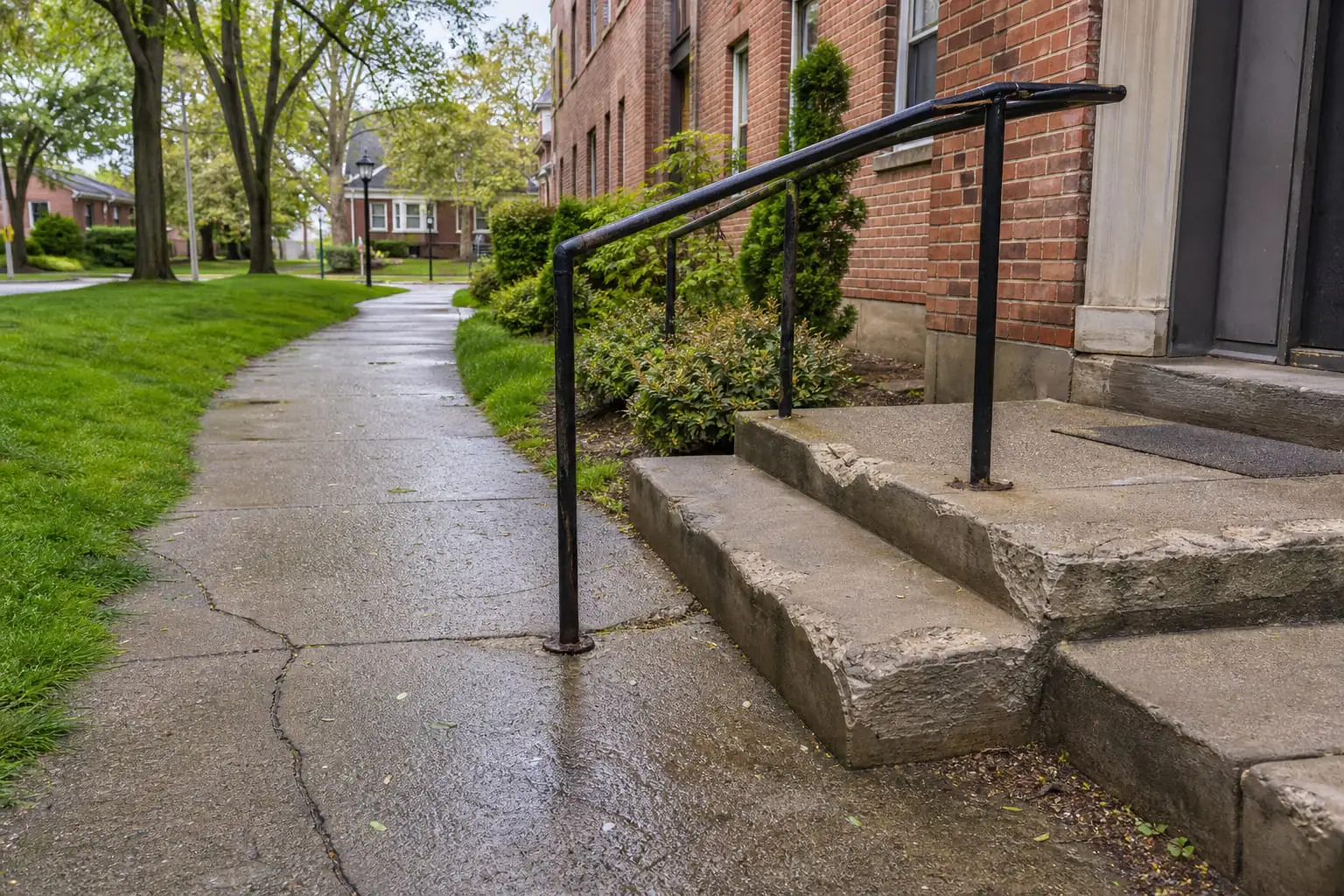
A sidewalk fall may involve cracked pavement, an uneven slab, cellar doors, construction debris, ice, or water draining from an adjoining building. Spring Valley’s local code can place maintenance and repair duties on the adjoining owner or occupant, even though the sidewalk is used by the public.
Parking lots
Parking lots can contain potholes, broken pavement, wheel stops, poor drainage, inadequate lighting, and snow piles that melt and refreeze. Responsibility may be divided among the owner, commercial tenant, property manager, paving contractor, or snow-removal company.
Transit and public property
A fall near a transit facility, public building, municipal sidewalk, or government-controlled property requires early attention. The agency that appears responsible may not actually own or maintain the exact area where the injury occurred. Special notice requirements can also expire long before the ordinary personal injury deadline.
Slip and Fall Cases Billy Cooper Law Handles
The firm represents people injured in:
- Parking lot falls
- Sidewalk falls
- Supermarket and grocery-store falls
- Falls inside private homes
- Residential building accidents
- Commercial property accidents
- Construction fall accidents
These cases may involve wet floors, ice, defective stairs, missing handrails, damaged flooring, poor lighting, unsafe walkways, neglected repairs, or objects left where people were expected to walk.
What to Do After a Slip and Fall
Your health comes first. If you may have suffered a fracture, concussion, spinal injury, or other serious trauma, call 911 or seek medical attention. Symptoms such as dizziness, headaches, numbness, confusion, and severe swelling should not be ignored.
When you can do so safely:
- Report the fall. Tell the owner, manager, landlord, or employee what happened. Ask for an incident report, but do not speculate about fault.
- Photograph the condition. Take close pictures of the hazard and wider views showing where it was located.
- Record the surroundings. Photograph lighting, warning signs, cameras, stairs, mats, drainage, footprints, snow piles, or nearby construction.
- Get witness information. A name and phone number may allow an investigator to follow up later.
- Preserve your shoes and clothing. Do not wash, repair, or discard them.
- Write down what you remember. Include the time, weather, lighting, people present, and anything said by employees or witnesses.
- Be careful with insurance calls. An adjuster may ask for a recorded statement before you know the full extent of your injuries.
If you were unable to take photographs because you needed emergency care, that does not necessarily end the case. Other evidence may show what the area looked like and who knew about the danger.
Evidence That Can Make the Difference
A puddle can be cleaned. Ice melts. A broken step can be repaired. Surveillance footage can be overwritten.
Depending on where the fall occurred, important evidence may include:
- Store, apartment, doorbell, or parking-lot video
- Incident reports
- Cleaning schedules and inspection logs
- Tenant complaints and maintenance requests
- Prior accident reports
- Emails, texts, and work orders
- Leases and property-management agreements
- Snow-removal and maintenance contracts
- Weather and precipitation records
- Building permits and certificates of occupancy
- Code violations and inspection files
- Village complaints concerning sidewalks or drainage
- Photographs and measurements of the hazard
- Medical records and diagnostic images
- Payroll records showing lost income
Businesses sometimes preserve only the few minutes immediately surrounding a fall. A proper preservation request should identify a broader period so that the footage may also show when the condition appeared, who passed through the area, and whether employees inspected it.
What New York Law Requires You to Prove
New York property owners and others controlling property generally must use reasonable care to keep the premises reasonably safe. That principle comes from the New York Court of Appeals decision in Basso v. Miller.
A successful claim generally requires proof that:
- A dangerous condition existed
- The defendant created the condition or knew or should have known about it
- The defendant had a reasonable opportunity to correct it or provide a warning
- The condition caused the fall
- The fall caused actual injuries and losses
For constructive notice, the hazard generally must have been visible and apparent and present long enough for the responsible party to discover and address it. The Court of Appeals explained that rule in Gordon v. American Museum of Natural History.
That is why evidence from before the accident matters. A photograph taken afterward may show what caused the fall, but inspection records, earlier video, witness testimony, and complaints may establish how long the condition existed.
Snow and Ice Falls in Spring Valley NY
Winter cases require careful timing.
Under New York’s storm-in-progress doctrine, a property owner generally is not required to eliminate snow or ice hazards while a storm is ongoing or during a reasonable period afterward. The Court of Appeals addressed that rule in Solazzo v. New York City Transit Authority.
Spring Valley’s local rules add another layer. The Village Code requires owners and occupants to clear adjoining sidewalks within eight daylight hours after a snowfall ends. If ice is frozen too hard to remove without damaging the sidewalk, suitable material must be applied so the surface is no longer dangerous, followed by complete clearing when practical.
The exact weather timeline can determine whether the storm-in-progress doctrine applies and whether there was enough time to address the condition. A lawyer may need hourly weather data, plowing records, photographs, witness accounts, and snow-removal contracts.
BILLY COOPER LAW
How Long Do You Have to File a Claim?
Under CPLR § 214, many New York personal injury lawsuits must be commenced within three years of the injury.
That is not a safe waiting period. Evidence may disappear within days, and much shorter deadlines apply when a village, county, state agency, public authority, or other government body may be responsible.
The correct deadline depends on the property, the defendant, the injured person’s circumstances, and the legal theory involved.
What If You Were Partly at Fault?
A property owner or insurer may argue that you were looking at your phone, wearing the wrong shoes, moving too quickly, or failing to notice an obvious condition.
For ordinary premises liability claims, New York continues to follow the comparative-fault rule in CPLR § 1411(a). Your own negligence does not automatically prevent recovery. Instead, compensation may be reduced according to the percentage of fault assigned to you.
Do not assume the insurer’s percentage is correct. Video, lighting, warnings, the shape of the hazard, surrounding distractions, and the property’s intended use may all affect the analysis.
Who May Be Responsible for the Fall?
The responsible party is not always the person whose name appears on the building.
Depending on the location and hazard, a claim may involve:
- The property owner
- A landlord
- A commercial or residential tenant
- A property-management company
- A maintenance or janitorial contractor
- A snow-removal company
- A construction or repair contractor
- A business operating at the property
- The Village of Spring Valley
- Rockland County
- New York State
- A public authority or transit operator
Contracts often determine who agreed to inspect, repair, clean, or clear the area. More than one party may share responsibility.
How Property Insurance Usually Enters the Case
Most slip and fall claims are handled through liability insurance. Depending on where the accident happened, coverage may come from a business liability policy, landlord policy, homeowners policy, contractor’s policy, or government risk program.
If you fell at a friend’s or relative’s home, bringing a claim does not necessarily mean asking that person to pay your medical expenses personally. Homeowners insurance may provide coverage for the loss.
If the fall occurred while you were working, workers’ compensation may pay certain benefits regardless of fault. A separate claim may also be possible against a negligent property owner, contractor, or other third party that was not your employer.
An insurance adjuster represents the insurance company. The adjuster’s job is to investigate coverage and reduce the insurer’s exposure—not to determine what medical care or compensation is best for you.
Compensation Available After a Serious Fall
Compensation depends on the evidence, insurance coverage, nature of the injury, and long-term effect on your life. A claim may include:
- Emergency treatment and hospital care
- Surgery and diagnostic testing
- Physical therapy and rehabilitation
- Medication and medical equipment
- Future medical care
- Lost wages
- Reduced future earning capacity
- Household or home-health assistance
- Pain and suffering
- Emotional distress
- Scarring or disfigurement
- Disability and loss of mobility
- Loss of enjoyment of everyday activities
A case should not be valued only by adding up the bills that have already arrived. A serious fracture, brain injury, or spinal injury may create future treatment needs and work limitations that are not yet fully known.
Claims Involving the Village or Another Government Entity
If a fall occurred on municipal property or involved a government-controlled sidewalk, building, parking area, or transit facility, ordinary deadlines may not apply.
General Municipal Law § 50-e generally requires a formal Notice of Claim within 90 days when a tort claim is brought against a public corporation. Under General Municipal Law § 50-i, many lawsuits against a village, town, or county must be commenced within one year and 90 days.
Claims against New York State follow different filing and service rules. Under Court of Claims Act § 10, a negligence claim or notice of intention may need to be filed and served within 90 days.
Spring Valley also has a prior-written-notice provision. A claim against the Village based on a defective or snow-covered street, sidewalk, crosswalk, bridge, or similar public area may depend on whether the Village Clerk received the type of written notice required by the code.
A Notice of Claim and prior written notice are not the same thing. One protects your right to bring a claim after the accident. The other concerns whether the Village received legally sufficient notice of the dangerous condition before the accident.
If public property may be involved, do not wait for an agency or insurance company to tell you which deadline applies.
Local Courts, Hospitals, and Agencies
Many substantial Rockland County injury lawsuits are heard in Rockland County Supreme Court, located at 1 South Main Street in New City NY. The court where a case is filed depends on the defendants, damages, and other legal considerations.
Nearby hospital systems include Montefiore Nyack Hospital and Good Samaritan Hospital in Suffern NY. In a serious or potentially life-threatening emergency, call 911 and let emergency medical professionals determine the appropriate destination.
Local records may be held by:
- The Rockland County Office of Buildings and Codes
- The Village of Spring Valley departments
- The Village Clerk or Department of Public Works
- Property owners and management companies
- Commercial tenants
- Snow-removal and maintenance contractors
- Transit or public authorities
Knowing that records may exist is only the beginning. They must be requested from the correct organization before they are altered, discarded, or routinely destroyed.
How Billy Cooper Law Investigates a Slip and Fall
The investigation begins with your account of what happened. Where did you fall? What did the condition look like? Who was present? What did employees or witnesses say? How has the injury affected your work and daily life?
From there, the firm may:
- Identify the owner, tenants, managers, and contractors responsible for the property.
- Determine whether a government entity controlled any part of the location.
- Send preservation requests for surveillance footage and electronic records.
- Obtain incident reports, maintenance logs, complaints, permits, and inspection files.
- Examine leases and service contracts to determine who accepted responsibility for the area.
- Interview witnesses and document the scene.
- Review medical evidence and consult qualified experts when necessary.
- Document lost income, future treatment, disability, and other consequences.
- Handle communications with insurers.
- Prepare the case for litigation if the responsible parties will not offer a fair resolution.
The goal is not to collect paperwork for its own sake. It is to answer three questions clearly: what caused the fall, who was responsible, and what the injury has taken from you.
Related Billy Cooper Law Resources
- Personal Injury
- Rockland County NY Personal Injury Lawyer
- New York Premises Liability Lawyer
- Billy Cooper Law Practice Areas
- Contact Billy Cooper Law
Tell Us What Happened
You do not need to know who owned the sidewalk, who hired the maintenance company, or how long the condition existed before asking for help. Those are questions the investigation can answer.
Call Billy Cooper Law at (914) 730-5789 or contact the firm online for a free consultation. Explain where you fell, what caused it, and how you were hurt. The firm will listen, answer your questions, and discuss your options.
BILLY COOPER LAW
Spring Valley NY Slip and Fall FAQs
These answers provide general information about New York injury claims and related concerns. The rules depend on the facts; this is not individual legal or medical advice.
Does falling on someone else’s property automatically create a claim?
No. A fall alone does not establish negligence. A premises claim generally requires evidence of a dangerous condition, a basis for holding the defendant responsible and a connection between that condition and the injury. In a typical slip-and-fall case, whether the defendant created the hazard or had notice of it is central.
Record the precise spot, what caused the loss of footing and who controlled the area. Photographs, witness accounts and inspection records can help distinguish an actionable condition from an unexplained fall. Avoid guessing how long a spill existed if you did not see it beforehand. The investigation should connect specific facts to responsibility rather than assuming that property ownership or an injury by itself proves the case.
Sources: Dorsa v National Amusements: Unsafe Conditions and Evidence; Branham v Loews Orpheum Cinemas: Constructive Notice.
What if I have no photographs from the time of my fall?
The absence of immediate photographs does not automatically end the inquiry. Witness accounts, incident reports, surveillance video, maintenance records and other evidence may help establish the condition and its timing. Later photographs can be useful, but they should be identified honestly as later images rather than presented as a record of the accident moment.
Write down what you remember while it is fresh, including the location, lighting, surface and people nearby. Identify possible cameras and tell counsel promptly because recordings can be overwritten. New York disclosure rules provide mechanisms for seeking relevant records, but the availability and significance of any particular item must be assessed. Preserve originals and avoid altering the scene merely to recreate how you believe it looked.
Sources: CPLR § 3101: Disclosure of Evidence; CPLR § 3126: Disclosure Sanctions.
Can I still recover if I was distracted or partly responsible?
Possibly. For an ordinary premises-injury claim outside the motor-vehicle no-fault framework, New York generally reduces damages in proportion to the injured person’s fault rather than treating every contribution as a complete bar. The defendant may nevertheless dispute both responsibility for the condition and the share of fault attributed to each person.
Keep evidence of visibility, lighting, handrails, footwear and the route you were using. Explain the circumstances accurately, including anything you were carrying or doing at the time. An insurer’s assertion that you should have seen the hazard is not a final court determination. Counsel can assess comparative fault alongside the separate questions of whether the defendant created or knew about the dangerous condition and whether it caused the injury.
Sources: CPLR § 1411: Comparative Fault; Dorsa v National Amusements: Unsafe Conditions and Evidence.
How long do I have to bring a fall-injury claim in Spring Valley NY?
Many New York negligence actions have a three-year limitation period, but government-related claims can require much earlier action. A notice of claim against a public corporation is often required within 90 days. The correct deadline depends on the defendant, legal theory and applicable exceptions, so the general three-year period should not be used as a reason to wait.
Identify the accident date, exact address and any owner, tenant or public agency connected with the site. An incident report to a building employee does not necessarily satisfy a statutory notice requirement. Save the report and correspondence, but have the legal deadlines checked separately. Early investigation also gives a better opportunity to locate records and witnesses while the relevant information is still available.
Sources: CPLR § 214: Limitation Periods; General Municipal Law § 50-e: Notice of Claim.
Does a store have to know about a spill before it can be responsible?
Responsibility may depend on whether the store created the spill or had actual or constructive notice of it. Constructive notice generally concerns a condition that was apparent and present long enough to allow discovery and correction. A spill’s existence when someone falls does not, by itself, establish every part of that analysis.
Record what the substance looked like, where it was located and whether anyone described an earlier complaint or cleanup. Preserve those statements accurately without inferring a duration you did not observe. Video, inspection schedules and maintenance records may help evaluate the sequence of events. The legal significance depends on the evidence and the applicable duty; a general belief that a store should always be safe cannot replace proof about the specific condition.
Sources: Branham v Loews Orpheum Cinemas: Constructive Notice; Dorsa v National Amusements: Unsafe Conditions and Evidence.
What should I preserve after a fall in an apartment building?
Preserve the exact location and the records showing the condition, including prior complaints, repair requests, photographs and communications with management. A lobby, stairwell, courtyard or inside apartment can raise different questions about control and responsibility. Do not assume that the name on the building sign identifies every potentially responsible party.
Keep copies of what you reported and when you reported it, and identify witnesses who actually saw the condition or the fall. Relevant leases, inspection records and management agreements may be requested through appropriate legal procedures. Avoid changing or discarding damaged personal items while the claim is being evaluated. The investigation should establish the responsible party’s connection to the hazard and notice rather than treating every building-related injury as automatically compensable.
Sources: CPLR § 3101: Disclosure of Evidence; Dorsa v National Amusements: Unsafe Conditions and Evidence.
What if I fell on public property or at a public housing development?
Special procedures may apply, so identify the public entity promptly. The correct defendant is not always obvious from the address or the appearance of the property. Government notice requirements are separate from ordinary reporting to staff, and claims against New York State follow procedures distinct from claims against many local public corporations.
Record the building, entrance, stairway or sidewalk segment precisely, and retain any incident number and employee correspondence. Have counsel determine ownership, operation and the applicable notice and filing rules. Do not assume that a maintenance request, police report or verbal complaint preserves a lawsuit. Because statutory requirements can depend on the entity and the type of claim, individualized deadline review is important before deciding that there is time to wait.
Sources: General Municipal Law § 50-e: Notice of Claim; Court of Claims Act § 10: Claims Against New York State.
What if headache or dizziness starts after I have gone home?
Seek medical advice promptly after new symptoms following a head impact. CDC guidance explains that concussion symptoms can appear hours or days later. Worsening headache, repeated vomiting, seizures, slurred speech, marked confusion or difficulty waking are emergency warning signs; call 911 or obtain emergency care immediately if these occur.
Tell the clinician when the fall happened, whether your head or body took a blow and when each symptom began. Ask for written guidance about returning to work, driving and other activities, and report symptoms that worsen or fail to improve. Medical assessment addresses your health; a symptom diary or this webpage cannot diagnose a concussion or establish the legal cause of an injury.
Sources: CDC: Symptoms of Mild TBI and Concussion; CDC: What to Do After a Mild TBI or Concussion.
What if I fell while working at someone else’s property?
A work-related fall may involve workers’ compensation and a separate claim against a responsible third party. Coverage depends on employment and the circumstances of the injury. Workers’ compensation does not generally require proof that the employer was negligent, while a third-party premises claim requires its own factual and legal basis.
Preserve work assignments, incident reports, photographs and information about the property owner and contractors. Tell counsel about any benefits claim before settling with another party. New York’s third-party provisions address the relationship between compensation and other recoveries, including reimbursement and settlement issues. Do not assume that receiving benefits eliminates every possible claim, or that a separate recovery can be accepted without affecting existing rights and obligations.
Sources: Workers’ Compensation Law § 10: Work-Related Injuries; Workers’ Compensation Law § 29: Third-Party Claims.
Does a fall injury have to meet the car-accident serious-injury threshold?
An ordinary premises-injury claim is generally not governed by the special no-fault serious-injury threshold used in covered motor-vehicle actions. That does not mean every fall produces a compensable case. The claimant still needs to establish responsibility, causation and actual injury, and the precise circumstances must be checked if a vehicle was involved.
Keep treatment records, bills, work-loss documentation and information about how the injury affects daily activities. Those records help evaluate the nature and extent of the claimed harm without relying on a diagnosis alone. A general case-value estimate cannot substitute for evidence about the individual injury and the defendant’s conduct. Counsel can determine which legal framework applies and what proof is needed for the particular claim.
Sources: Insurance Law § 5104: Personal Injury Actions; Dorsa v National Amusements: Unsafe Conditions and Evidence.
Sources
Billy Cooper Law
- Billy Cooper Law
- Personal Injury
- Rockland County NY Personal Injury Lawyer
- New York Premises Liability Lawyer
- Meet the Billy Cooper Law Team
- William H. Cooper
- Anieska J. Garcia
- Billy Cooper Law Offices and Contact Information
- Parking Lot Falls
- Sidewalk Falls
- Supermarket Falls
- Home Falls
- Residential Building Accidents
- Commercial Property Accidents
- Construction Fall Accidents
Spring Valley NY and Rockland County
- U.S. Census Bureau Spring Valley NY QuickFacts
- Rockland County Office of Buildings and Codes
- Rockland County Office of Buildings and Codes Three-Year Report
- Spring Valley Village Code Chapter 229 Article I
- Spring Valley Village Code Snow and Ice Removal Rules
- Village of Spring Valley Departments
- Rockland County Supreme and County Court
- Montefiore Nyack Hospital
- Good Samaritan Hospital
New York Law



Get the Answers You Need
At Billy Cooper Law, every day we renew our pledge to help injured people get the justice and compensation they deserve. We have a reputation throughout New York and nationally for standing up for our clients, and we take that responsibility seriously by approaching every case with preparation, persistence, and an unwavering commitment to results.