
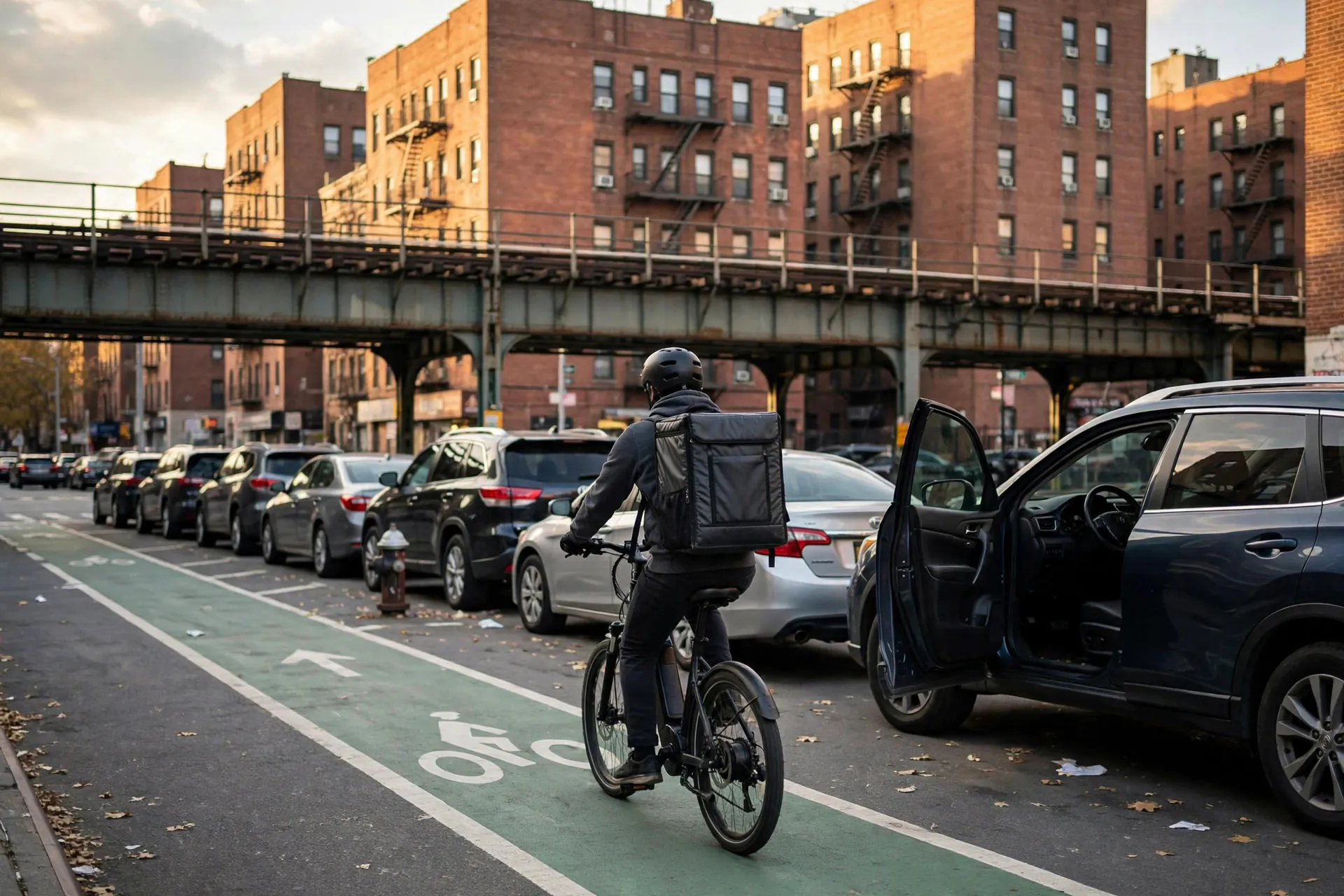
A delivery rider in the Bronx works inches from a row of parked cars, and one of the most common ways that ride ends is a door swinging open into the bike lane. Dooring crashes happen in a fraction of a second, but the claim that follows is built over days and weeks — and it is built out of evidence that starts disappearing immediately. The car drives off. The app overwrites its logs. The bruise that looked minor turns into a shoulder injury that keeps you off the bike.
What you preserve in the first hour, the first day, and the first month after a dooring collision often decides whether you are paid fairly or paid nothing. This guide walks through exactly what a Bronx delivery rider should save — photographs, app data, the police report, medical records, and the no-fault paperwork — and explains how New York law treats the driver or passenger who opened the door.
Why Dooring Is So Dangerous for Delivery Riders in the Bronx
A car door opens directly into the space a rider is traveling through, with no time to brake or swerve. Unlike a rear-end crash, there is no crumple zone and no warning: the rider either strikes the edge of the door itself or swerves into moving traffic to avoid it. Delivery riders face this risk more than almost anyone else on the road because the job keeps them beside parked cars all day — double-parked delivery zones, restaurant rows, and residential blocks where drivers and passengers step out without looking.
The Bronx adds its own pressures. Riders work the length of the Grand Concourse, Fordham Road, and the shopping corridors around Third Avenue and Westchester Avenue, often on e-bikes carrying loaded delivery bags that change how the bike handles. An e-bike is heavier than a conventional bicycle, and a loaded rider who hits a door edge can be thrown over it or under it. Riders serving neighborhoods across the borough face the same pattern street after street, which is why the steps in this guide matter for anyone who rides for the apps in the Bronx — including riders covered by our South Bronx e-bike accident lawyer page and the rest of the borough.
New York City’s crash data, published through NYC Open Data, records collisions involving cyclists across the five boroughs, and dooring is a recognized category of bike crash in city reporting. The physics are unforgiving even at moderate speeds: the door’s edge concentrates the impact, and riders commonly suffer fractures, head injuries, and shoulder and knee damage from the fall that follows.
New York’s Door Law: Vehicle and Traffic Law § 1216
New York has a specific statute for this exact crash. Vehicle and Traffic Law § 1216 provides that no person may open a door of a motor vehicle on the side available to moving traffic unless it is reasonably safe to do so and can be done without interfering with the movement of other traffic. The same section also prohibits leaving a door open on the traffic side for longer than necessary to load or unload passengers.
That statute does two things for an injured rider. First, it sets a clear legal duty: the person opening the door — driver or passenger — had to look first. Second, violating a statute like § 1216 is evidence of negligence in a New York personal injury case, which means the door-opener’s own conduct is measured against a written rule, not just a general idea of carefulness. When a door opens into a bike lane or a rider’s line of travel, the legal question is usually not whether a duty existed, but whether the facts are preserved well enough to prove how it was broken.
Fault can also be shared. New York follows pure comparative fault, so a driver may argue the rider was traveling too close to the parked cars or too fast for conditions. That argument reduces an award by the rider’s percentage of fault rather than eliminating it — but it is one more reason the physical evidence matters. Photographs of the door’s position, the bike lane markings, and where you landed answer the comparative-fault argument before it is made. Riders can read more about how these cases are evaluated on our e-bike accidents page.

What to Preserve in the First Hour After a Dooring Crash
If you are physically able, treat the scene like it will be gone in twenty minutes — because it will be. The single most valuable evidence in a dooring case is the position of the door and the vehicle when it happened, and that evidence exists only until the driver closes the door and leaves. Work through this list before anything is moved:
- The open door itself. Photograph and video the door still open, from the front, the side, and from your approach direction. Capture how far it extended into the bike lane or travel lane.
- The vehicle. Photograph the full car, its license plate, and any damage to the door’s edge. If it is a taxi or rideshare vehicle, photograph the medallion, roof light, or app decals as well.
- Your e-bike and gear. Photograph the bike where it fell, damage to the wheel, fork, and frame, your helmet, and the delivery bag. Do not repair or discard anything yet.
- The street. Photograph bike lane markings, parking signs, the curb, and the view a person in that car would have had looking back. Street position is the heart of a § 1216 case.
- The people. Get the name, phone number, and insurance information of the driver and of the passenger who opened the door, if a passenger did. Photograph their licenses and insurance cards rather than writing numbers by hand.
- Witnesses. Ask anyone who saw the crash — pedestrians, shop staff, other riders — for a name and number, and record a short voice memo of what they say while it is fresh.
If you are too injured to do this yourself, ask a bystander or the responding officers to note the door’s position, and tell a friend or family member to photograph the scene and the bike as soon as possible. Then write down your own account the same day: the street, the direction you were traveling, your speed, what you saw, and what the driver or passenger said. Admissions at the scene — “I didn’t even look” is a common one — are valuable, and they are only preserved if someone writes them down.
Save Your Delivery App Data Before It Disappears
For a delivery rider, the most important witness may be the app. The platform’s records can establish where you were, when you were there, whether you were on an active delivery, your route, and your speed and stops in the minutes before the crash. That data corroborates your account of the collision, proves you were working (which matters for workers’ compensation), and can rebut a claim that you darted out from between cars.
App data is not kept forever, and account access can change if you are deactivated or your phone is replaced. Before anything cycles out, preserve:
- Screenshots of the completed delivery — the order number, restaurant, customer address, timestamps for pickup and the crash-time trip, and the route map.
- Your earnings and trip history screens for that day and week, which show you were on an active shift.
- Any in-app messages with the customer, restaurant, or support about the crash or the undelivered order, plus any incident report you filed in the app.
- Your phone’s location history (for example, Google Maps Timeline or Apple location records) covering the hour of the crash.
- Photos of the damaged phone itself, if the crash broke it — and do not factory-reset or trade it in.
A lawyer can also send a preservation letter to the platform and to the vehicle’s insurer demanding that trip data, telematics, and any camera footage be kept. That letter carries far more weight when it goes out in the first days, before routine deletion windows close. Riders who deliver around Fordham and the northwest Bronx can see how local cases are handled on our Fordham e-bike accident lawyer page.
The Police Report and Your Medical Records
Call 911 from the scene, even if you think you can walk away. A police response creates the official record of the crash — the report will identify the vehicles, the parties, and the officer’s observations about how it happened — and it anchors the insurance claims that follow. In the Bronx, the responding officers come from the local NYPD precinct, and their report feeds into the state crash record. If the crash is not reported at the scene, a civilian accident report (Form MV-104) can be filed with the DMV afterward, but a report made at the scene, with the door still open, is far stronger evidence.
Get medical care the same day, and tell the provider exactly how the crash happened: that a car door opened into your path while you were riding. Emergency room and urgent care records become the foundation of both the no-fault claim and any lawsuit, and they are much harder to attack when they were made within hours of the crash. Adrenaline masks injuries; riders routinely discover fractures, concussions, and shoulder damage a day or two later. Follow-up care matters too — gaps in treatment are the first thing an insurer points to when it argues you were not really hurt.
Keep everything the system generates: discharge papers, imaging results, prescriptions, bills, and the names of every provider you see. If your injuries keep you off the bike, keep a simple log of the days you could not work and the symptoms you had. That log, matched against the app earnings you preserved, documents lost income in a way an insurer cannot easily dispute.
BILLY COOPER LAW
No-Fault Benefits and the 30-Day NF-2 Deadline
New York’s no-fault system pays basic economic loss — medical bills and a portion of lost earnings — regardless of who caused the crash. A cyclist or e-bike rider struck by a motor vehicle is generally covered under the insurance policy of the vehicle involved, which in a dooring case is the car whose door opened. But that coverage is not automatic: it starts with filing a written no-fault application, Form NF-2, with the vehicle’s insurer within 30 days of the crash.
Missing the 30-day window does not always end the claim, but it gives the insurer a reason to delay or deny payment, and late filings require a written explanation. Treat 30 days as a hard deadline. The New York State Department of Financial Services, which regulates no-fault, explains the system and the filing requirement in its auto insurance and no-fault guidance. Medical providers also have their own billing deadlines within the no-fault system, so tell every provider from the first visit that this was a motor-vehicle crash and give them the claim information as soon as you have it.
No-fault has limits. It covers economic loss up to the policy’s basic threshold and does not pay anything for pain and suffering. For a rider with serious injuries, no-fault is the floor, not the whole recovery — which is why the fault evidence preserved at the scene, and the third-party claim described below, matter so much.
Working While Hurt: Workers’ Compensation vs. a Third-Party Claim
Delivery riders are often told they have no workers’ compensation because they are classified as independent contractors. That classification is contested in New York, and it is not the end of the analysis: app-based delivery workers in New York City have specific protections, and some riders are covered through the platform, a fleet operator, or a restaurant that employs them directly. The New York State Workers’ Compensation Board is the agency that decides coverage disputes, and a rider who was working when doored should have the question evaluated rather than assume the answer is no.
Workers’ compensation and a lawsuit against the door-opener are not alternatives — they can proceed together. Workers’ comp, where it applies, pays medical care and partial wage replacement without regard to fault, but it does not pay for pain and suffering and it does not depend on proving the driver broke § 1216. The third-party claim against the driver or passenger (and the vehicle’s owner) is where full damages live: the rest of your lost income, future care, and compensation for the injury itself. The two claims have different deadlines, different paperwork, and an offset relationship — comp benefits paid can create a lien against the third-party recovery — so they should be planned together from the start.
One warning: if the vehicle that doored you belongs to a government agency — a city vehicle, for example — the deadlines change completely. Claims against New York City and its agencies generally require a Notice of Claim within 90 days under General Municipal Law § 50-e. A rider doored by a municipal vehicle who waits out the ordinary timeline can lose the case before it starts.
The Serious-Injury Threshold for a Lawsuit
To recover pain-and-suffering damages from the person who opened the door, a rider must show a “serious injury” as New York’s Insurance Law defines it. Insurance Law § 5102(d) lists the qualifying categories, which include fractures, significant disfigurement, loss of use of a body organ or member, significant limitation of use of a body function or system, and injuries that prevent the rider from performing substantially all of their usual daily activities for at least 90 of the first 180 days after the crash.
Dooring injuries frequently qualify. A fractured wrist, collarbone, or leg is a fracture on its face. Head injuries, torn shoulders, and knee damage can qualify under the limitation categories when the medical records document them properly — one more reason the same-day and follow-up records described above matter. The 90/180-day category is particularly relevant to delivery riders: if your injuries kept you from riding, working, and carrying out your normal routine for the statutory period, your own work log and the app’s earnings history help prove it.
The general deadline to file a personal injury lawsuit in New York is three years from the crash under CPLR § 214, subject to the much shorter municipal deadlines noted above. Three years sounds generous, but the evidence work in this guide cannot be done in year two. The door position, the app logs, the witnesses — all of it is preserved in the first days or it is not preserved at all.
BILLY COOPER LAW
Frequently Asked Questions About Dooring Crashes in the Bronx
The answers below cover the questions Bronx delivery riders ask most after a dooring crash — who is at fault, which deadlines apply, and how no-fault, workers’ compensation, and a lawsuit fit together. They are general information about New York law, not legal advice about a specific case.
Who is at fault when a car door opens into a delivery rider in New York?
Ordinarily, the person who opened the door. Vehicle and Traffic Law § 1216 requires anyone opening a door on the traffic side of a vehicle to do so only when it is reasonably safe and without interfering with other traffic — and that duty covers passengers as well as drivers.
The vehicle’s owner can also be responsible under New York’s owner-liability rules, and the claim is typically paid by the car’s insurance. A rider’s own conduct is measured under comparative fault, which can reduce but does not erase a recovery.
Sources: N.Y. Vehicle and Traffic Law § 1216 (NY Senate); N.Y. Vehicle and Traffic Law § 388 (NY Senate)
How long do I have to file the no-fault NF-2 form after a dooring crash?
Thirty days from the date of the crash. The NF-2 is the written application that opens no-fault benefits under the insurance policy of the vehicle whose door opened, and it should be filed with that vehicle’s insurer as soon as possible after the collision.
A late filing is not always fatal, but the insurer can require a written explanation for the delay and may deny benefits if the delay is not excused. Riders should treat the 30 days as a firm deadline and keep proof of when the form was sent.
Sources: N.Y. Department of Financial Services — Auto Insurance & No-Fault; N.Y. Insurance Law § 5103 (NY Senate)
What if I was riding in a marked bike lane when the door opened?
That fact helps your case. A door opened into a bike lane is opened into a space where the person opening it should expect bicycle and e-bike traffic, which strengthens the argument that opening it without looking violated § 1216.
Photograph the lane markings and the door’s reach into the lane before the car moves. New York City’s DOT publishes the rules and layout of the city’s bike network, and the lane’s design is part of the proof of where you were entitled to ride.
Sources: N.Y. Vehicle and Traffic Law § 1216 (NY Senate); NYC DOT — Bicyclists
Can I receive workers’ compensation and still sue the person who opened the door?
Yes, in most cases the two claims run at the same time. Workers’ compensation — if you are covered — pays medical treatment and part of your lost wages regardless of fault, while the lawsuit against the driver or passenger seeks the damages comp does not cover, including pain and suffering.
The claims interact: benefits paid by comp can become a lien against part of the lawsuit recovery, and each claim has its own deadlines. Whether a delivery rider is covered at all depends on the employment relationship, a question the Workers’ Compensation Board decides.
Sources: N.Y. Workers’ Compensation Board; N.Y. Workers’ Compensation Law § 29 (NY Senate)
What if the driver says I was riding too close to the parked cars?
That is a comparative-fault argument, not a complete defense. New York’s pure comparative fault rule reduces an injured rider’s recovery by their share of fault rather than barring it, so even a rider found partly at fault can still recover the remaining percentage.
The best answer is the preserved evidence: photos showing the door’s extension into your path, the lane markings, and your position on the street. Riders are expected to ride with reasonable care, but a door opened without looking remains a statutory violation by the person who opened it.
Sources: N.Y. CPLR § 1411 (NY Senate); N.Y. Vehicle and Traffic Law § 1216 (NY Senate)
Do I still need a police report if I felt fine at the scene?
Yes. Many dooring injuries — concussions, fractures, shoulder and knee damage — are not obvious in the first hour, and a report made at the scene records the parties, the vehicles, and the door’s position while the evidence still exists.
If police did not respond, a civilian accident report (Form MV-104) can be filed with the DMV afterward, but it carries less weight than a same-scene report. Either way, get medical evaluation the same day so the records connect the injury to the crash.
Sources: N.Y. DMV — Form MV-104, Report of Motor Vehicle Accident; NYC Open Data — Motor Vehicle Collisions
What delivery app records should I save, and how quickly?
Save them the same day: screenshots of the active delivery (order, restaurant, destination, timestamps, route map), your trip and earnings history for that shift, in-app messages and any incident report, and your phone’s location history for the hour of the crash.
Platforms cycle their data and account access can change, so do not rely on being able to pull the records later. A preservation letter from a lawyer can require the platform and the insurer to keep trip and telematics data, but it works best when sent within the first days.
Sources: NYC DOT — Bicyclists; N.Y. Vehicle and Traffic Law § 1216 (NY Senate)
Which dooring injuries count as a “serious injury” in New York?
Insurance Law § 5102(d) sets the list. Fractures qualify outright, as do significant disfigurement, loss of use of an organ or member, and a significant limitation of a body function or system documented by medical evidence.
There is also a time-based category: an injury that prevents you from performing substantially all of your usual daily activities for at least 90 of the 180 days after the crash. For a delivery rider, documented time off the bike and out of work is central to that proof.
Sources: N.Y. Insurance Law § 5102 (NY Senate); N.Y. Department of Financial Services — Auto Insurance & No-Fault
What if a passenger in a taxi or rideshare opened the door that hit me?
The passenger who opened the door owed you the same § 1216 duty as any driver, and the claim is usually made against the vehicle’s insurance. Identify the vehicle, its plate or medallion, and the passenger if you can, and photograph the car before it leaves.
Rideshare trips add a layer: the driver’s app status at the time of the crash can affect which insurance applies, so preserve the same kind of app-side evidence — your own trip record and any details of the vehicle — and note whether the car was on an active trip.
Sources: N.Y. Vehicle and Traffic Law § 1216 (NY Senate); N.Y. Department of Financial Services — Auto Insurance & No-Fault
How long do I have to file a lawsuit after a dooring crash in New York?
Generally three years from the date of the crash for a personal injury claim, under CPLR § 214. That period covers most dooring cases against private drivers, passengers, and vehicle owners.
The major exception is a government vehicle or agency: claims against New York City and other municipalities usually require a Notice of Claim within 90 days, long before the three-year period matters. Because evidence in a dooring case fades in days, the practical deadline is far shorter than either legal one.
Sources: N.Y. CPLR § 214 (NY Senate); N.Y. General Municipal Law § 50-e (NY Senate)

Get the Answers You Need
At Billy Cooper Law, every day we renew our pledge to help injured people get the justice and compensation they deserve. We have a reputation throughout New York and nationally for standing up for our clients, and we take that responsibility seriously by approaching every case with preparation, persistence, and an unwavering commitment to results.