
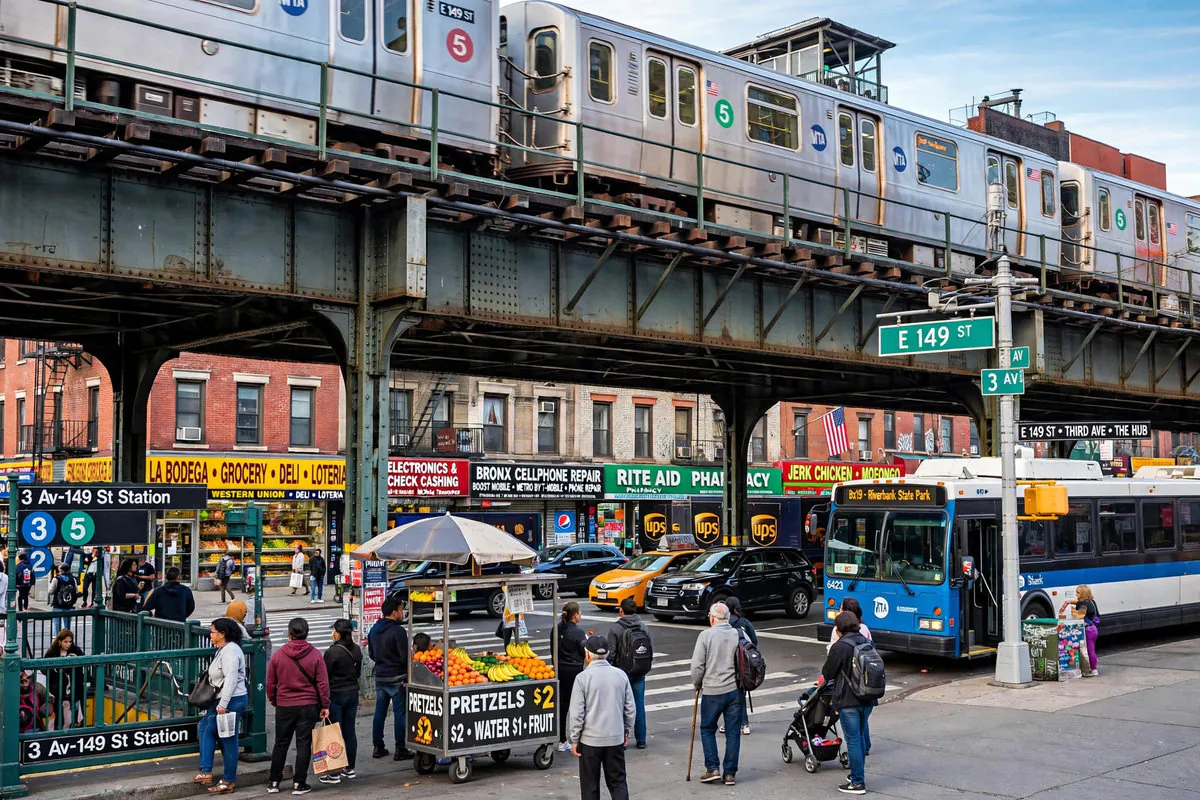
South Bronx NY Personal Injury Lawyer
The South Bronx — Mott Haven, Melrose, Port Morris, Longwood and the streets around the Hub at 149th Street — carries some of the heaviest working traffic in New York City. The Hunts Point Food Distribution Center alone feeds thousands of truck movements into local streets, layered over MTA buses, delivery vans, the Major Deegan and Bruckner expressways, and some of the most walked sidewalks in the borough. The injury claims match the environment.
Billy Cooper Law represents people injured in the South Bronx and across Bronx County. This page explains how these claims work and how the firm builds them. The county-wide view is on our Bronx County personal injury page.
A Bronx Firm for a Serious South Bronx Injury
Bronx civil cases are heard at the Bronx County Courthouse on the Grand Concourse, and Bronx juries have their own well-earned reputation for taking working people’s injuries seriously. Billy Cooper Law builds its Bronx cases for that courtroom: complete medical records, every responsible party identified, and evidence gathered before the street forgets.
The South Bronx rewards a firm that moves quickly. The truck that struck a pedestrian at a Hunts Point intersection is back on a route within hours; the corner store’s video rotates within days; the construction fencing around a Melrose development changes weekly. The first days of the case are spent capturing what the neighborhood will not keep.
Clients get the full practice — investigation, negotiation and litigation — with a free consultation and no fee unless there is a recovery.
Why South Bronx Cases Get Complicated
South Bronx injuries sit at the crossing of several systems. A single crash can involve a commercial truck with a corporate insurer, a no-fault claim on a thirty-day clock, and a workers’ compensation claim if the injured person was working — while a defective roadway or a city vehicle adds the ninety-day notice-of-claim track. A fall in a NYCHA development or a public building runs on public-entity rules from the start.
The neighborhood’s employment pattern matters too: warehouse and food-distribution work, delivery driving, home care, construction. Many South Bronx clients were hurt doing physical jobs, and their cases must coordinate compensation benefits, third-party claims and lost-wage proof across all of them.
Getting that structure mapped at intake — defendants, policies, clocks — is what keeps a strong case from being weakened by a missed step.
BILLY COOPER LAW

Types of Injury Cases We Handle in South Bronx NY
One South Bronx practice page already exists; the firm’s main practice pages and the Bronx County pages cover the rest:
- E-Bike Accidents in the South Bronx
- Car Accidents
- Personal Injury
- Uber and Lyft Accidents
- Uber Accidents — Bronx County
A Useful Local Snapshot
The South Bronx is the borough’s historic gateway: the Harlem River crossings and the Triborough (RFK) Bridge land here, the Major Deegan Expressway (I-87) and Bruckner Expressway (I-278) cross here, and the Hub — where Third Avenue, Melrose Avenue, 149th Street and Willis Avenue meet — is one of the busiest retail and transit crossroads in the city.
Hunts Point hosts the region’s food distribution center, with the Fulton Fish Market and produce and meat markets generating round-the-clock truck traffic. Lincoln Hospital at 149th and Morris Avenue is the neighborhood’s major medical center, and the Grand Concourse carries the borough’s civic buildings north from the Hub.
Where Serious Injuries Happen in South Bronx
South Bronx claims cluster where its working traffic meets its walking population:
- The Hub (149th Street, Third and Melrose Avenues) — dense pedestrian flow crossing buses, trucks and turning vehicles at one of the city’s busiest intersections.
- Hunts Point and the food distribution center — tractor-trailers and box trucks maneuvering among workers, vendors and local traffic day and night.
- The Bruckner and Major Deegan expressways and their ramps — higher-speed collisions, truck merges and debris.
- Southern Boulevard and Boston Road corridors — bus routes, delivery stops and heavy foot traffic around retail.
- Construction and development sites in Mott Haven and Melrose — scaffold, ladder and equipment injuries, and falling-object claims.
- Public and private housing stairwells, sidewalks and lots — falls on stairs, defective conditions and inadequate lighting, including NYCHA properties on public-entity clocks.
Real Injury Cases Often Begin in Ordinary Places
The firm handles South Bronx claims across the spectrum: truck, car and bus collisions; pedestrians and cyclists struck on local streets; e-bike and delivery-rider crashes; workplace injuries at warehouses, markets and construction sites, including Labor Law claims; slip, trip and fall injuries in buildings, stores, housing and on sidewalks; and wrongful death cases.
Two patterns define the neighborhood docket. The first is the commercial-vehicle case — trucks and delivery vehicles whose corporate records (routes, telematics, maintenance) can prove the claim if they are demanded before they rotate away. The second is the public-entity case — NYCHA, the City, the MTA — where the ninety-day notice deadline, not the three-year statute, is the first real hurdle.
What To Do After an Injury in South Bronx
After an injury in the South Bronx, the steps that protect your health and your claim:
- Get medical care. Call 911 for emergencies. Lincoln Hospital at East 149th Street is the major local facility; tell providers the visit follows an accident.
- Report it. NYPD for a crash (the 40th Precinct covers Mott Haven, Melrose and Port Morris; the 41st covers Hunts Point and Longwood); the building, store or site management for a fall — and get the incident number.
- Photograph the scene. Vehicles and company markings, the condition that caused a fall, the intersection, and your injuries — before anything moves.
- Collect names. Drivers and their employers, witnesses, responding officers. Note truck company names and DOT numbers — they identify the insurer.
- Keep every paper. Discharge records, bills, pay and schedule records — warehouse and shift documentation matters for wage proof.
- Hold off on recorded statements and fast settlements until you know your injuries, whether a public entity is involved, and which deadlines apply.
How Evidence Proves a South Bronx Injury Claim
South Bronx evidence is industrial and perishable. Trucking and distribution operations generate exactly the records that prove commercial cases — electronic logs, telematics, dispatch and scanner data, maintenance files — and those systems overwrite or archive on corporate schedules. Intersection and storefront cameras rotate quickly. A job site’s configuration changes by the week.
The firm’s first move is preservation: written demands to the companies and camera holders while the records exist, alongside the police report, any agency files, and the medical record build. For clients hurt at work, employer and compensation records are captured in parallel so the wage story is documented from the same period as the injury.
BILLY COOPER LAW
Deadlines That Control a South Bronx Personal Injury Claim
New York’s general negligence period is three years from the injury (CPLR 214) — but South Bronx cases are frequently governed by much shorter clocks. No-fault applications in vehicle cases are generally due within thirty days. Where the City, NYCHA, the MTA or another public body may be responsible, a notice of claim is generally due within ninety days and the suit window is one year and ninety days.
Fault follows CPLR 1411’s pure comparative rule — your share reduces the recovery rather than barring it — except that CPLR 1411(b) bars motor-vehicle claims commenced on or after May 26, 2026 where the claimant’s fault exceeds the defendants’ combined fault. Pain-and-suffering claims against motorists must meet the serious-injury threshold of Insurance Law § 5102(d).
All of these dates run from the accident itself. The deadline map is drawn at intake, and the shortest applicable clock sets the working schedule.
How Fault Is Divided Under New York Law
Responsibility in a South Bronx case can rest with a driver and the company behind the route, a property owner or manager, a contractor, a public agency, or several at once. The investigation follows control: who set the schedule the truck was rushing to meet, who maintained the staircase, who owned the condition that caused the fall.
Partial fault on your side does not end the case in most situations — comparative fault reduces the award instead. Insurers argue the percentages early and hard, particularly against pedestrians and riders; a documented record — footage, measurements, witnesses, vehicle data — is what answers them.
What Compensation Covers After a Serious Injury
A South Bronx claim seeks medical expenses past and future, lost wages and diminished earning capacity, and pain, suffering and loss of enjoyment of life. For clients whose work is physical — warehouse, driving, construction, care work — the earning-capacity side is often the largest part of the case, and it is proved with schedules, pay records and medical restrictions, not estimates.
No honest value can be stated before the medical picture and the coverage are known. What the firm protects immediately is the claim’s foundation: deadlines met, evidence preserved, treatment documented, and no release signed for an early, inadequate check.
When a Government Agency Is Involved
Public entities run through South Bronx life: NYCHA developments, City streets and sidewalks, MTA buses and stations, public schools and hospitals. Any injury touched by one of them — a housing stairwell fall, a bus collision, a defective roadway — takes the notice-of-claim path: ninety days, the correct entity, the prescribed form, then one year and ninety days to sue.
Precision matters: NYCHA is a separate authority from the City, and a notice to one does not reach the other. If a public building, vehicle or roadway appears anywhere in your account, raise it in the first conversation so the right notice goes to the right body in time.
Which Courts Hear South Bronx Personal Injury Cases?
Bronx civil claims are heard at the Bronx County Courthouse, 851 Grand Concourse — Supreme Court for serious cases. Smaller civil matters may be filed in Bronx Civil Court in the same complex. The neighborhood’s cases are tried before Bronx juries drawn from the borough itself.
Treatment usually begins at NYC Health + Hospitals/Lincoln on East 149th Street; severe trauma may route to Jacobi in the eastern Bronx or to St. Barnabas in Belmont. Police records come from the 40th or 41st Precinct depending on the location. Gathering those records into a single file — medical, police, agency, employment — is the backbone on which the claim is built.
How Billy Cooper Law Builds a South Bronx Injury Case
A South Bronx case at Billy Cooper Law starts with the deadline map and the preservation run: demands to trucking and distribution companies for logs and telematics, camera holders for footage, agencies for their files — all while the medical record and the insurance layers (no-fault, liability, commercial and excess policies) are assembled.
Most cases are then negotiated on a documented file. If the offers do not match the record, the case is filed in Bronx County Supreme Court and prepared for trial. Clients are kept informed in plain language throughout — what has been gathered, what it means, and what happens next.
The First 72 Hours After a South Bronx Injury
The three days after a serious South Bronx injury decide more than the three months that follow. Treatment starts the medical record — at Lincoln Hospital for emergencies, or at urgent care and the patient’s own doctors for injuries that declare themselves more slowly. The mechanism of injury recorded in those first notes (‘struck by box truck,’ ‘fell on broken sidewalk’) becomes the reference point every later record is measured against, which is why the intake conversation asks what the first chart says.
Evidence moves fastest in the same window. Corridor and bodega cameras in the South Bronx typically hold footage for days, not weeks; a preservation demand has to name the right holders — the deli on the corner, the building’s management, the MTA for station and bus footage — before the overwrite cycle runs. The vehicle or condition that caused the injury changes too: trucks are repaired, sidewalks are patched, scaffolding comes down. Photographs and measurements taken in the first 72 hours are frequently the only proof of how things actually were.
The clocks start in the same window. No-fault’s thirty days runs from the crash date; the ninety-day notice of claim runs from the fall or collision whenever a city agency, NYCHA, the MTA or a public vehicle is in the picture — a live possibility in a district where so much land, housing and transit is public. A case that begins in the first 72 hours begins with all of its options intact.
South Bronx NY Personal Injury FAQs: Truck Crashes, Public Housing Falls, and Deadlines
Below are answers to common questions about personal injury claims in the South Bronx, New York. This information is general and not legal advice — contact our office for guidance about your specific situation.
How long do I have to file a personal injury claim in the South Bronx?
Against a private party, generally three years from the date of injury under CPLR 214.
Public-entity claims run much faster: where the City, NYCHA, the MTA or another public body may be responsible, a notice of claim is generally due within ninety days and suit within one year and ninety days. Vehicle cases also carry a thirty-day no-fault application deadline.
Sources: CPLR 214 (N.Y. Senate) · General Municipal Law § 50-e (N.Y. Senate)
What does it cost to hire Billy Cooper Law?
The consultation is free, and personal injury cases are handled on a contingency fee — you pay no legal fee unless the firm recovers for you.
The fee and expense terms are explained in writing before you sign anything.
Sources: CPLR 214 (N.Y. Senate) · Insurance Law § 5102 (N.Y. Senate)
A truck hit me near Hunts Point. What makes that case different?
Commercial trucks bring corporate defendants and corporate evidence: driver logs, telematics, dispatch and maintenance records, and a commercial insurance policy. The company behind the route can be responsible for its driver’s negligence, and sometimes for its own — unrealistic schedules, poor maintenance, inadequate training.
Those records rotate and archive on company schedules. A preservation demand should go out in the first days, identifying the company and vehicle precisely — photographing the truck’s markings and DOT number at the scene is genuinely valuable.
Sources: Vehicle and Traffic Law § 388 (N.Y. Senate) · CPLR 214 (N.Y. Senate)
I fell in my NYCHA building. What are my deadlines?
NYCHA is a public authority, so the claim follows the notice-of-claim track: a formal notice generally served within ninety days of the fall, and a lawsuit within one year and ninety days.
The substance of the case is the condition — a broken stair, a failed light, a defective railing — and what the authority knew about it. Photograph the condition, report the fall to management, and get medical care; repair and inspection records become evidence.
Sources: General Municipal Law § 50-e (N.Y. Senate) · General Municipal Law § 50-i (N.Y. Senate)
Who pays my medical bills after a crash in the South Bronx?
No-fault insurance pays first in vehicle cases: the policy on the vehicle you were in — or, if you were walking or riding, the striking vehicle — covers necessary treatment and part of lost earnings regardless of fault.
The application is generally due within thirty days. If you were working when hurt, workers’ compensation may also apply; the systems coordinate, and both should be opened correctly at the start.
Sources: Insurance Law § 5103 (N.Y. Senate) · Insurance Law § 5102 (N.Y. Senate)
Can I recover if I was partly at fault?
Usually, yes. Pure comparative fault under CPLR 1411 reduces your recovery by your share of fault rather than barring it.
The exception is CPLR 1411(b): for motor-vehicle actions commenced on or after May 26, 2026, a claimant whose fault exceeds the defendants’ combined fault is barred. Percentages are decided on the evidence — footage, measurements, vehicle data — assembled early.
Sources: CPLR 1411 (N.Y. Senate) · CPLR 214 (N.Y. Senate)
What is the serious-injury threshold?
It is the standard a claim against a motorist must meet to recover for pain and suffering. Insurance Law § 5102(d) lists qualifying injuries — fractures, significant disfigurement, permanent or significant limitation or loss of use of a body member or function, and injuries preventing substantially all usual activities for 90 of the first 180 days, among others.
Meeting it is proved in the medical record: imaging, documented limitations and restrictions. Consistent treatment builds that record; gaps in care undermine it.
Sources: Insurance Law § 5102 (N.Y. Senate) · Insurance Law § 5104 (N.Y. Senate)
I was hurt working at a warehouse/market. Is workers’ comp my only remedy?
Workers’ compensation covers your medical care and partial wage benefits through your employer, but it is often not the whole case. If a third party contributed — a truck driver, a property owner, another contractor, defective equipment — a personal injury claim may run alongside the compensation case.
The claims interact (compensation can claim a lien on part of the third-party recovery), so they should be assessed together from the beginning.
Sources: Workers’ Compensation Law § 29 (N.Y. Senate) · NYS Workers’ Compensation Board — What Is Workers’ Compensation?
Where are South Bronx injury cases heard?
Serious civil claims are heard in Supreme Court, Bronx County, at the Bronx County Courthouse, 851 Grand Concourse. Smaller matters may go to Bronx Civil Court in the same complex.
Most cases resolve by settlement once the file is documented — but they are prepared for that courtroom and those juries from the start.
Sources: CPLR 503 (N.Y. Senate) · CPLR 214 (N.Y. Senate)
What should I bring to my first consultation?
Bring the date and exact location, any police or incident report number, insurance information, photographs, witness names, medical paperwork, and proof of missed work or wages — including shift and schedule records.
Do not delay because the file is incomplete. In the South Bronx, the most perishable evidence — truck data, camera footage — has the shortest life, and the ninety-day public-entity clock may already be running.
Sources: CPLR 214 (N.Y. Senate) · CPLR 1411 (N.Y. Senate) · General Municipal Law § 50-e (N.Y. Senate)
Tell Us What Happened
If you were injured in the South Bronx, tell us where it happened, what treatment you have had, and what any insurer has said. We will map your deadlines, explain the next steps in plain language, and tell you honestly whether we can help. Request a free consultation online or call (914) 730-5789.
Communities We Serve
- Bronx County
- South Bronx
- Co-op City
- Fordham
- Kingsbridge
- Morrisania
- Riverdale
- Soundview
Sources
Firm Information
- Billy Cooper Law: Meet the Team
- Billy Cooper Law: Billy Cooper, Esq.
- Billy Cooper Law: Case Results
- Billy Cooper Law: Office Locations
- Billy Cooper Law: Personal Injury
- Billy Cooper Law: Contact
South Bronx Sources
- U.S. Census Bureau QuickFacts: Bronx County, New York
- NY Courts — Twelfth Judicial District (Bronx County)
- City of New York
NOTABLE RESULTS
Selected results in Billy Cooper Law’s broader personal injury practice:
$9,000,000 settlement · $2,005,000 settlement
Read more about these results
- $9,000,000 settlement — Tank explosion
A man suffered extensive burns and loss of his dominant hand in a tank explosion in Westchester County.
- $2,005,000 settlement — Construction-site roof fall
A worker fell from a roof after inadequate safety equipment was provided on a Rockland County job site.
These are reported gross results, before fees, expenses, and applicable liens. They are not estimates of another claim’s value. Read the firm’s published case results.
Prior results do not guarantee a similar outcome. Each case is different and must be evaluated on its own facts.
WHAT OUR CLIENTS SAY
General feedback about working with Billy Cooper Law:
“I had the pleasure of working with Billy Cooper a number of years back, and I can’t thank him enough for his incredible help and ongoing support. From the beginning, he made the legal process feel less daunting with his approachable and friendly manner. His expertise in personal injury law was evident, and he fought hard for my case, resulting in a substantial settlement.Billy didn’t just stop once the case was over. He has always been there to offer advice and guidance whenever I’ve needed it. His down-to-earth explanations of legal jargon made everything so much easier to understand, empowering me to make informed decisions.I can’t recommend Billy Cooper enough. He’s not just a fantastic lawyer; he’s a genuine human being who goes above and beyond for his clients.”
— H. K., Google review
“You wont find an attorney who is smart, and empathetic at the same time as William Cooper. I have spoken to many personal injury attorneys who would go no further than a phone call. Mr. Cooper took the extra step and made inquiries for me just to try and help me with an issue that’s been unresolved. He is patient, clear and concise in conversation and does not rush, he waits until you have a full understanding of all aspects of the situation. Don’t waste your time searching for the right personal injury attorney, look no further than William Cooper. He is a rare find!”
— T. P., Google review
Professional Recognition

Recognition applies to the named attorneys and selection years. See the linked profiles for details.
Related Billy Cooper Law Videos and Social Posts
- Billy Cooper Law official YouTube channel — Youtube — official account.
- Billy Cooper Law official Instagram profile — Instagram — official account.
- Billy Cooper Law official Linkedin profile — Linkedin — official account.
- Protecting an Injury Claim on Social Media — Facebook.
- Types of Personal Injury Cases the Firm Handles — Facebook.
Published Articles by Billy Cooper
- When the Video Disappears: Liability, Missing Footage, and the Modern New York Injury Case — New York Law Journal · June 23, 2026.
Billy Cooper discusses video evidence that is missing, incomplete, or overwritten in New York injury litigation.
Related Locations and Practice Resources
BILLY COOPER LAW
Related Resources

Get the Answers You Need
At Billy Cooper Law, every day we renew our pledge to help injured people get the justice and compensation they deserve. We have a reputation throughout New York and nationally for standing up for our clients, and we take that responsibility seriously by approaching every case with preparation, persistence, and an unwavering commitment to results.