

New City NY Car Accident Lawyer
A car crash can leave you in pain, without reliable transportation, and unsure which insurance company is supposed to pay. While you are trying to arrange medical care and explain missed work to your employer, an adjuster may already be asking for a recorded statement.
The first steps matter. So does the exact location of the collision. A crash on Route 304 may involve different records and government agencies than one on Little Tor Road, New Hempstead Road, or a neighborhood street. Billy Cooper Law helps injured people identify the applicable insurance, preserve evidence, and understand what New York law allows them to recover.
BILLY COOPER LAW

Types of Injury Cases We Handle in New City NY
- Personal Injury
- E-Bike Accidents
- Car Accidents
- Slip and Fall
Car Accident Lawyers Serving Rockland County
Why Call Billy Cooper Law After a New City Crash?
You should be able to speak with a lawyer who will listen before drawing conclusions. Billy Cooper Law says that people who contact the firm speak directly with an attorney and receive an explanation of the law—even when the firm cannot accept the case.
William H. Cooper joined Marvin A. Cooper, P.C. in 1991 and has served as lead trial counsel for more than 25 years. His biography lists Super Lawyers recognition from 2024 through 2026. Attorney Anieska J. Garcia is fluent in English and Spanish, allowing clients to discuss difficult medical and financial concerns without relying on a relative to interpret. The firm offers free consultations and handles injury cases on a contingency-fee basis, meaning there is no attorney’s fee unless compensation is recovered. (Billy Cooper Law attorney profiles; Anieska Garcia’s biography) (billycooperlaw.com)
Billy Cooper Law represents Rockland County clients from its White Plains office. It does not claim to have an office in New City. If you call (914) 730-5789, the first conversation is an opportunity to explain what happened, ask questions, and learn whether any immediate deadlines require attention. (Billy Cooper Law contact information) (billycooperlaw.com)
Why New City Car Accident Cases Require Local Investigation
A New City mailing address does not tell you who controls the road.
Route 304 is a state road. By contrast, Rockland County identifies North Main Street and Old Route 304 as portions of County Route 29, Little Tor Road as part of County Route 33, and New Hempstead Road and Congers Road as parts of County Route 80. Other streets may be maintained by the Town of Clarkstown. (Town of Clarkstown state and county road information; Rockland County route listing) (rocklandcountyny.gov)
That difference becomes important when a case involves more than another driver’s mistake. If poor drainage, a malfunctioning signal, obstructed sight lines, construction activity, ice, or defective pavement contributed to the collision, the investigation must identify the responsible agency. Maintenance records, work orders, traffic studies, complaints, and inspection files may be held by the state, county, or town.
The Town of Clarkstown has also acknowledged that Routes 303 and 304 generate significant traffic and road-safety concerns, while noting that those roads are under state—not town—control. That is a useful reminder that the closest government office is not necessarily the agency responsible for the roadway. (Town of Clarkstown Route 303/304 safety study) (clarkstown.gov)
What the Local Crash Numbers Show
The latest Rockland County community health assessment reports 9,144 police-reported crashes in 2024, based on preliminary data. That followed 9,711 crashes in 2023. In 2024, 21.1% of reported crashes involved personal injury, while 0.19% were fatal. Separately, New York State health data reports an age-adjusted motor vehicle mortality rate of 4.0 deaths per 100,000 Rockland County residents for 2021–2023. (Rockland County Community Health Assessment; New York State Rockland County health indicators) (rocklandcountyny.gov)
Those countywide figures do not tell us who caused a particular New City collision. They do show why prompt medical care, accurate reporting, and early evidence preservation matter. Even when vehicle damage initially appears manageable, a crash can produce injuries that affect a person’s ability to work or function for months.
Where New City Collisions Become Complicated
Route 304 and commercial entrances
Crashes on Route 304 may involve drivers entering or leaving businesses, turning across traffic, changing lanes, or approaching signalized intersections. Nearby stores and offices may have exterior cameras, but recordings can be overwritten quickly.
If the allegation concerns the road itself—rather than another motorist—the investigation may require New York State records and compliance with Court of Claims procedures.
Little Tor Road, New Hempstead Road, and Congers Road
These are county routes, so a collision involving drainage, lane markings, roadwork, snow treatment, signage, or sight obstructions may require records from the Rockland County Highway Department. The precise location matters because maintenance responsibility can change from one road segment to the next.
Main Street and the county government district
The area around the Rockland County Courthouse and county offices brings together employees, visitors, pedestrians, delivery vehicles, buses, and drivers searching for unfamiliar entrances. A collision in this area may generate police records, public-building video, private surveillance, dispatch records, and multiple eyewitness accounts.
The presence of a government building does not make a public agency responsible. The evidence still has to show who caused the crash and whether any public property or employee played a role.
Snow and ice conditions
Winter crashes require more than a general statement that the road was slippery. Investigators may need weather records, treatment logs, plow routes, photographs, witness accounts, and evidence showing when the condition developed. They must also determine whether the state, county, town, or a private property owner controlled the location.
The Town of Clarkstown reports that snowstorms typically produce additional crashes and stranded vehicles, making early photographs and an exact location especially important. (Clarkstown snow preparation information) (clarkstown.gov)
Car Accident Cases Billy Cooper Law Handles
Billy Cooper Law represents drivers, passengers, and families affected by:
- Rear-end and chain-reaction collisions
- Intersection and left-turn crashes
- Head-on and sideswipe collisions
- Distracted-driving crashes
- Drunk-driving accidents
- Hit-and-run and uninsured-driver crashes
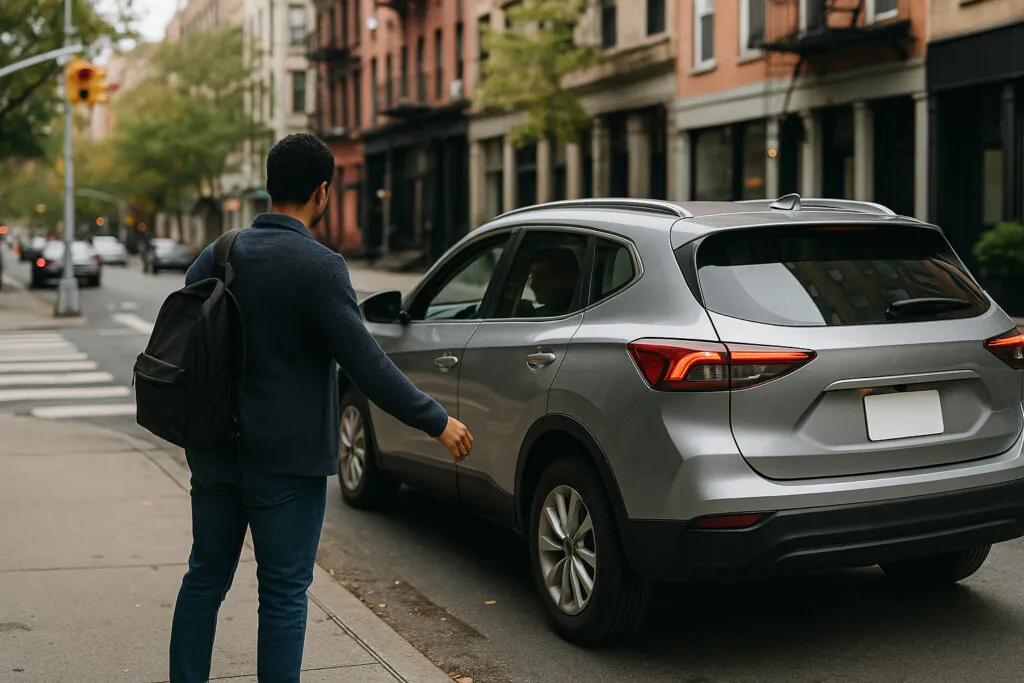
- Uber and Lyft accidents
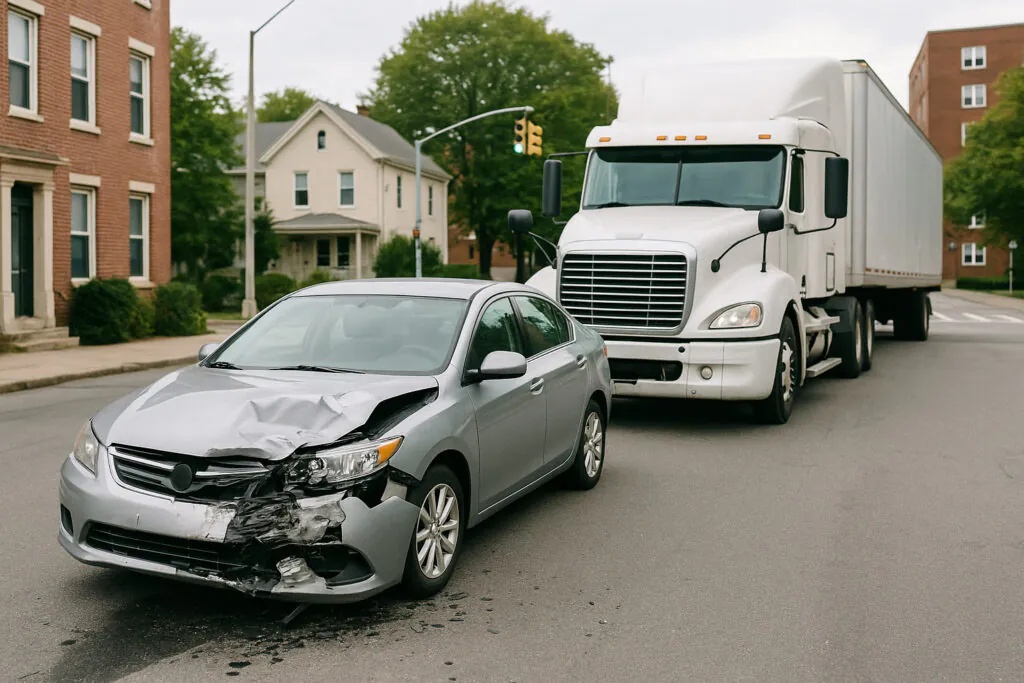
- Truck, delivery van, and commercial vehicle collisions
- Crashes causing traumatic brain injuries or spinal cord injuries
- Catastrophic injury claims
- Wrongful death claims
The legal issues vary. A rear-end collision may turn on following distance and sudden-stop claims. A rideshare crash may require analysis of the driver’s app status. A delivery-vehicle case may involve an employer and commercial insurance. A hit-and-run claim may depend on uninsured motorist coverage and prompt notice to the correct insurer.
What to Do After a Car Accident in New City
Your health comes first. Call 911 if anyone may be injured or if the vehicles create a continuing danger. Do not move an injured person unless remaining in place presents an immediate threat.
Once the immediate danger has passed:
- Ask the police to document the collision. Give accurate information, but do not guess about speed, distance, or fault.
- Photograph the entire scene. Include vehicle positions, damage, debris, lane markings, traffic signals, signs, weather, and nearby businesses or homes.
- Exchange information. Obtain the other driver’s license, registration, insurance details, license plate number, and contact information.
- Identify witnesses. Get names and phone numbers yourself. Do not assume everyone will appear in the police report.
- Seek medical attention. Adrenaline can temporarily mask head, neck, back, shoulder, and internal injuries.
- Notify the proper no-fault insurer promptly. Waiting can jeopardize benefits.
- Avoid a recorded statement to the other driver’s insurer before understanding your rights. You do not need to speculate or minimize symptoms to appear cooperative.
- Preserve the vehicle and damaged property. Do not authorize destruction or disposal before important evidence is documented.
New York also requires a motorist to file Form MV-104 with the Department of Motor Vehicles within 10 days when a crash causes an injury, death, or more than $1,000 in damage to any one person’s property. Reporting the collision to the police or an insurance company does not necessarily satisfy that separate obligation. (New York DMV Form MV-104) (dmv.ny.gov)
Evidence Worth Preserving
A police report is a starting point, not the entire case. Depending on how the crash happened, useful evidence may include:
- Dashcam, traffic, doorbell, or business surveillance video
- Photographs and measurements of the road
- 911 calls and dispatch records
- Witness statements
- Vehicle event-data-recorder information
- Cellphone records in a distracted-driving case
- Rideshare app records
- Commercial driver and vehicle inspection files
- Repair estimates and photographs of vehicle damage
- Traffic-signal, road-maintenance, and construction records
- Prior complaints about a dangerous condition
- Medical imaging, treatment records, and bills
- Employment, wage, and tax records
The Clarkstown Police Department provides information for obtaining accident reports. It also maintains a surveillance-camera registration program that may help police identify participating camera owners. Registration does not preserve the actual footage, so potentially relevant video should still be requested quickly. (clarkstown.gov)
How New York No-Fault Insurance Works
“No-fault” does not mean that no one caused the collision. It means that eligible injured people generally turn first to no-fault insurance for basic medical expenses and limited wage-loss benefits, regardless of who was responsible.
Standard basic economic loss coverage generally provides up to $50,000 per person for combined covered losses. Wage benefits are subject to statutory limits, including a 20% reduction and a maximum of $2,000 per month for up to three years. (New York Insurance Law § 5102) (nysenate.gov)
A driver or passenger ordinarily files through the insurer covering the occupied vehicle. A pedestrian generally files with the insurer for the vehicle that struck them. Hit-and-run, uninsured-vehicle, and household-policy situations may require a different analysis.
Deadlines arrive quickly:
- Written notice of the no-fault claim is generally due within 30 days of the crash.
- Medical bills generally must be submitted within 45 days after treatment.
- Wage-loss and other necessary-expense claims generally must be submitted within 90 days after the loss is incurred.
Limited exceptions may apply when there is a clear and reasonable justification for delay, but you should not plan around an exception. (New York Department of Financial Services no-fault guidance) (dfs.ny.gov)
The Serious-Injury Requirement Changed in 2026
To recover pain and suffering in a case governed by New York’s no-fault law, an injured person generally must prove a “serious injury” under Insurance Law § 5102(d).
The current categories include:
- Death
- Dismemberment
- Significant disfigurement
- A fracture
- Loss of a fetus
- Permanent loss of use of a body organ, member, function, or system
- Permanent consequential limitation of a body organ or member
- Significant limitation of a body function or system
A 2026 amendment removed the former category for a medically determined, nonpermanent injury that prevented a person from performing substantially all customary activities for at least 90 of the first 180 days after the collision. Objective medical documentation is therefore more important than ever in cases involving disc injuries, torn ligaments, nerve damage, or other conditions that do not automatically meet a listed category. (New York Insurance Law §§ 5102 and 5104; New York Insurance Law § 5104) (nyassembly.gov)
That does not mean every injured person needs surgery. It means the medical record must clearly connect the collision to a qualifying limitation or permanent injury. Imaging, specialist evaluations, measured range-of-motion findings, treatment recommendations, and explanations of prior medical conditions can all become important.
What If You Were Partly at Fault?
New York changed its comparative-fault rule for motor vehicle personal injury cases in 2026.
For lawsuits subject to Article 51 of the Insurance Law and commenced on or after May 26, 2026, recovery is barred when the injured person’s share of fault is greater than the combined fault of the people being sued. In practical terms, a person found more than 50% responsible will generally recover nothing. At 50% fault or less, compensation may still be available, but it is reduced by that percentage. (CPLR § 1411; 2026 enacted legislation) (nysenate.gov)
This makes early fault investigation critical. Skid marks disappear. Vehicles are repaired. Video is erased. Witnesses become difficult to locate. An insurer’s first version of the collision should not become the only version simply because evidence was not preserved.
Who May Be Responsible for a New City Crash?
Depending on the facts, responsibility may rest with:
- A driver who was speeding, distracted, following too closely, or failing to yield
- More than one driver in a chain-reaction collision
- The vehicle owner
- An employer whose employee caused a crash while working
- A rideshare or commercial insurance carrier
- A business that negligently entrusted a vehicle to an unsafe driver
- A contractor responsible for unsafe roadwork or traffic control
- A government entity responsible for a roadway or public vehicle
New York Vehicle and Traffic Law § 388 can make a vehicle owner responsible for negligence committed by someone driving the vehicle with the owner’s permission. That can be important when the negligent driver has limited coverage but the vehicle owner carries a separate policy. (New York Vehicle and Traffic Law § 388) (nysenate.gov)
Compensation After a Serious Car Accident
The compensation available depends on the injury, insurance coverage, medical evidence, work loss, and degree of fault.
A claim may seek recovery for:
- Medical expenses not covered by no-fault
- Future treatment, rehabilitation, and assistive care
- Lost wages beyond available no-fault benefits
- Reduced future earning capacity
- Transportation and other accident-related expenses
- Vehicle and personal-property damage
- Pain and suffering
- Loss of enjoyment of life
- Permanent disability or disfigurement
No lawyer can responsibly value a case from the police report alone. The long-term prognosis, available insurance, strength of the fault evidence, and ability to meet the serious-injury threshold all matter.
When a Government Agency May Be Involved
A government claim can arise when a town, county, or state vehicle causes a collision or when a public roadway condition contributes to it. These cases may have deadlines far shorter than the ordinary three-year period.
For claims against a town, county, or similar municipal entity, New York General Municipal Law § 50-e generally requires a notice of claim within 90 days. The lawsuit ordinarily must be commenced within one year and 90 days under General Municipal Law § 50-i. (General Municipal Law § 50-e; General Municipal Law § 50-i) (nysenate.gov)
A negligence claim against New York State may require filing and serving a claim—or serving a notice of intention—within 90 days under the Court of Claims Act. The proper court and procedure depend on the defendant and the nature of the claim. (Court of Claims Act § 10) (nysenate.gov)
Do not assume that a crash on a public road automatically creates a government claim. The lawyer must first determine who controlled the road, what condition allegedly caused the collision, whether the agency had legally sufficient notice, and whether another driver remains primarily responsible.
BILLY COOPER LAW
Local Police, Courts, and Medical Resources
- Clarkstown Police Department: 20 Maple Avenue, New City NY 10956. Emergency calls should go to 911. The department maintains motor vehicle accident reports and related records. (Clarkstown Police Department)
- Rockland County Supreme Court: 1 South Main Street, New City NY 10956. Many substantial civil car accident cases arising in Rockland County are filed here. (New York Courts—Rockland Supreme and County Court)
- Montefiore Nyack Hospital: 160 North Midland Avenue, Nyack NY 10960. New York State lists the hospital as a Level III adult trauma center. (New York State hospital profile; Montefiore Nyack Emergency Center)
- Good Samaritan Hospital: 255 Lafayette Avenue, Suffern NY 10901. New York State lists it as a Level II adult and pediatric trauma center. (New York State hospital profile)
An ambulance crew will decide where to transport a seriously injured person based on medical needs and current conditions. Do not delay emergency care to select a facility for legal reasons. (clarkstown.gov)
How Billy Cooper Law Investigates a New City Car Accident
A proper investigation starts with listening to your account and identifying what could disappear first. The firm may then:
- Obtain police, 911, and dispatch records
- Send preservation requests for video and electronic evidence
- Photograph and inspect the scene
- Identify the agency responsible for the road
- Interview witnesses
- Review vehicle damage and event-data information
- Analyze no-fault, liability, uninsured motorist, and underinsured motorist coverage
- Coordinate medical documentation with the serious-injury requirement
- Investigate the driver, vehicle owner, employer, and other potentially responsible parties
- Consult medical or accident-reconstruction experts when needed
- Document wage loss and the effect of the injury on daily life
- File suit in the appropriate court if the claim cannot be resolved fairly
The goal is not simply to collect records. It is to connect the evidence—to show how the crash happened, why another party is legally responsible, and how the injuries changed your life.
Related Guidance for New City Injury Claims
This page addresses car crashes only. For information about falls, construction accidents, medical malpractice, and other injury matters, visit the firm’s New City NY personal injury lawyer page.
Tell Us What Happened
You do not need the police report, complete medical records, or a final diagnosis before asking for help. Start with what you know: where the crash happened, which vehicles were involved, what injuries you are experiencing, and which insurance companies have contacted you.
Billy Cooper Law can explain the no-fault process, the evidence worth preserving, and the deadlines that may apply. Call (914) 730-5789 for a free consultation. If the firm accepts your case, there is no attorney’s fee unless compensation is recovered.
New City NY Car Accident FAQs: Safety, Insurance, and New York Claims
These answers provide general information about New York car crashes, not advice about a particular claim. The result can change with the collision facts, available evidence, insurance policies, and the date an action is started.
What should I do immediately after a car accident in New City NY?
First, get to a safe place if you can, call 911 when anyone may be injured, and follow emergency responders’ instructions. New York requires involved drivers to stop and exchange identifying, license, vehicle, and insurance information after property damage; an injury crash must also be reported to police. Do not move an injured person unless an immediate danger makes movement necessary.
If it is safe, record vehicle positions, damage, road and weather conditions, traffic controls, and witness contact information before the scene changes. Save the other driver’s insurance details and your medical discharge papers. These steps do not decide fault, but they preserve information that police, insurers, doctors, and counsel may later need to evaluate what happened and which deadlines apply.
Sources: New York Vehicle and Traffic Law § 600; New York State Driver’s Manual—crash duties.
Do I have to file a New York DMV crash report after a New City NY collision?
You must file an MV-104 with the New York DMV within 10 days when a New York crash causes a death, any personal injury, or more than $1,000 in damage to any one person’s property. This motorist report is separate from a police officer’s report and from notifying an insurance company. The filing duty can therefore remain even when officers came to the scene.
Complete the form accurately with the information reasonably available; do not guess about injuries, speeds, or fault. If the driver is physically unable to report, Vehicle and Traffic Law § 605 identifies when another participant or the vehicle owner must report. Missing the deadline can be a misdemeanor and can lead to suspension of a license or registration until the report is filed.
Sources: New York Vehicle and Traffic Law § 605; New York DMV Form MV-104 and instructions.
How do New York no-fault benefits work after a car crash?
New York no-fault coverage generally pays eligible basic economic loss arising from the use or operation of a covered motor vehicle without first deciding who caused the crash. Basic economic loss includes qualifying medical expenses, part of lost earnings, and certain necessary expenses, up to the statutory limit and subject to policy terms, offsets, exclusions, and proof requirements. It is different from a liability claim for pain and suffering.
Notice is time-sensitive. New York’s prescribed no-fault rules generally require written notice within 30 days, health-service bills within 45 days of treatment, and lost-earnings proof within 90 days; late submissions require a reasonable justification under the regulation. Identify the correct no-fault insurer promptly and keep copies of the NF-2, bills, wage records, authorizations, and delivery confirmations.
Sources: New York Insurance Law § 5102; New York DFS no-fault consumer FAQs; 11 NYCRR Part 65—Insurance Regulation 68.
What counts as a serious injury in a New York car accident case?
For a covered person to recover pain-and-suffering damages from another covered person, New York generally requires a “serious injury” under Insurance Law § 5102(d). The current categories include death, dismemberment, significant disfigurement, fracture, loss of a fetus, permanent loss of use, permanent consequential limitation, or significant limitation of a body function or system. A diagnosis alone does not automatically establish the legal threshold.
The Legislature removed the former 90-out-of-180-days category for actions and proceedings commenced on or after May 26, 2026. Medical records should therefore document the condition, objective findings when appropriate, treatment course, functional limitations, causation, and relevant prior conditions. Whether the threshold is met depends on admissible evidence and the category asserted, not simply the severity label used in a chart.
Sources: New York Insurance Law § 5102(d); New York Insurance Law § 5104; New York DFS Circular Letter No. 3 (2026).
How long do I have to bring a car accident claim in New York?
New York generally gives three years to commence an action for personal injury, but that is not a universal deadline for every crash-related claim. A wrongful-death claim, a no-fault submission, a claim under an insurance policy, a claim involving a public entity, or a claim for a minor can follow different rules. The applicable date should be checked from the specific facts and defendant.
If a city, county, town, village, school district, or another covered public corporation may be responsible, General Municipal Law § 50-e commonly requires a notice of claim within 90 days. Section 50-i can require suit within one year and 90 days for covered municipal tort claims. Because identifying a public vehicle or road-maintenance defendant takes time, preserving the crash report and investigating ownership early can matter.
Sources: New York CPLR § 214; New York General Municipal Law § 50-e; New York General Municipal Law § 50-i.
Can I recover if I was partly at fault for a New York car accident?
Possibly, but New York changed the rule for motor-vehicle personal-injury actions subject to Insurance Law Article 51. For actions and proceedings commenced on or after May 26, 2026, CPLR § 1411(b) bars recovery when the claimant’s fault is greater than the fault of the person sued or the combined fault of all persons sued. When recovery is not barred, the claimant’s percentage of fault reduces the damages.
The statute uses a greater-than test, so a finding of exactly 50 percent claimant fault is not itself the bar described in subsection (b), although it can reduce recoverable damages by 50 percent. Fault percentages depend on evidence such as right-of-way rules, signals, speed, visibility, witness accounts, photographs, and electronic records. Earlier-commenced actions may require a different analysis.
Sources: New York CPLR § 1411; New York DFS explanation of the 2026 motor-vehicle reforms.
Can the vehicle owner be liable when someone else caused the crash?
Yes, a vehicle owner can be responsible under New York Vehicle and Traffic Law § 388 when a person using or operating the vehicle with the owner’s express or implied permission negligently causes injury or property damage. That rule can make ownership and permission important even when the titled owner was not in the car. It does not eliminate the need to prove negligent operation and causation.
Registration records, the police report, insurance disclosures, lease documents, and testimony about permission may help identify the owner and available coverage. The statute contains definitions and exceptions, and leased, rented, employer-owned, government, and out-of-state vehicles can raise additional issues. A careful review should separate the driver, titled owner, policyholder, employer, and any other entity instead of assuming they are the same party.
Sources: New York Vehicle and Traffic Law § 388; New York Insurance Law § 3420(e).
What if the at-fault driver was uninsured or left the scene?
An uninsured-motorist claim may be available when an uninsured or unidentified hit-and-run vehicle causes bodily injury, but coverage depends on who qualifies as an insured and compliance with the policy and statutory procedures. New York liability policies include required uninsured-motorist protection, while supplementary uninsured/underinsured motorist coverage may provide additional protection if it was selected and the applicable conditions are satisfied.
Report a hit-and-run promptly to police and all potentially applicable insurers, and preserve proof of physical contact, witness information, video, vehicle damage, and efforts to identify the other driver. Do not assume that the absence of the driver ends the inquiry: household policies, the occupied vehicle’s policy, supplementary coverage, and the Motor Vehicle Accident Indemnification Corporation may require separate review and different notices.
Sources: New York Insurance Law § 3420(f); New York DFS Automobile Insurance Consumer Guide; New York Vehicle and Traffic Law § 600.
Should I get medical care if car-crash symptoms appear later?
Yes—new or worsening symptoms after a crash should be assessed by a qualified health professional, and emergency warning signs require immediate care. CDC explains that some mild traumatic brain injury symptoms can appear hours or days after an injury. A worsening headache, repeated vomiting, seizure, weakness, slurred speech, increasing confusion, unequal pupils, or inability to wake warrants emergency evaluation rather than waiting on an insurance decision.
Tell the clinician when and how the collision occurred, describe symptoms accurately, and follow individualized medical instructions. Keep records of visits, restrictions, referrals, and symptom changes because contemporaneous records can help clinicians and can clarify the timeline later. Medical literature reports associations between early pain or disability measures and persistent whiplash problems, but those population findings do not diagnose an individual or predict a particular recovery.
Sources: CDC mild TBI and concussion symptoms; PubMed systematic meta-review of whiplash prognostic factors.
How is the value of a New York car accident claim determined?
There is no official settlement calculator or guaranteed value. A claim is evaluated from supported losses and legal limits: fault, the serious-injury threshold, medical expenses, lost earnings, future care, other economic loss, pain and suffering when legally available, insurance limits, liens, and the strength of causation evidence. New York defines “basic economic loss” and “non-economic loss,” but those definitions do not assign one price to an injury.
Useful proof can include medical records and bills, wage verification, tax or employment records, photographs, repair documents, and evidence of functional limitations. Insurers and factfinders may dispute whether treatment was necessary, whether a condition was caused or aggravated by the crash, and whether claimed losses are documented. Any estimate should therefore be tied to the actual records and available coverage, not an average advertised online.
Sources: New York Insurance Law § 5102 definitions; New York Insurance Law § 5104 limits on personal-injury actions.
Sources
Billy Cooper Law
- Billy Cooper Law
- New City NY Personal Injury Lawyer
- New York Car Accident Lawyer
- Billy Cooper, Esq.
- Anieska Garcia, Esq.
- Case Results
- Contact Billy Cooper Law
- Drunk-Driving Accidents
- Uber and Lyft Accidents
- Commercial Vehicle Accidents
- Catastrophic Injuries
- Traumatic Brain Injuries
- Spinal Cord Injuries
- Wrongful Death
New City and Rockland County
- Rockland County Community Health Assessment
- Rockland County Highway Department Route Listing
- Town of Clarkstown State and County Roads
- Town of Clarkstown Route 303/304 Safety Study
- Town of Clarkstown Snow Preparation Information
- Clarkstown Police Department
- Clarkstown Police Accident Reports
- Clarkstown Surveillance Camera Registration
- Rockland Supreme and County Court
- Rockland County Hospital Profiles
- Montefiore Nyack Emergency Center
- New York State Rockland County Health Indicators
New York Law and Insurance Rules
- New York DMV Form MV-104
- New York DMV Guidance After a Traffic Crash
- New York Department of Financial Services No-Fault FAQs
- New York Insurance Law § 5102
- New York Insurance Law § 5104
- New York Vehicle and Traffic Law § 388
- CPLR § 1411
- CPLR § 214
- General Municipal Law § 50-e
- General Municipal Law § 50-i
- Court of Claims Act § 10
- 2026 New York Transportation and Insurance Legislation
BILLY COOPER LAW

Get the Answers You Need
At Billy Cooper Law, every day we renew our pledge to help injured people get the justice and compensation they deserve. We have a reputation throughout New York and nationally for standing up for our clients, and we take that responsibility seriously by approaching every case with preparation, persistence, and an unwavering commitment to results.