
White Plains NY Car Accident Lawyer
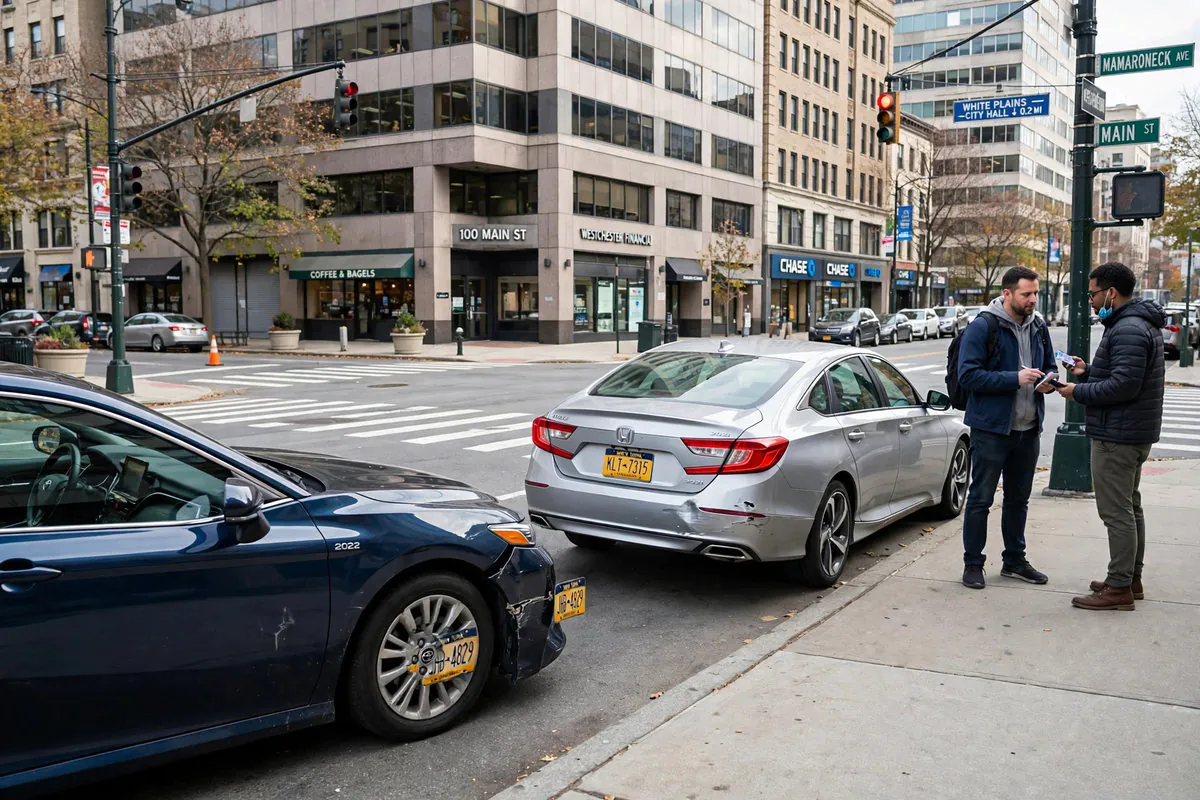
A car accident in White Plains is a local event with local rules. The crash happens on I-287, the Bronx River Parkway or Mamaroneck Avenue; the treatment happens at White Plains Hospital; the no-fault claim runs on a thirty-day clock; and if the case is litigated, it is litigated at the Westchester County Courthouse a few blocks from our office. Billy Cooper Law is based in White Plains, and this page explains how car accident claims work here. The firm’s dedicated White Plains personal injury lawyer page covers the broader injury practice. For the statewide picture, see our New York car accident page. White Plains’ broader injury practice is on the White Plains personal injury page, and the county hub is Westchester County.Car Accident Lawyers Serving Westchester County
- Westchester County
- White Plains
- Yonkers
- Greenburgh
- New Rochelle
- Mount Vernon
Car Accident Cases We Handle in White Plains
- Delivery Accidents
- E-Bike Accidents
- Uber and Lyft Accidents
- Slip and Fall
- White Plains Personal Injury
Car Accident Lawyers Serving Westchester County
The firm’s Westchester car accident pages cover the county’s southern tier and its corridors: Yonkers, Greenburgh, Mount Vernon and New Rochelle, alongside White Plains under the Westchester County hub. The law is the same across the county — no-fault first, the serious-injury threshold, the comparative-fault rules — but the evidence is local: which police force responded, which hospital holds the records, which cameras saw the corner. Those details are handled town by town.BILLY COOPER LAW

Why Injured People Turn to Billy Cooper Law
Billy Cooper Law’s office is on Main Street in White Plains. Our lawyers file in the Westchester County courts at 111 Dr. Martin Luther King Jr. Boulevard, deal with the carriers and defense firms that work this county, and can be at a crash corridor, a hospital or a courthouse without a day’s travel in between. That proximity shows up in the first week of a case: preservation letters to the right camera holders, the correct police file requested from the correct agency, and no-fault paperwork filed inside its thirty-day window. The consultation is free, and there is no fee unless we recover for you.What Makes White Plains Car Accident Cases Different
White Plains crashes divide into two families. The first is the corridor crash: I-287 and the parkways carry high-speed commuter and commercial traffic through the city’s edges, producing rear-end chains, merge collisions and truck involvement at speeds that cause serious injury. The second is the downtown crash: lower speeds but denser conflict — turning vehicles, garage and lot entrances, delivery and rideshare stops, and pedestrians everywhere around the hospital, the station and the malls. Lyft trips are part of that downtown traffic, and our Lyft accident page for White Plains covers crashes involving them. The two families generate different evidence and different fights. Corridor cases turn on vehicle data, State Police files and speed. Downtown cases turn on camera footage, sightlines and who had the right of way in a complicated intersection. The investigation follows the family the crash belongs to.A Local Car Accident Snapshot
A White Plains car case usually turns on a handful of items gathered early: the police report (White Plains Public Safety in the city, State Police on the parkways, County Police on the county parkways), the White Plains Hospital record, photographs of the vehicles and the scene, the no-fault filing made in time, and an early read on the other driver’s coverage. None of that is exotic — but each piece has a custodian and a clock, and the cases that go well are usually the ones where all five were assembled in the first two weeks rather than reconstructed in the second year.Where Car Accident Injuries Happen in White Plains
White Plains collisions cluster where its traffic systems intersect:- I-287 (Cross Westchester Expressway) — the city’s highest-speed corridor: merging, lane-change and rear-end collisions around the White Plains exits, with heavy commercial traffic.
- The Bronx River Parkway and Sprain Brook Parkway interchanges — short ramps and tight geometry producing sideswipes and rear-end chains.
- Mamaroneck Avenue and East Post Road — the downtown spine: turning traffic, garage and lot entrances, delivery and rideshare stops, and constant pedestrian flow.
- Westchester Avenue (Route 119) and North Broadway (Route 22) — retail and office traffic with frequent turning conflicts.
- The station and TransCenter area — buses, taxis, rideshares and commuters layered into a few compressed blocks.
- Downtown garages and mall entrances (The Westchester, the Galleria) — low-speed but injury-producing collisions and pedestrian strikes in structured parking.
Real Cases Often Begin in Ordinary Moments
The firm handles White Plains car accident claims of every type: rear-end and intersection collisions, highway and parkway crashes, crashes involving trucks and commercial vehicles, rideshare and delivery collisions (covered on their own White Plains pages), pedestrian and cyclist strikes, uninsured and hit-and-run claims through your own policy’s endorsements and MVAIC where applicable, and wrongful death cases. Severity ranges from soft-tissue injuries that must still clear the serious-injury threshold to fractures, surgeries and permanent limitations. The medical documentation that proves the threshold is built from the first treatment visit forward.What To Do After a Car Accident in White Plains
After a car accident in White Plains, the steps that protect your health and your claim:- Get medical care. Call 911 for emergencies. White Plains Hospital’s emergency department is the usual first stop; tell providers the visit follows a crash.
- Report the crash. White Plains Public Safety patrols city streets; the State Police cover I-287 and the state parkways; County Police cover the county parkways. Knowing which force responded tells you where the report lives — get its number.
- Photograph everything. Vehicle positions and damage, the intersection, signals and sightlines, and your visible injuries — before the scene is cleared.
- Exchange information. Names, plates, licenses and insurance details for every driver; contact information for witnesses.
- Open the no-fault claim in time. The written application (Form NF-2) is generally due within thirty days — your own insurer if you were in your car, the other vehicle’s coverage in defined pedestrian/cyclist situations.
- Do not give a recorded statement to the other insurer or accept a quick settlement before your injuries and deadlines are understood.
How Evidence Proves the Claim
The evidence that decides a White Plains car case is assembled, not found. Vehicle event data and the other car’s condition disappear when it is repaired or salvaged; downtown and garage cameras overwrite; the hospital record’s first notes — mechanism of injury, complaints on arrival — anchor the medical story and should say ‘car accident’ from the first page. The firm sends preservation demands in the first days, requests the correct police file from the correct agency, and builds the treatment record as it develops. For corridor crashes, State Police reconstruction materials and any commercial-vehicle data are requested while they exist. The product is a file that answers the insurer’s questions before they are asked as objections.BILLY COOPER LAW
How New York No-Fault Insurance Works After a White Plains Crash
New York is a no-fault state: after a crash, first-party benefits — reasonable medical expenses, a share of lost earnings, and certain other losses — are paid by the no-fault carrier regardless of who caused the collision, up to the policy’s limits (the basic coverage is $50,000 per person). For most occupants that is their own vehicle’s policy; pedestrians and cyclists struck by a car claim through the striking vehicle’s coverage. No-fault is a floor, not a recovery. It does not pay for pain and suffering, and claims for those damages against the at-fault driver require meeting the serious-injury threshold in Insurance Law § 5102(d) — categories such as fractures, significant disfigurement, loss or permanent or significant limitation of use, or 90/180-day disability. Beyond the at-fault driver’s liability policy, your own SUM (supplementary uninsured/underinsured motorists) endorsement may respond when the other driver’s limits are too small or nonexistent. Sorting that stack — no-fault, liability, SUM, and health insurance behind them — is early case work.Deadlines That Control the Claim
Three clocks dominate a White Plains car case. The no-fault application is generally due within thirty days of the crash. A negligence lawsuit against a private party is generally due within three years (CPLR 214). And if a public entity played a part — a Bee-Line bus, a city or county vehicle, a roadway condition — a notice of claim is generally due within ninety days, with suit within one year and ninety days. The fault rules changed recently and matter here: under CPLR 1411, New York applies pure comparative fault — your recovery is reduced by your share — but for actions commenced on or after May 26, 2026, § 1411(b) bars recovery where your fault is greater than the defendants’ combined fault. Greenburgh’s car page flagged the same 2026 changes; they make the early fault record — footage, measurements, witness accounts — a first-week priority rather than a litigation afterthought.Who May Be Responsible?
The other driver is the usual defendant, but the full list can include the vehicle’s owner (responsible under Vehicle and Traffic Law § 388 for permissive use), an employer if the driver was working, a delivery or rideshare company behind the trip, a manufacturer where a defect contributed, and a public body where a roadway or signal condition played a part. Each defendant brings its own insurer and its own account of the crash. The investigation assigns responsibility from the physical and documentary record rather than from the loudest early version.What Compensation Covers
Beyond no-fault’s basic benefits, a White Plains car claim seeks the losses the crash actually caused: medical expenses beyond no-fault and into the future, lost wages and diminished earning capacity, and pain, suffering and loss of enjoyment of life for injuries meeting the serious-injury threshold. Serious cases — surgery, permanent limitation, inability to return to prior work — are valued on medical and economic documentation, not on formulas. No honest figure can be given before the treatment picture and the coverage stack are known. The firm’s early work protects the value: the threshold documented, the deadlines met, and no release signed for the first offer.When a Government Agency Is Involved
Government involvement in a White Plains crash usually arrives as a Bee-Line bus, a city, county or state vehicle, a Metro-North or station-area incident, or a roadway or signal condition maintained by a public body. Any of these can move the case onto the notice-of-claim track — ninety days, the correct entity, the prescribed form — and shorten the suit window to one year and ninety days. The entity question is exact: the City of White Plains is not Westchester County, and neither is the MTA or the State. If anything public appears in your account of the crash, raise it in the first conversation.Which Courts Hear White Plains Cases?
Serious White Plains car cases are filed in Supreme Court, Westchester County, at 111 Dr. Martin Luther King Jr. Boulevard. Smaller civil claims may go to White Plains City Court on South Lexington Avenue; the federal Southern District also sits in White Plains for cases that belong there. Treatment records begin at White Plains Hospital on East Post Road (severe trauma may route to Westchester Medical Center in Valhalla). Police files come from White Plains Public Safety, the State Police or the County Police, depending on the roadway. Assembling those records promptly is the backbone of the case.How Billy Cooper Law Investigates a White Plains Car Accident Case
A White Plains car investigation at this firm follows a set sequence: deadline mapping at intake; preservation demands for footage and vehicle data; the police file and hospital record obtained; the no-fault claim opened inside its window; the coverage stack identified — liability, SUM, health — and the medical documentation built to the serious-injury standard where the case requires it. Most cases then negotiate from a complete file. If the carrier’s offers do not reflect the record, the case is filed in Westchester County Supreme Court and prepared for trial.Night and Weather: When White Plains Crashes Turn Serious
White Plains’ most serious car crashes concentrate in predictable conditions: darkness on the parkway corridors, where speeds are high and lighting is limited; rain and winter weather on I-287 and the ramps, where following distances collapse; and the late-night downtown hours, when the Mamaroneck Avenue restaurant and bar traffic mixes with rideshares and delivery vehicles. Condition cases carry their own evidence questions — headlight and speed data from the vehicles, weather and road-condition records, and, where a roadway or drainage condition contributed, the public-entity notice-of-claim track with its ninety-day window. The practical advice follows from the pattern. If your crash happened at night or in weather, the vehicle data and the scene documentation matter even more than usual, because memory and visibility accounts will conflict. Photographs of lighting, standing water, ice, signage and sightlines — taken promptly — are frequently the difference between a contested case and a documented one.White Plains NY Car Accident FAQs: No-Fault, Serious Injury, and the 2026 Rules
Below are answers to common questions about car accident claims in White Plains, New York. This information is general and not legal advice — contact our office for guidance about your specific situation.Who pays my medical bills after a car accident in White Plains?
No-fault insurance pays first. The policy covering the vehicle you occupied provides first-party benefits — necessary medical care and part of lost earnings — regardless of who caused the crash, up to its limits (basic coverage is $50,000 per person). Pedestrians and cyclists claim through the striking vehicle’s policy.
The written application (Form NF-2) is generally due within thirty days. Health insurance and the at-fault driver’s liability coverage sit behind no-fault in the payment order.Sources: Insurance Law § 5103 (N.Y. Senate) · Insurance Law § 5102 (N.Y. Senate)
How long do I have to file a car accident lawsuit in White Plains?
Generally three years from the date of the crash under CPLR 214, for a negligence claim against a private party.
If a public entity is involved — a Bee-Line bus, a government vehicle, a roadway condition — a notice of claim is generally due within ninety days and the lawsuit within one year and ninety days. The no-fault application has its own thirty-day clock.Sources: CPLR 214 (N.Y. Senate) · General Municipal Law § 50-e (N.Y. Senate)
What is the serious-injury threshold, and why does it control my case?
Insurance Law § 5102(d) limits pain-and-suffering claims against a motorist to defined serious injuries: death, dismemberment, significant disfigurement, a fracture, loss of a fetus, permanent loss or limitation of use of a body organ, member, function or system, a significant limitation of use, or an injury preventing substantially all usual activities for 90 of the first 180 days.
Whether an injury qualifies is proved in the medical record — imaging, measured range-of-motion findings, documented work restrictions. Consistent treatment builds that record.Sources: Insurance Law § 5102 (N.Y. Senate) · Insurance Law § 5104 (N.Y. Senate)
I was partly at fault. Can I still recover?
In most cases, yes. New York follows pure comparative fault under CPLR 1411: your recovery is reduced by your percentage of fault instead of being barred — 25 percent fault still recovers 75 percent.
But for actions commenced on or after May 26, 2026, CPLR 1411(b) bars recovery where your fault is greater than the defendants’ combined fault. Percentages are set by the evidence — footage, measurements, vehicle data — so fault is documented from the first week.Sources: CPLR 1411 (N.Y. Senate) · CPLR 214 (N.Y. Senate)
The other driver had little or no insurance. What are my options?
Your own policy may answer: supplementary uninsured/underinsured motorists (SUM) coverage responds when the at-fault driver is uninsured or underinsured, up to your SUM limits. In a true hit-and-run, the Motor Vehicle Accident Indemnification Corporation (MVAIC) may provide a path for qualified persons.
These claims have their own notice requirements and deadlines — a hit-and-run must be reported to the police promptly. Identifying every available layer is part of the intake coverage analysis.Sources: Insurance Law § 3420 (N.Y. Senate) · Insurance Law § 5202 — MVAIC Definitions (N.Y. Senate) · Insurance Law § 5103 (N.Y. Senate)
A Bee-Line bus or a city vehicle was involved. Is my deadline different?
Yes — completely. Claims against public entities begin with a notice of claim, generally served within ninety days, on the correct body; the lawsuit window is one year and ninety days.
The correct entity matters: the county (Bee-Line), the City of White Plains, and the State are different defendants. Tell us about any public vehicle or roadway condition at the first conversation so the right notice goes out.Sources: General Municipal Law § 50-e (N.Y. Senate) · General Municipal Law § 50-i (N.Y. Senate)
Should I give the other insurer a recorded statement?
You are generally not required to give a recorded statement to the at-fault driver’s insurer, and doing so in the first days — before your injuries are understood — rarely helps you. Adjusters are trained to close questions early.
Your own insurer is different: your policy imposes cooperation duties, and no-fault has its own forms and examinations. A short consultation before any statement keeps the two obligations straight.Sources: CPLR 214 (N.Y. Senate) · Insurance Law § 5102 (N.Y. Senate)
What does it cost to hire Billy Cooper Law for my crash case?
The consultation is free. Car accident cases are handled on a contingency fee — no legal fee unless the firm recovers money for you.
The fee and the treatment of case expenses are explained in writing before you sign, and questions about them are welcome at the first meeting.Sources: CPLR 214 (N.Y. Senate) · Insurance Law § 5102 (N.Y. Senate)
Where will my White Plains car accident case be heard?
Serious claims are filed in Supreme Court, Westchester County, at 111 Dr. Martin Luther King Jr. Boulevard in White Plains. Smaller civil claims may be filed in White Plains City Court.
Most cases settle once the file is complete — but they are prepared from the start for that courtroom, which is what gives a demand its weight.Sources: CPLR 503 (N.Y. Senate) · CPLR 214 (N.Y. Senate)
What should I bring to my first consultation?
The date, time and exact location; the police report number and the agency that responded; insurance information for every vehicle; photographs; witness names; medical paperwork from White Plains Hospital or elsewhere; and proof of missed work.
Do not wait for a complete file. The thirty-day no-fault clock and the evidence-preservation window both run from the crash date, not from your first appointment.Sources: CPLR 214 (N.Y. Senate) · Insurance Law § 5102 (N.Y. Senate) · CPLR 1411 (N.Y. Senate)
Related Billy Cooper Law Resources
Talk With a White Plains NY Car Accident Lawyer
If you were hurt in a White Plains crash, the most useful first step is a conversation at the firm whose office is here. Tell us where it happened, what treatment you have had, and what any insurer has said. We will map your deadlines — no-fault, notice of claim, and the rest — and explain the next steps in plain language. Request a free consultation online or call (914) 730-5789.Sources
Firm Information
- Billy Cooper Law: Meet the Team
- Billy Cooper Law: Billy Cooper, Esq.
- Billy Cooper Law: Case Results
- Billy Cooper Law: Office Locations
- Billy Cooper Law: Personal Injury
- Billy Cooper Law: Contact
White Plains Sources
- City of White Plains
- Ninth Judicial District — Westchester County Courts (NY Courts)
- U.S. Census Bureau QuickFacts: White Plains, New York
NOTABLE RESULTS
Selected results in Billy Cooper Law’s broader personal injury practice: $9,000,000 settlement · $2,005,000 settlementRead more about these results
- $9,000,000 settlement — Tank explosionA man suffered extensive burns and loss of his dominant hand in a tank explosion in Westchester County.
- $2,005,000 settlement — Construction-site roof fallA worker fell from a roof after inadequate safety equipment was provided on a Rockland County job site.
WHAT OUR CLIENTS SAY
General feedback about working with Billy Cooper Law:“You wont find an attorney who is smart, and empathetic at the same time as William Cooper. I have spoken to many personal injury attorneys who would go no further than a phone call. Mr. Cooper took the extra step and made inquiries for me just to try and help me with an issue that’s been unresolved. He is patient, clear and concise in conversation and does not rush, he waits until you have a full understanding of all aspects of the situation. Don’t waste your time searching for the right personal injury attorney, look no further than William Cooper. He is a rare find!”— T. P., Google review
“Mr. Cooper came to my home to discuss my personal injury case. Without any commitment to his services on my part, he took the time to explain a great deal about my particular situation, did so with great clarity, and was presented a measured and understandable answers to all my questions. I really appreciate his time and would very much recommend his services.”— B. H., Google review Read the firm’s client reviews
Professional Recognition

Recognition applies to the named attorneys and selection years. See the linked profiles for details.
Related Billy Cooper Law Videos and Social Posts
- Billy Cooper Law official YouTube channel — Youtube — official account.
- Billy Cooper Law official Instagram profile — Instagram — official account.
- Billy Cooper Law official Linkedin profile — Linkedin — official account.
- Protecting an Injury Claim on Social Media — Facebook.
- Types of Personal Injury Cases the Firm Handles — Facebook.
Published Articles by Billy Cooper
- When the Video Disappears: Liability, Missing Footage, and the Modern New York Injury Case — New York Law Journal · June 23, 2026.Billy Cooper discusses video evidence that is missing, incomplete, or overwritten in New York injury litigation.
BILLY COOPER LAW

Get the Answers You Need
At Billy Cooper Law, every day we renew our pledge to help injured people get the justice and compensation they deserve. We have a reputation throughout New York and nationally for standing up for our clients, and we take that responsibility seriously by approaching every case with preparation, persistence, and an unwavering commitment to results.